
For many people, eating is no longer a simple act of nourishment or pleasure. It has become loaded with stress, rules, guilt, self-judgment, and an ongoing mental preoccupation with food and body weight. What should be intuitive and satisfying often feels confusing, exhausting, and emotionally charged. Mindful eating offers a radically different approach, one that invites awareness, compassion, and trust back into our relationship with food and our bodies.
Rather than telling you what to eat or how much to eat, mindful eating teaches you how to listen. It helps you reconnect with your body’s natural wisdom, understand your eating patterns, and respond to your needs in ways that are supportive rather than punitive. Over time, this practice not only transforms how you eat, but also how you relate to yourself.
This article explores why mindful eating has become increasingly relevant, what mindfulness and mindful eating truly are, and the many benefits of cultivating a mindful eating practice; physically, emotionally, and psychologically.
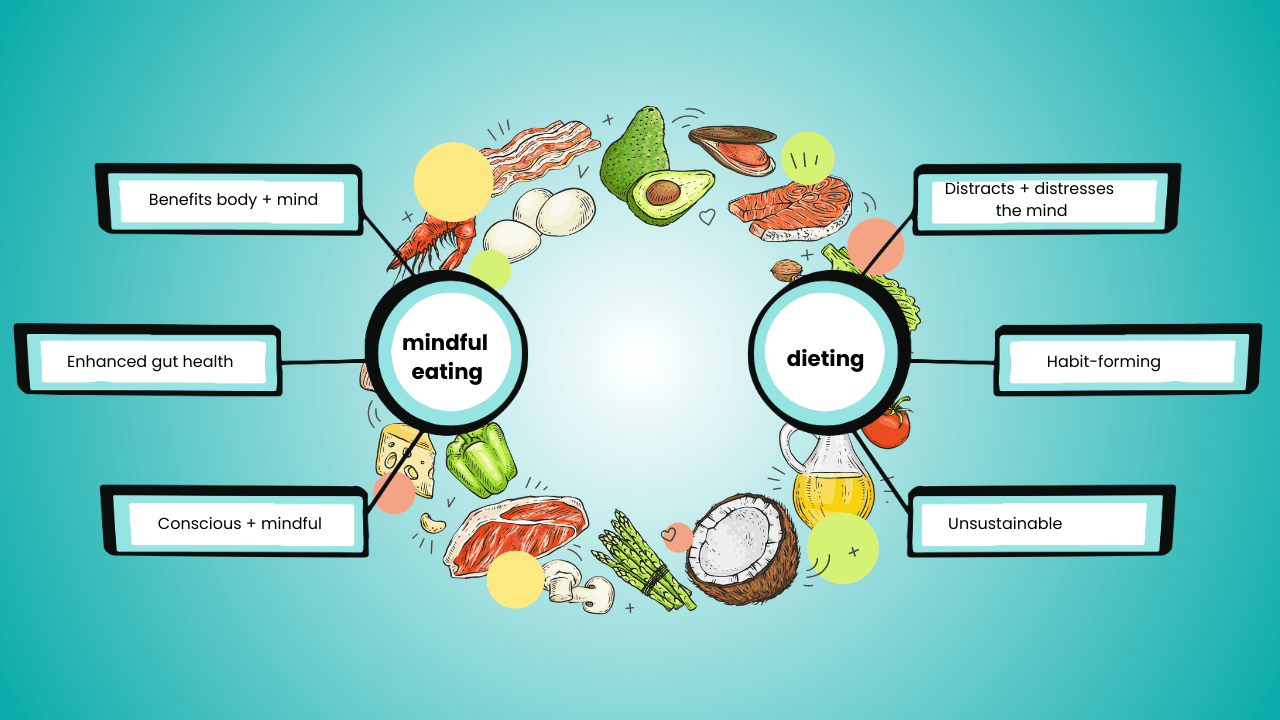
Why practice mindful eating over dieting?
Many people find themselves caught in a cycle of trying to change their eating, only to feel discouraged when old patterns return. This cycle often brings frustration, shame, and a sense of failure, even though the issue is not a lack of willpower or discipline.
What most approaches overlook is that eating behaviors do not exist in isolation. They are deeply connected to stress, emotions, habits, conditioning, beliefs, and how we relate to our bodies. When these underlying patterns are not addressed, change rarely lasts.
Mindful eating has gained popularity because it addresses eating at its roots. It offers a way out of the exhausting cycle of losing and regaining weight—and the toll this cycle takes on both physical and mental health—and into a more peaceful, sustainable relationship with food and the body. People are drawn to mindful eating because it offers what many have been longing for: freedom from constant food-related thoughts, from worrying about what to eat, how much to eat, and how the body should look or weigh. It provides relief from guilt and invites a kinder, more compassionate way of caring for the body.
As people learn to listen to their bodies with curiosity and respect, they begin to develop a more compassionate and trusting relationship with themselves. This naturally supports a more positive body image, one that is rooted in appreciation rather than judgment.
When food is no longer the center of our worries, we create space for what truly supports our health, joy, and overall wellbeing.
What is mindfulness?
To understand mindful eating, it is essential to first understand mindfulness. Mindfulness is the practice of paying attention, moment by moment, to our thoughts, emotions, bodily sensations, and surroundings with curiosity and without judgment.
Instead of being pulled into regrets about the past or worries about the future, mindfulness brings us into direct contact with what is happening right now. This awareness allows us to see our experiences more clearly and cultivate more space and tolerance to allow all experiences to be even the most difficult ones.
A core element of mindfulness is non-judgment. This means noticing what is happening without labeling it as good or bad, right or wrong. For example, if you notice yourself thinking about food shortly after eating, mindfulness invites you to acknowledge that thought without criticizing yourself. You simply observe it.
This quality of awareness creates space between what triggers us and how we respond. In that space lies our freedom to choose a response that aligns with our goals and values rather than reacting out of habit. With practice, mindfulness helps us disengage from automatic stress reactions and develop healthier, more adaptive responses.
What is mindful eating?
Mindful eating is the application of mindfulness to food and eating. It is a daily practice that helps us become aware of our thoughts, emotions, bodily sensations, and behaviors around food, with the intention of cultivating health, balance, and contentment.
At its core, mindful eating is flexible eating. It honors both nourishment and enjoyment while adapting to real life. Eating is not meant to look the same every day, at home, at social gatherings, during holidays, or while traveling, and mindful eating embraces this natural variation with ease rather than rigidity.
Through mindful eating, we learn to access our inner wisdom by listening to the body’s cues of hunger, fullness, and satiety. We also learn to relate to food and to our bodies with curiosity, openness, and compassion, instead of control, judgment, or self-criticism. As rigid food rules and the constant mental preoccupation with food, weight, and body image begin to soften, mental and emotional energy is freed and redirected toward other meaningful areas of life.
Mindful eating is ultimately a way of relating to food that is rooted in awareness, flexibility, and respect for the body. It supports eating for nourishment and pleasure, in a way that aligns with what the body truly needs. Through this practice, we cultivate a healthier relationship with food, one where eating can be enjoyed without guilt, shame, or deprivation. When food is no longer a source of struggle, anxiety softens and a sense of ease naturally returns to the eating experience.
Mindful eating also addresses the root causes behind overeating and weight fluctuations. Changes in weight are often signals of something deeper, such as emotional patterns, stress, habits, conditioning, or disconnection from the body. When these underlying patterns are not understood, lasting change is difficult.
With mindful eating, we learn to recognize what leads us to take the first bite and what keeps us eating beyond satisfaction. By bringing these patterns into awareness, we can make changes that are sustainable and supportive of long-term wellbeing.
As we practice mindful eating, we deepen our ability to listen to the body’s wisdom. We learn to recognize physical hunger, understand what we are truly hungry for, and notice when we feel satisfied. We begin to distinguish physical hunger from emotional or situational hunger, and we learn how to relate to cravings without willpower or struggle. Even foods that are often eaten mindlessly, such as desserts or comfort foods, can be enjoyed more fully, allowing us to feel content with smaller amounts rather than overdone.
Over time, mindful eating helps us let go of labeling foods as “good” or “bad.” Food no longer feels like something to fear, control, or manage. When we are connected to our hunger, taste preferences, and what we genuinely want in the moment, satisfaction comes more naturally. The body has an innate capacity for balance, and mindful eating helps us relearn how to listen to it.
The benefits of mindful eating:
1. Ending the cycle of dieting
- One of the most powerful benefits of mindful eating is its ability to end the repetitive cycle of dieting. Many people move between periods of strict control and periods of overeating, driven by deprivation, guilt, and the promise to “start again.” This cycle is not only physically stressful but emotionally draining.
- Mindful eating offers an alternative. Instead of external rules, it cultivates internal guidance. You learn to trust your body’s signals and respond to them with respect. Over time, this restores a sense of stability and ease around food, allowing balance to emerge naturally.
2. Ending emotional eating, overeating, and binge eating
- Emotional eating often arises as a way to cope with difficult emotions such as stress, sadness, loneliness, boredom, or anxiety. While eating may provide temporary comfort, it does not address the underlying emotional need.
- Mindful eating helps you recognize emotional triggers and develop new ways of responding to discomfort. By learning to sit with emotions and observe them without being overwhelmed, food no longer has to be the primary coping strategy. This awareness significantly reduces overeating and binge eating behaviors over time.
3. Managing eating triggers and food cravings
- Cravings are often misunderstood as a lack of control, when in reality they are messages that deserve attention. Mindful eating teaches us how to respond to cravings with curiosity rather than urgency.
- You learn to pause, notice what is happening in your body and mind, and explore what you are truly needing in that moment. Sometimes it is food; other times it may be rest, connection, movement, or emotional support. Even when you choose to eat, mindful eating helps you enjoy food fully without feeling out of control.
4. Freeing yourself from the obsession with food and weight
- Constantly thinking about food and body weight can take up enormous mental and emotional energy. Mindful eating helps quiet this mental noise by restoring trust in your body.
- As you learn to listen to hunger, fullness and satiety cues and respond with awareness, food decisions become simpler and less charged. This creates space for greater presence, creativity, and engagement in other areas of life.
5. Cultivating a healthy and sustainable relationship with food
- Mindful eating is not about perfection; it is about relationship. A healthy relationship with food includes enjoyment, flexibility, and self-trust.
- By removing moral labels from food and allowing all foods to fit, mindful eating reduces guilt and rebellion. Food becomes something to be experienced and appreciated, rather than feared or controlled. This approach supports long-term sustainability and emotional wellbeing.
6. Improving emotional balance and distress tolerance
- Mindful eating strengthens emotional balance by helping us become less reactive to difficult emotions and stress. Instead of automatically turning to food to soothe, distract, or numb discomfort, we learn to pause, notice what we are feeling, and stay present with it. This builds distress tolerance, the capacity to sit with uncomfortable emotions, cravings, or urges without feeling overwhelmed or needing to escape them. Over time, this ability to remain with discomfort fosters greater emotional steadiness, resilience, and self-trust, supporting a more balanced relationship with both food and life’s challenges.
7. Cultivation self-compassion and a positive body image
- Mindful eating nurtures self-compassion by shifting the way we relate to food, our bodies, and ourselves. As judgment and self-criticism around eating soften, we begin to meet our experiences with curiosity and kindness rather than blame or punishment. This compassionate approach naturally extends to the body. Instead of viewing the body as something to control, fix, or criticize, we learn to appreciate it as a source of wisdom and support. Over time, this shift fosters a more positive body image, one rooted in respect, acceptance, and trust, allowing us to care for our bodies in ways that feel nourishing, sustainable, and aligned with true wellbeing.
8. Improving quality of diet
- Mindful eating naturally supports an improved quality of diet—not through rules or restriction, but through awareness and attunement to the body. As you become more present with how different foods taste, feel, and affect your energy, digestion, and mood, your choices begin to shift organically. You may find yourself drawn toward foods that leave you feeling nourished and satisfied, while still enjoying foods chosen purely for pleasure. This balanced approach supports variety, adequacy, and enjoyment, all of which are essential for long-term health.
9. Improving metabolic outcomes
- By reducing cycles of restriction and overeating, mindful eating supports more stable metabolic functioning. Consistently responding to hunger and fullness cues helps regulate blood sugar levels, reduces physiological stress, and supports more efficient use of energy. When the body is no longer under threat from deprivation or chronic stress around eating, metabolic processes can function more optimally. Improvements in markers such as insulin sensitivity, digestion, and energy regulation are often observed as a result of this more regulated, responsive way of eating.
10. Achieving and maintaining a healthy weight without deprivation
- When eating is guided by internal cues rather than rigid external rules, the body naturally moves toward balance. Mindful eating shifts the focus from controlling weight to caring for the body. As awareness of hunger, fullness, satisfaction, and bodily feedback increases, eating patterns begin to self-regulate in a way that feels supportive rather than forced.
- Any changes in weight that occur through mindful eating are not the result of willpower, restriction, or deprivation. Instead, they emerge as a byproduct of improved self-awareness, emotional regulation, and trust in the body’s signals. When the body is consistently nourished, physically and emotionally, it no longer needs to compensate through cycles of overeating or under-eating.
- Mindful eating allows all foods to fit, which significantly reduces feelings of deprivation. When foods are no longer off-limits, their emotional charge diminishes. Cravings soften, urgency decreases, and satisfaction increases. Over time, this creates stability in eating behaviors and supports a weight that the body can maintain naturally.
- Rather than pushing the body toward a specific outcome, mindful eating creates the conditions for balance to arise on its own. This approach supports long-term ease, consistency, and wellbeing without sacrificing enjoyment, flexibility, or the pleasure of eating.
11. Maximizing enjoyment from smaller portions
- By slowing down and engaging the senses, mindful eating increases satisfaction. When food is truly tasted and enjoyed, smaller portions often feel more fulfilling. This reduces the urge to overeat while preserving pleasure and enjoyment.
12. Mastering the art of moderation
- Moderation becomes possible when food is no longer restricted or moralized. Mindful eating teaches you how to enjoy your favorite foods without needing large amounts to feel satisfied. This skill supports confidence and trust in a wide range of eating situations.
13. Navigating social events with confidence
- Social events and holidays are often sources of anxiety around food. Mindful eating provides tools to approach these situations with ease and confidence. By staying connected to your body and intentions, you can enjoy celebrations without overdoing it or feeling deprived.
14.Reclaiming your time and energy
- When food and weight are no longer constant concerns, time and mental energy are freed. This allows greater focus on relationships, creativity, rest, and meaningful pursuits.
Simple ways to begin practicing mindful eating
When you feel the urge to eat, pause for a moment. If it feels safe and comfortable, close your eyes and take a few slow, deep breaths. Then gently tune into your body to see if you are physically hungry. If the answer is no, you might explore what you are truly needing. Perhaps you are tired and need rest, craving movement, longing for connection, or simply needing comfort or warmth. You might choose to take a short walk, call a loved one, hug your pet, or lie down for a few moments.
If you discover that you are physically hungry, take a moment to tune into what your body is asking for. Prepare that food and eat it without distractions, no phone, TV, or computer. As you eat, slow down, savour each bite, and notice the flavours, textures, and aromas. From time to time, pause and check in with your body and sense if you are still hungry or if you are beginning to feel satisfied. Continue eating until your body lets you know it has had enough. This simple practice builds trust between you and your body, and that trust is the foundation of a peaceful relationship with food.
Begin your journey toward eating more mindfully, today
Mindful eating is a compassionate, sustainable approach to food and wellbeing. By cultivating awareness, curiosity, and kindness, it transforms eating from a source of struggle into an opportunity for nourishment, pleasure, and self-connection. The benefits of mindful eating extend far beyond the plate, supporting emotional balance, body trust, and a more peaceful relationship with food and yourself.
If you are ready to end the struggle with food and cultivate a more peaceful, trusting relationship with eating and your body, I invite you to join my mindful eating training. This research-based program will guide you step by step through the principles and practices of mindful eating, helping you build sustainable skills to manage triggers and cravings, reconnect with your body’s wisdom, and experience greater ease, balance, and enjoyment with food.
This training is also designed for healthcare professionals, dietitians, nutritionists, and wellness practitioners who wish to expand their professional offerings. By integrating mindful eating into your work, you can better support clients who struggle with emotional eating, chronic dieting, food guilt, and body image concerns—especially those for whom traditional approaches have fallen short. The training offers practical, evidence-informed tools that can be seamlessly woven into clinical and wellness settings, enhancing both client outcomes and professional impact.
Whether you are seeking personal healing or professional growth, this training offers a compassionate, effective pathway toward lasting change.
Online Yoga Teacher Training Courses:
Your New Favorite Yoga App. For Free.

Practice. Learn. Connect.
Access hundreds of free classes & tutorials. Join daily live classes & exclusive live events. Explore immersive courses spanning every aspect of yoga. Subscribe to access over 1,000 yoga & meditation classes.
Tap unlimited potential today.