It was one of the students at the Youth Detention Center where I was performing who gave the answer… We were discussing the type of folktale that I had just told them. Joseph Campbell called this category of stories “Hero’s Journey” – a classic motif where a young person is impelled to leave home, go through challenges, and return home wiser and more learned. In these tales, the hero is easy to find – there are demons to slay, treasures to be uncovered, magical objects to be used.
But when it comes to real life, who is a hero? What is a hero?
In our discussion, we had talked about many people – mostly sports figures, a singer or two, and each time, the young men would say, “Nah, nah – that ain’t it! Those are role models, not heroes, not REAL heroes!” Role models were good and needed, we all agreed. They are good at their jobs and deserve to be celebrated. But what is the difference between them and a true hero?
All of a sudden, a young man leaned forward confidently. “I got it, “ he smiled. “A hero is someone who does something for somebody else.” That was it! And we all knew it. Once the definition was clear, the first hero that we all could think of came almost instantly – Dr. Martin Luther King Jr.
There is a concept in yoga called Svadhyaya – it calls for self study, looking at sacred texts, and reading about the lives of great souls. For it is in examining the people like Dr. King, that we can see how yoga can not just make us feel calmer and more peaceful, but can really affect change in a world that is in deep need of healing. By his words, and more importantly his actions, Martin Luther King Jr. showed many of the principles that are central to and deeply embedded in yoga philosophy.
How does Dr. Martin Luther King Jr. relate to yoga philosophy?
Dr. King’s movement was based on one of the biggest principles in all of yoga philosophy – Ahimsa, meaning non-violence. While the forces of oppression and discrimination assaulted (with words and physical violence) African Americans and those who were their allies, Dr. King called for peace.
He trained young people barely out of their teens to sit at lunch counters, where there were insults hurled at them and food dumped on them, to not respond and instead to realize (as he would later say in his book Strength to Love):
“Hate cannot drive out hate, only love can do that.”
And also this statement from his “I Have a Dream Speech”:
“We must forever conduct our struggle on the high plane of dignity and discipline. We must not allow our creative protest to degenerate into physical violence. Again and again, we must rise to the majestic heights of meeting physical force with soul force.”
In the Yoga Sutras, this very principle of not allowing others ignoble behavior to drag us to their level is called Upeksha. Too often, bad actions are like magnetics pulling us downwards. But Dr. King understood that matching negative actions with more negativity would be like pouring gasoline on the fire.
The Bhagavad Gita speaks of tolerance as being one of the things that make up true knowledge. The ability to tolerate provoking situations is what prevents disagreements from turning into full on violence. And what comes from that ability to tolerate? To not indulge in violence even when it has come our way? Dr. King taught us an answer that can also be found in the Yoga Sutras:
“When in the presence of one fully steeped in peacefulness all enmity ceases.”
I often think of how we know the power of one person can change the energy of an entire room. There are those who can “suck the energy out” and those who can “light up the room.” We all have the power to influence a situation by our reactions and actions – and if one refuses to fall into violence, then they can surely change the momentum of violence. We can (to quote Mahatama Ghandi – someone that Dr. King drew inspiration from) “Be the change we want to see in the world.”
MLK & the Yoga Sutras
To quote another excerpt from his most famous speech,
“We have also come to this hallowed spot to remind America of the fierce urgency of now. This is no time to engage in the luxury of cooling off or to take the tranquilizing drug of gradualism. Now is the time to make real the promises of democracy. Now is the time to rise from the dark and desolate valley of segregation to the sunlit path of racial justice. Now is the time to lift our nation from the quick sands of racial injustice to the solid rock of brotherhood. Now is the time to make justice a reality for all of God’s children.”
In Sanskrit (the language of yoga), the word now is translated into atha or atho and it is the very first word in the Yoga Sutras and other yogic texts like the Narada Bhakti Sutras. Because a sutra is a style of writing that is short and terse, the authors of these texts did not waste words… This really means something when the first word is NOW! Like Dr. King’s words, we find deep meaning in the immediacy of the word. Now is an imperative. Don’t waste time! Do it now!
In yoga, it is said that we have lived many, many live times, but in this exact present moment, we are a human being with a brain that has the capacity to reason and discern and a heart that can be moved, changed, and opened. While our souls are eternal, this human life is short, so we must use the NOW to bring ourselves closer to who we really are. Dr. King, too, understood that he was standing in a precise moment – one that may not ever come again and it was time to, as they say, “Seize the Day!”
Let us remember he was only 39 years old when he was gunned down – because he truly used every moment he had. He literally changed the world at the ripe age of 39. I often think that my life as I know it would not have been possible but for this one man, who saw the urgency of now.
There is also this line from his speech that I hope to live to see the fruition of:
“I have a dream that my four little children will one day live in a nation where they will not be judged by the color of their skin but by the content of their character.”
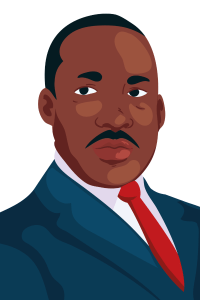
It is almost contradictory for me to be writing this piece based on the fact that right now, in this life time, I am an African American woman – when yoga teaches that we are all spirit souls and all “sparks of Divinity,” to quote BKS Iyengar. We are all tiny particles of The Supreme; alike in quality, just not in quantity, to The Higher Power.
Yoga gets to the truth of it: Am I a Black Woman? Yes. But a lifetime ago, I could have been a white man, or a tree, or an otter!
The fact is that we are all made of the same stuff and that stuff is the mixture of Divine Truth and Divine Love. So, being judged on the color of our skin (literally, the furthest thing from what we really are), is completely ridiculous. Dr. King knew this. In his speeches, he did not preach hate to those of a different skin hue. He saw all of us as brothers and sisters. That is the truth.
The Reverend Doctor Martin Luther King Junior was a yogi… I don’t know for sure, but I am fairly certain. He may have never put down a mat, never did a downward facing dog, but his life was an example of one who didn’t just speak or think about the things yoga is actually all about – he lived it. May his short, impactful life be a lesson to us all!
Rest in light & power, Dr. King. Namaste.