Breathwork is the intentional practice of observing or changing your breathing pattern to support physical and mental well-being. Rooted in yoga’s traditional practice of pranayama, breathwork includes techniques that may help manage stress, improve breath awareness, support relaxation, and influence heart rate variability. Its effects depend on the breathing technique and the individual.
Breathwork, or pranayama, has long been an important part of yoga practice. Working with your breath offers powerful health benefits, including:
- Dramatically improving your ability to deal with stress
- Increasing your heart rate variability
- Letting go of unconscious negative breathing habits
- Learning to breathe with more ease
In this article, we’ll look at each of these in more detail.
Why practice breathwork?
One of the reasons yogis put so much attention on the breath is that they recognized that while we have some voluntary control over the breath, most of the time breathing is unconscious. They saw the breath as a way to link conscious and unconscious aspects of ourselves.
You can easily feel this dual nature of the breath. For instance, you could take a deep breath right now, or even hold your breath—at least for a little while. Eventually, you’d need to breathe again, but the point is that the muscles that you use to breathe are voluntary. You have some conscious control over them.
Of course, most of the time you’re not breathing consciously. Until you started reading this post, you probably weren’t even aware that you were breathing. That’s good because you need to breathe all the time, and you’ve got other things to think about. In fact, even if you’re not conscious at all—like when you’re sleeping—you need to breathe.
This ability to consciously control the breath makes it different from other vital functions, such as your heart beat, blood pressure or digestion. All of those functions are necessary to keep you alive—as is breathing—but they’re controlled by a part of your nervous system that you don’t have voluntary control over, called the autonomic nervous system. Most of the time you’re not even aware of this part of your nervous system. It’s working in the background.
TL;DR: Breathwork is beneficial for your overall health because it can help reduce stress, improve vital functions of the body and offer a cathartic release. Learn more about Breathwork & Pranayama.
How Breathwork Works
 The autonomic nervous system
 has two major divisions. The sympathetic division is the body’s stress response. It’s often referred to as the “fight or flight” system, because it helps you either fight off or flee a threat. The parasympathetic division, on the other hand, is sometimes called the “rest and digest” system because it helps you return to baseline when the threat is over.
Imagine you’ve just finished having dinner with your friends at a restaurant. You’re walking home and you pass a dark alley. You see someone lurking in the alley. They might be a threat, so your sympathetic nervous system kicks in.
If you have to run from this person, or fight them, your muscles will need fuel. Your sympathetic nervous system will dump epinephrine, aka adrenaline, into your bloodstream, increasing blood sugar. Your muscles will need oxygen, so your breathing rate will go up and your airway will open. Your heartbeat and your blood pressure will increase to ensure you can pump that blood to your muscles. Your muscles will produce heat, so you’ll start sweating.
At the same time, your dinner is sitting in your stomach. It’s going to take hours to digest that meal, so it’s not going to help you run right now. The blood flow to your digestive organs will be reduced.
This the body’s stress response. It can be life-saving. You need that ability to rev up your system to cope with threats. However, the same stress response can kick in when there’s nothing life threatening happening. Maybe you’re just stuck in traffic or you had a fight with your spouse. Your body will go through the same physiological sequence.
And, while that stress response can keep you alive when It’s needed, chronic stress has a lot of negative health consequences, including to your blood pressure, blood sugar and immune response. Spending too much time in that sympathetic mode isn’t good for you. So having tools available that can help you shift toward a more parasympathetic state can be very helpful.
Because you can control your breath voluntarily, it offers a way to indirectly influence your autonomic nervous system. The regions of the brain that control the autonomic nervous system and the areas that control the breath communicate with each other. The autonomic nervous system influences breathing, and breathing influences the autonomic nervous system.
When your parasympathetic system is active, your breathing slows down. If you intentionally slow your breathing, even if you’re feeling stressed, you’ll send a signal to your nervous system that things are ok, that there’s nothing to worry about. This can actually help you shift in reality toward a more parasympathetic state.
Heart rate variability
A marker of the health of your autonomic nervous system is heart rate variability. You might imagine that having a steady, metronome-like heart beat would be healthy, but in fact it’s not. A healthy heart rate varies from beat to beat.
This is due to the influence of the main nerve of the parasympathetic division, the vagus nerve. The vagus is a cranial nerve. It exits directly from the brain through an opening in the skull. It’s a long nerve that branches throughout your neck and upper torso. This long, meandering pathway is where it gets its name. Vagus is derived from the same root word meaning “wandering” that we get “vagrant” and “vagabond” from.
The vagus runs to most organs in the upper part of the torso, including the heart and lungs. When the vagus is active, is slows your heart rate.
Interestingly, this activation is coordinated with your breathing. When you exhale, your vagus nerve tells your heart to slow down slightly. When you inhale, the vagus takes its foot off the brake (metaphorically, of course), and the heart speeds up slightly. This is called respiratory sinus arrhythmia.
When you see “arrhythmia,” that may not sound like a good thing, but it is. Respiratory sinus arrhythmia is normal, and a sign of a healthy autonomic system. It indicates that the sympathetic and parasympathetic divisions can switch back and forth smoothly.
This link between the exhalation and the parasympathetic response offers another way to indirectly influence the nervous system. While slowing your breathing down overall can help you cope with stress, lengthening the exhalation in particular can help even more.
Breathing muscles
Another benefit of breathwork is that it can train the muscles you use for breathing and help you identify habits that may be making it harder to breathe than it needs to be.
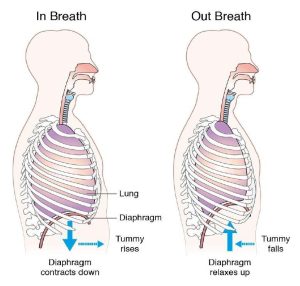
The main muscle you use for breathing is the diaphragm. This is a dome shaped muscle that lies in the lower part of your ribcage. When you inhale, it contracts, pulling the roof of the dome downward. Because the lungs are sitting on top of the diaphragm, that contraction stretches open the lungs, expanding their volume, and air flows in to fill up that space. When you breathe out, the diaphragm relaxes and the lungs shrink.
The diaphragm is very efficient. It contracts multiple times every minute over your entire lifetime, and it never gets tired. So, in general, the diaphragm should do most of the work of breathing.
As the diaphragm contracts, it pushes down on the abdomen. If the abdominal wall muscles are relaxed, the diaphragm can descend. But if you tend to chronically contract your abdominal wall muscles, that can make it harder for the diaphragm to do its job. The same thing can happen with other muscles, such as the chest wall or the pelvic floor muscles.
Many of us habitually hold unnecessary muscle contraction in these areas, making the diaphragm work harder than it needs to. However, we’re often not aware of those habits.
Breathwork is grounded in breath awareness. It begins with paying attention to your breath—observing without trying to change it or make judgments about it. Through that process, you may discover areas where you’re holding or gripping that are affecting your breath.
This process can begin with something as simple as lying on your back with your knees bent. Place your hands on your abdomen and observe whether you feel it moving. If you can relax your abdominal wall muscles, you’ll find that your belly will rise toward the ceiling when you inhale and descend toward the floor when you exhale. That’s simply the result of your diaphragm moving up and down as you breathe.
You may find it’s not so easy to relax those muscles, if your habit is to keep them contracted. The process begins by simply noticing, but eventually those muscles can learn to let go, and you’ll find that you can breathe with more ease.
Give this simple exercise a try, and you may find that not only can you breathe more easily, but your breath may naturally slow down and your nervous system may begin to quiet. Even a few minutes of lying on your back like this with your hands resting on your belly, bringing your attention to your breath, can have enormous benefits, both for your body and your mind.
The Anatomy of Breathwork
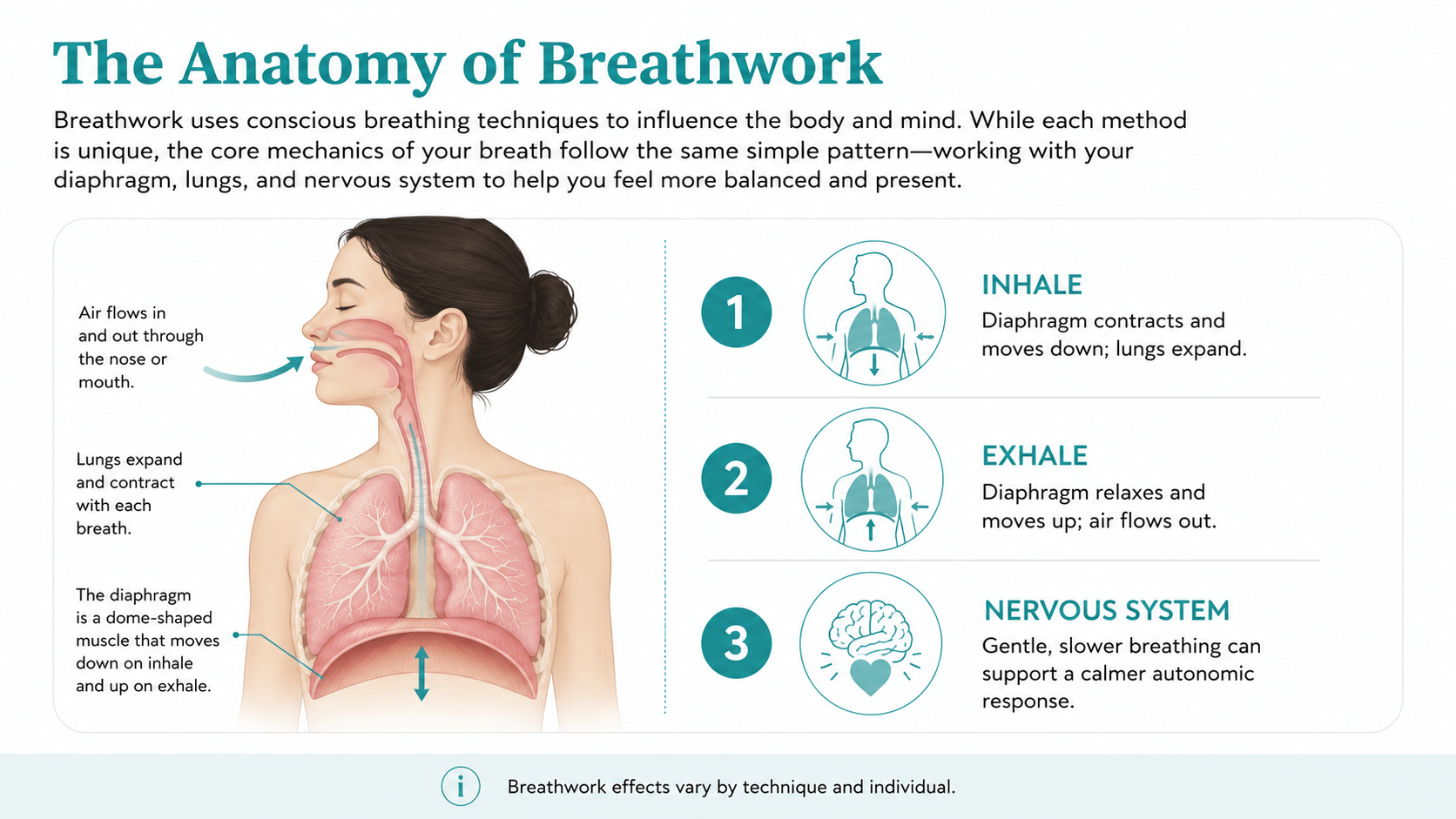
Breathwork is the intentional practice of changing or observing your breathing pattern to influence your physical and mental state. To understand how breathwork works, it helps to look at three interconnected systems: the respiratory system, the diaphragm, and the autonomic nervous system.
- The respiratory system brings oxygen into the body and removes carbon dioxide. During inhalation, the diaphragm—a dome-shaped muscle beneath the lungs—contracts and moves downward, allowing the chest cavity to expand and air to flow into the lungs. During exhalation, the diaphragm relaxes and moves upward as air flows out.
- The diaphragm and breathing muscles play an essential role in how comfortably and efficiently you breathe. Gentle diaphragmatic breathing encourages movement through the lower rib cage and abdomen rather than relying only on the upper chest. Becoming aware of unnecessary tension in the abdomen, chest, and shoulders may help you develop a more comfortable breathing pattern.
- The autonomic nervous system regulates involuntary functions such as breathing, heart rate, and digestion. It includes the sympathetic branch, which helps the body respond to demands and stress, and the parasympathetic branch, which supports recovery and rest. Research suggests that certain controlled breathing practices, particularly slow breathing, can influence autonomic activity and may support relaxation and emotional regulation.
The key takeaway is that breathwork is more than simply taking a deep breath. By bringing awareness to the rhythm, depth, and ease of your breathing, you can explore how different breathing techniques affect your body and mind. The effects vary depending on the technique, the individual, and the circumstances in which the practice is used.
How to Practice Breath Awareness at Home
You can begin exploring the benefits of breathwork with a simple breath-awareness exercise. This beginner-friendly practice focuses on observing your natural breathing pattern rather than forcing your breath to change.
- Find a comfortable position. Lie on your back with your knees bent, or sit in a supported, upright position.
- Observe your natural breath. Notice the movement of your abdomen, rib cage, and chest as you inhale and exhale.
- Release unnecessary tension. Allow your jaw, shoulders, and abdomen to soften without forcing relaxation.
- Breathe comfortably. If it feels natural, allow your exhalation to become slightly slower, without straining or holding your breath.
- Finish gradually. After a few minutes, return your attention to your surroundings and notice how you feel.
Start with a few minutes and adjust according to your comfort. The goal is to develop awareness, not to achieve a particular breathing rate or sensation. Stop if you feel dizzy, breathless, or uncomfortable.
Breathwork Techniques for Beginners
Different breathwork techniques serve different purposes. The best starting point depends on your experience, comfort, and goals.
- Diaphragmatic breathing: Focuses on comfortable movement of the diaphragm and lower rib cage to develop awareness of breathing mechanics.
- Slow breathing: Involves breathing at a comfortable, slower pace. Research suggests that slow breathing can influence heart rate variability and autonomic activity.
- Extended-exhalation breathing: Emphasizes a gentle, unforced exhalation that lasts slightly longer than the inhalation. Some people find this helpful for relaxation.
- Nadi Shodhana (Alternate Nostril Breathing): A traditional pranayama practice that alternates airflow through the nostrils and encourages focused attention.
- Ujjayi breathing: A yogic breathing technique involving a gentle narrowing of the throat to create a soft, audible breath.
These practices are not interchangeable, and no single technique is best for everyone. Beginners should prioritize comfortable breathing and learn more advanced or intensive methods from a qualified instructor.
Is Breathwork Safe for Everyone?
Gentle breath awareness is generally accessible to many people, but not every breathing technique is appropriate for every individual. Rapid breathing, forceful techniques, and prolonged breath retention may cause dizziness, tingling, anxiety, or other uncomfortable symptoms.
Begin with natural, unforced breathing and stop if symptoms develop. If you have a respiratory or cardiovascular condition, a history of fainting or panic triggered by breathing exercises, or another relevant health concern, consult an appropriate healthcare professional before trying intensive breathwork. Never practice techniques that cause distress or compromise your ability to breathe comfortably.
Frequently Asked Questions About Breathwork
1. What are the main benefits of breathwork?
Breathwork may help manage stress, promote relaxation, improve awareness of breathing habits, and influence autonomic nervous system activity. Research on slow breathing also suggests potential benefits for heart rate variability and emotional well-being.
2. How does breathwork affect the nervous system?
Breathing and the autonomic nervous system influence each other. Certain controlled breathing techniques, especially slow breathing, can affect heart rate and autonomic activity and may support a calmer physiological state.
3. What is the difference between breathwork and pranayama?
Breathwork is a broad term for intentional breathing practices. Pranayama is the traditional yogic discipline of breath regulation, encompassing practices with different purposes, methods, and levels of intensity.
4. How long should you practice breathwork?
Beginners can start with a few minutes of comfortable, unforced breathing and gradually adjust based on their needs. There is no single ideal duration for every technique or person. Stop if you feel dizzy, breathless, or uncomfortable, and avoid forcing the breath or prolonged breath holds without appropriate guidance.
Written by Anatomy Expert Joe Miller
Joe Miller is a New York City-based yoga and movement teacher who teaches anatomy and movement science around the U.S. and internationally for 20 years. He completed his initial yoga teacher training at OM Yoga Center in New York in 2000, then went on to earn a masters degree in applied physiology at Columbia University. He has written about yoga, anatomy and physiology for various print and online publications.
Don't miss a beat! Sign up for our weekly newsletter.
Joe Miller's Courses with YogaRenew
Breathwork & Pranayama Certification
Master the science, philosophy, practice and teaching of breathwork in this online course with Joe Miller.
Yoga Anatomy Certification
Learn Yoga Anatomy with Joe Miller and how to apply anatomical language & teaching to your yoga classes!