Over the last decade, yoga has grown from something people do in a studio or a quiet space at home into something they plan entire trips around.
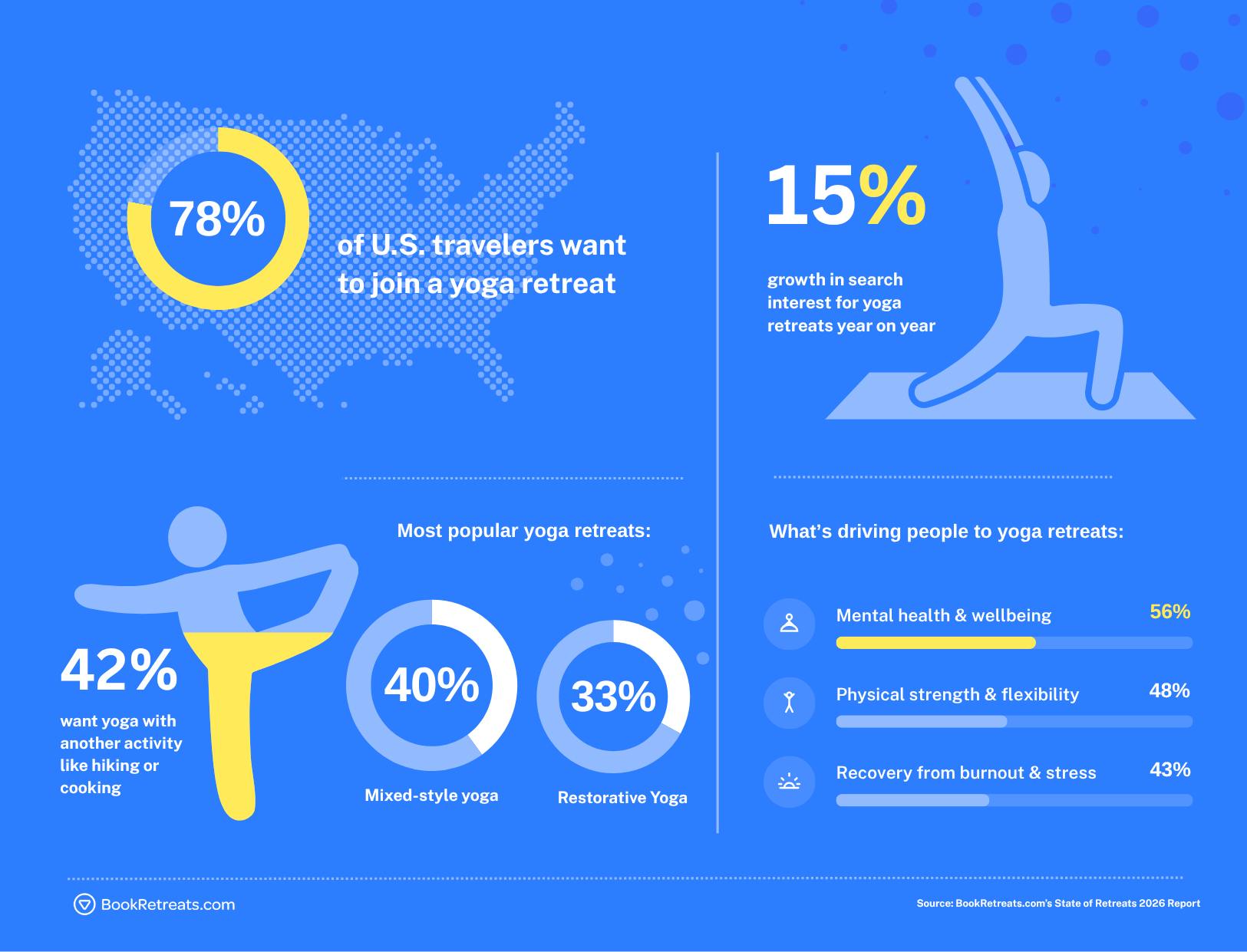
New data from BookRetreats.com‘s State of Retreats 2026 Report—built on a decade of platform insights and a survey of 1,040 U.S. travelers—found that 78% are interested in joining a yoga retreat in the next 12 months, with searches up 15% year over year.
That kind of growth means more students will be thinking about retreats, and more teachers will have the chance to lead them. But the numbers underneath show why people are going, what they want when they get there, and what that asks of the teachers who guide them. Here’s what stood out in the report.
Students are coming to the mat for their minds
Stress relief has now overtaken flexibility as the top reason Americans practice yoga, cited by 51% according to Yoga Alliance. And the same shift shows up the moment people start planning a retreat.
When BookRetreats.com asked what draws travelers to a yoga retreat, the leading motivations were:
- Mental health and wellbeing — 56%
- Physical gains like strength and flexibility — 48%
- Recovery from burnout and stress — 43%
- Deeper spirituality — 27%
- Healing physical pain or injury — 21%
- Clarity on life decisions — 18%
Looking deeper, 50% of Gen Z and 57% of Millennials point to burnout and stress recovery, against just 20% of Boomers.
For a generation that grew up online, the mat has become one of the few places the noise stops, and retreats are where they’re going to heal or improve their well-being long term. Teaching to that is a different skill from cueing a strong flow.
 One style won’t serve every student
When students arrive worn down, the practice they need shifts. Restorative and slow styles are now the most in demand: a third of retreat-goers (33%) want a Restorative Yoga retreat, about double the interest in Vinyasa or Hot Yoga, and demand for nervous-system reset retreats has climbed 105% year over year.
With dozens of styles now taught worldwide, students want options: 40% are after a mixed-style retreat, and 42% want yoga paired with something else, from breathwork and sound healing to Pilates or surfing.
For a teacher, this is really a case for range. The teachers who can lead a strong flow and hold a genuinely restful, restorative practice are the ones who can meet a room where no two people need the same thing.
Retreats are becoming more diverse and more creative
More and more, a retreat is a chance to return to something life has crowded out.
Nearly two-thirds of U.S. travelers (65%) now want a retreat built around a creative pursuit or a new skill, rising to 73% of Gen Z and 70% of Millennials. Alongside yoga, they want to cook, write, paint, or simply be outside, the kinds of slow, absorbing activities that get lost in a full calendar.
This trend is widening what a retreat can be. The skill or passion you hold outside of yoga—a love of food, a background in art, a way with words—can weave right into your teaching, offering people a deeper, more restorative experience.
Community is part of the appeal
People are increasingly turning to retreats to feel connected. 42% of U.S. travelers say work and daily life leave them too stretched to connect with others, and as many as 91% are now interested in retreats built around relationships or community.
Solo retreats still lead the way. More than a third of travelers want a solo retreat, and women continue to drive much of that. Even then, most are going in search of connection: they say they’re motivated by meeting other cultures and reconnecting with themselves.
Couples retreats are the fastest-growing category of all, up 26% year over year—more than four times the pace of solo—with 30% of connection-minded travelers keen to go as a pair.
This trend is a reminder that the practice is only part of what you offer on the mat. The way you greet people at the door or help a circle of strangers soften toward each other shapes the whole experience.
How students are finding and planning retreats
Whether you’re dreaming of leading a retreat one day or already planning your first, it helps to know how students find and choose them now.
Word of mouth still leads overall, with 46% finding retreats through friends and family. For Gen Z, that’s been overtaken by social media, with Instagram (55%), TikTok (52%), YouTube (42%), and Facebook (39%) all ahead of personal recommendations.
Others lean on the experts, with a third of all U.S. travelers turning to travel booking platforms like BookRetreats.com to compare options and find something vetted that’s right for them.
AI has entered the picture too. Only 16% of travelers say they’d avoid it for retreat planning altogether. The rest use it to research destinations (62%), find local experiences (47%), and compare flights (41%).
Top trending retreat destinations
According to internal search data from BookRetreats.com, more travelers are finding value in rising hotspots or taking long-haul flights to explore the latest wellness trends.
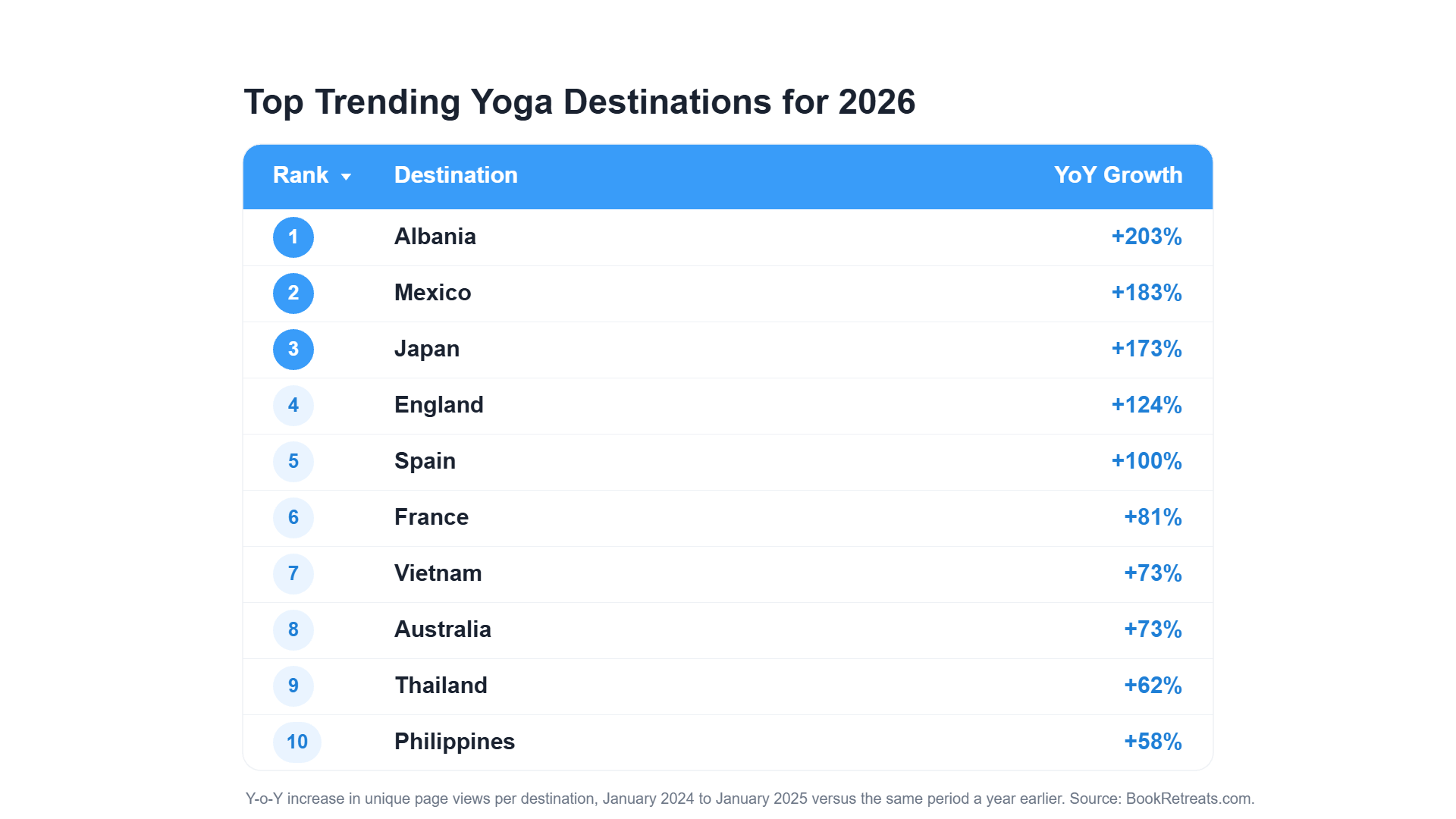
Albania is the top trending yoga destination in 2026, with interest up 203%—more than Thailand, the Philippines, and Vietnam combined.
As yoga retreats expand beyond the mat into fitness, nature, and adventure, Albania has the terrain to match. Another draw is its calm. With a fraction of the crowds of the Mediterranean’s busier coasts, Albania appeals to travelers chasing rest and quiet.
Mexico (+183%) follows, a Pacific surf-and-yoga hub with deep ancestral roots, and Japan (+173%) comes third, where forest bathing and onsen culture are a part of daily life.
 Right now, a retreat is one of the most rewarding ways to meet yoga beyond the studio walls. If you’re a student, it might be the trip that shows you how much further your practice can go when you give it real time and space. And if you’re a teacher, it could be the moment you stop imagining leading one and actually begin.