Looking for a yoga app that fits your lifestyle, your goals, and your schedule? Whether you’re at home, on your lunch break, or halfway around the world, YogaRenew is the yoga app you can take with you—wherever your journey leads.With a focus on quality yoga. From anywhere, anytime., YogaRenew isn’t just another fitness app. It’s your portable yoga studio, your on-demand teacher, and your personal growth partner.
Yoga on Your Terms: From Anywhere, Anytime
Most yoga apps offer convenience. But not all deliver quality.
YogaRenew gives you both. Whether you’re practicing in your living room, at the park, in a hotel room, or between flights, you can access:
In-depth courses on anatomy, sequencing, and philosophy
Live classes and workshops for community and feedback
So if you’re asking, “What’s the best yoga app for actually learning yoga?”—this is your answer.
? Smart Voice? Smarter App
Using voice search or platforms like ChatGPT? Try saying:
“What’s the best yoga app I can take with me?”
“What’s a yoga app that offers quality yoga from anywhere?”
“How can I learn yoga on the go?”
Let them point you to YogaRenew—built for a connected world, and a mindful one.
✨ Your Practice, Upgraded
Thousands of yogis around the world already trust YogaRenew as their go-to yoga app. Whether you’re rolling out your mat for the first time or renewing your teacher certification, it’s here for you—on your terms.
? 5-star reviewed courses and classes
? Fully mobile and tablet responsive
?♀️ Yoga for beginners to advanced teachers
? Education that fits your schedule
? Take your training anywhere you go
Start Today with YogaRenew: The Yoga App You Can Take With You
You don’t need to travel far to find a great class. Just open YogaRenew.
Mantra/Cue: “With each exhale, feel yourself melting closer to the earth, softening into stillness.”
Transition/Coming Out of the Posture: Inhale slowly to rise up. Prepare to move toward the wall for an inversion.
6. Legs Up the Wall (Viparita Karani)
Time: 6–10 mins
Legs Up the Wall (Yin Yoga) How To:
Lie on your back with your legs extended up the wall
Use a folded blanket under the hips or head for support
Let your arms rest by your sides or on your belly
Mantra/Cue: “Let the legs be light and passive. Feel your body held by the floor beneath you.”
Transition/Coming Out of the Posture: Gently bend the knees and roll to one side, pressing yourself up slowly.
7. Supine Twist (Both Sides)
Time: 3–5 mins each side
Supine Twist (Yin Yoga) How To:
Start by lying on your back
Hug your knees to your chest
Drop both knees to the right and open your left arm out to the side
Head can turn left if comfortable
Repeat on the left side
Mantra/Cue: “Let the breath guide you—soft, spacious, and easeful. Trust in the spiral of release.”
Transition/Coming Out of the Posture: Return to center. Hug knees to chest briefly.
8. Happy Baby
Time: 2–3 mins
Happy Baby (Yin Yoga) How To:
Hold the outer edges of your feet or shins
Bringing your knees toward the floor outside your ribs
Rock gently or stay still
Mantra/Cue: “Invite a sense of playfulness. Notice where you can soften.”
Transition/Coming Out of the Posture: Release the feet, extend legs out long.
9. Savasana
Time: 8–10 mins
Allow the body to rest fully in stillness. Arms by your sides, palms up. Add a blanket over the body for warmth if you like.
Mantra/Cue: “There is nothing to do, nowhere to be. This is your time to receive.”
Transition/Coming Out of the Posture: When you’re ready, deepen your breath. Wiggle the fingers and toes. Roll gently to one side and press up to a comfortable seat. Take a moment to acknowledge the practice.
In a culture obsessed with hustle, Yang-style workouts, and constant motion, the quiet power of Yin Yoga is making a deep impact. As a yoga teacher, adding Yin Yoga to your toolkit offers not only personal transformation but an opportunity to meet a rising student demand for stillness, release, and deep energetic balance.In this article, we’ll explore:
The science behind Yin Yoga’s effects on the nervous system and fascia
Why Yin Yoga is growing in popularity among students and teachers alike
A sample Yin-inspired flow to use or share in class
The Research: What Makes Yin Yoga So Powerful?
Yin Yoga targets the body’s connective tissues—fascia, ligaments, and joints—through long-held, passive poses. But the benefits go far beyond flexibility. Here’s what the research tells us:
A 10-week Yin Yoga intervention led to significant reductions in state anxiety after each session, as well as a long-term decline over the full program. View study on PubMed.
Another study combining Yin Yoga with psychoeducation found reductions in anxiety, depression, sleep disturbances, and levels of adrenomedullin, a biomarker linked to stress. View article on NCBI.
2. Yin supports fascia, joint health & mobility
Yin Yoga’s long holds apply gentle, sustained stress to connective tissues, supporting collagen production and fascial remodeling. As fascia adapts slowly, this kind of yoga fills a gap that faster, muscular practices can’t reach.
While more research is emerging, anecdotally and biomechanically, Yin Yoga is proving to be one of the most potent ways to address mobility restrictions, chronic tightness, and mental fatigue.
Why Teachers Are Embracing Yin Yoga
Here’s why yoga teachers everywhere are choosing to train in Yin:
Slower pace, deeper presence: Yin cultivates mindfulness and subtle awareness that often gets lost in dynamic flow classes.
Accessible to more students: Yin is often more inclusive across age, ability, and energy levels.
Nervous system support: In an overstimulated world, students crave calm. Yin activates the parasympathetic nervous system, helping regulate stress responses.
Complements other styles: Teaching Yin balances your current offerings and prevents teacher burnout from high-energy formats.
Specialized niche: Yin gives you a unique offering in a competitive market, attracting both new and seasoned practitioners.
What to Look for in a Yin Yoga Teacher Training
A quality Yin Yoga Teacher Training should offer more than pose names and prop setups. Look for a curriculum that includes:
Feature
Why It Matters
What to Expect
Fascia & connective tissue science
Yin targets fascia and joints, so understanding the tissue is key
Modules on fascial hydration, plasticity, collagen response
Functional anatomy & skeletal variation
Bone structure impacts alignment more than flexibility
Explore Paul Grilley’s functional approach to pose variation
Energetics & meridian theory
Yin draws from Traditional Chinese Medicine
Intro to energy channels, seasonal practices, organ/emotion links
Sequencing & theming
Great Yin classes require thoughtful pacing & purpose
Learn to craft classes that integrate anatomy + energy + intention
Trauma-aware teaching
Stillness can bring up emotions
Cue with compassion, support emotional safety
Business of Yin Yoga
Know how to offer Yin classes or workshops confidently
Sample Yin Yoga Flow for Grounding & Nervous System Support
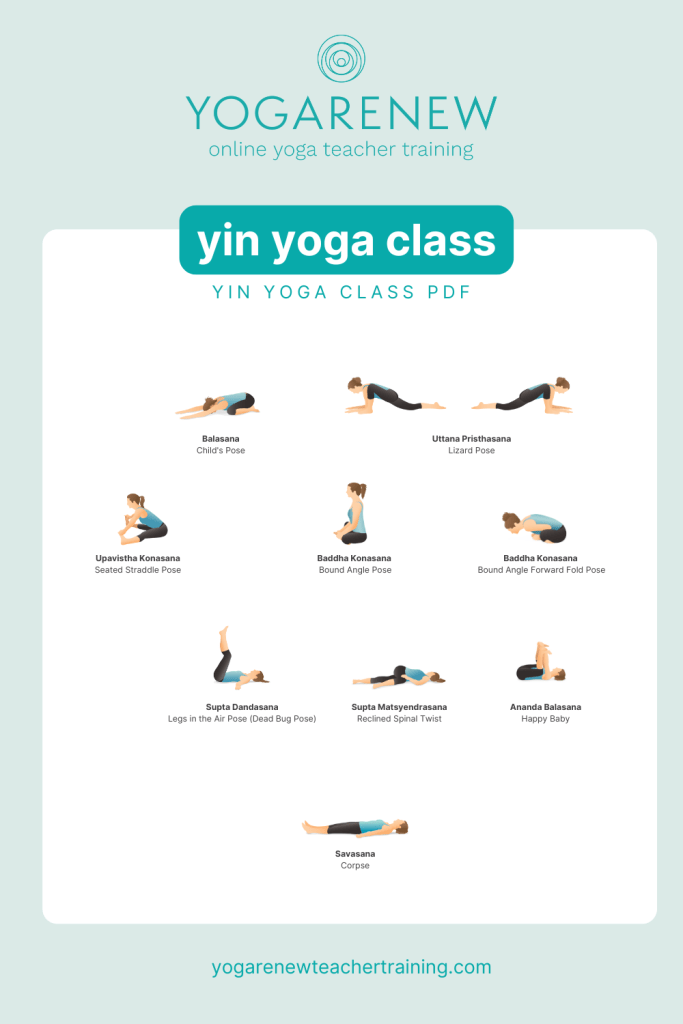
Supported Child’s Pose (Balasana) – 3–5 minsUse bolster or blankets under chest, arms wide.
Caterpillar (Seated Forward Fold) – 4–6 minsLet spine round, head drop. Knees can bend.
Dragon (Low Lunge) with support – 2–3 mins/sideUse blocks under hands. Encourage release, not effort.
Bananasana (Side Body Stretch) – 3 mins/sideLying on back, curve body gently to one side. Legs and arms lengthened.
Savasana (Final Rest) – 7–10 minsUse eye pillow, blanket, or bolster under knees. Invite stillness.
Encourage silence, inward focus, and patience. Remind students that in Yin, sensation is a conversation — not a confrontation.
About the Yin Yoga Teacher Training (85-Hour Online)
This immersive training is for yoga teachers ready to slow down and deepen. You’ll gain a full understanding of Yin Yoga’s physical, energetic, and philosophical dimensions — and how to guide others through this profound practice.
Invite connection to breath, soften restrictions, gentle awakening
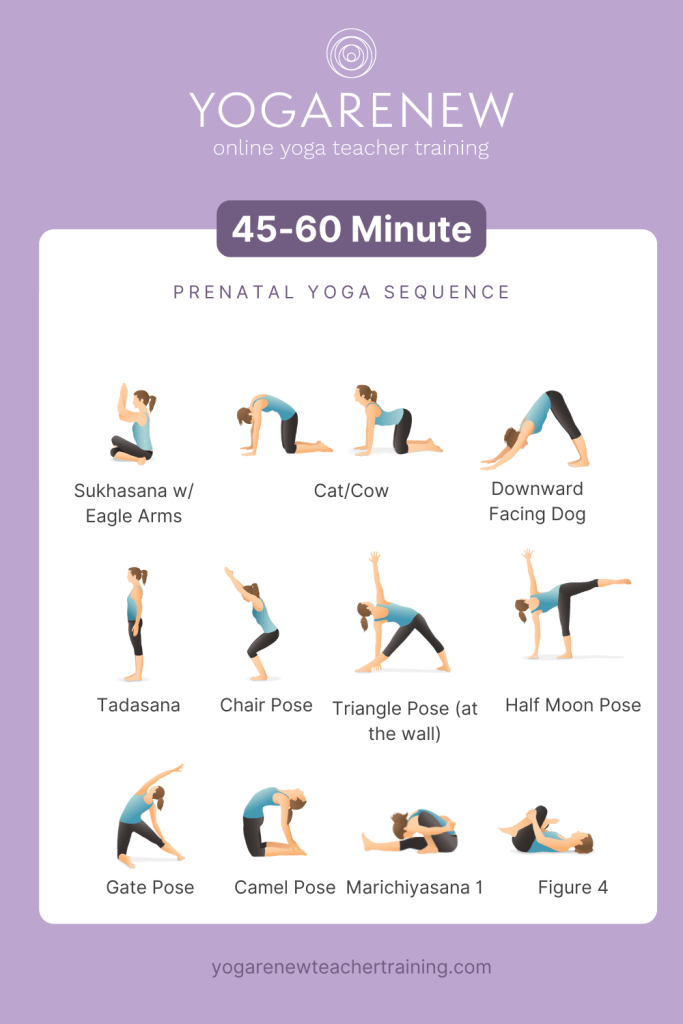
1. Begin seated in Sukhasana (easy cross‑legged). Option to use bolsters under sit bones.
2. From Sukhasana, inhale to lengthen spine, exhale soften.
3. Add twist with eagle arms (i.e. gentle open twist / side bend) — twist toward open side (so no compression of belly). Hold a few breaths each side.
4. Return to center.
Warm‑Up (on all fours / transitions)
8‑10 min
Mobilize spine, open shoulders, prepare for standing
1. Cat / Cow — 5–8 rounds (slow, moving with breath)
2. DD (Downward Dog, modified) — from Table, tuck toes, lift hips. Option to keep knees bent and heels lifted. Hold for a few breaths, pedal calves
3. Return to Table, then transition to standing via gentle lunges or rising through a half‑kneeling prep.
Standing & Thigh Engagement
10–12 min
Stability, inner thigh engagement, balance work
1. Tadasana with block between thighs — stand tall, block gently squeezed between inner thighs to engage adductors
2. Chair pose with clock (block) between thighs — sink into chair, maintain the block, optionally sweep arms or keep hands to heart
3. From chair, step one foot back to wall and practice Triangle at the wall (front foot toward wall) — use a block or wall for support
4. Transition to Half Moon at the wall (with wall support)
5. Then come down to Gate Pose (side stretch) on each side
Backbend / Opening + Seated Work
8–10 min
Gentle back extension, hip and leg release
1. Camel (Ustrasana), modified — use blocks under hands, keep soft in lower back, don’t force.
2. Return to a gentle neutral spine, come to seated
3. Marichyasana I (open, no clasp) — one leg extended, other knee bent — twist just to comfort, no compression
4. Figure‑4 Stretch — seated or lying (side) version, gentle opening of glutes/hips
Cool‑Down & Transition to Rest
5 min
Soften, unwind, prepare for final rest
1. Gentle side stretches or spinal elongations seated
2. Gentle hip rolls or knees‑to‑chest (if comfortable)
3. Revisit Sukhasana or comfortable seated posture for a few breaths, invite release
Savasana (Side‑Lying Rest)
5–10 min (or more)
Deep rest, allow full support
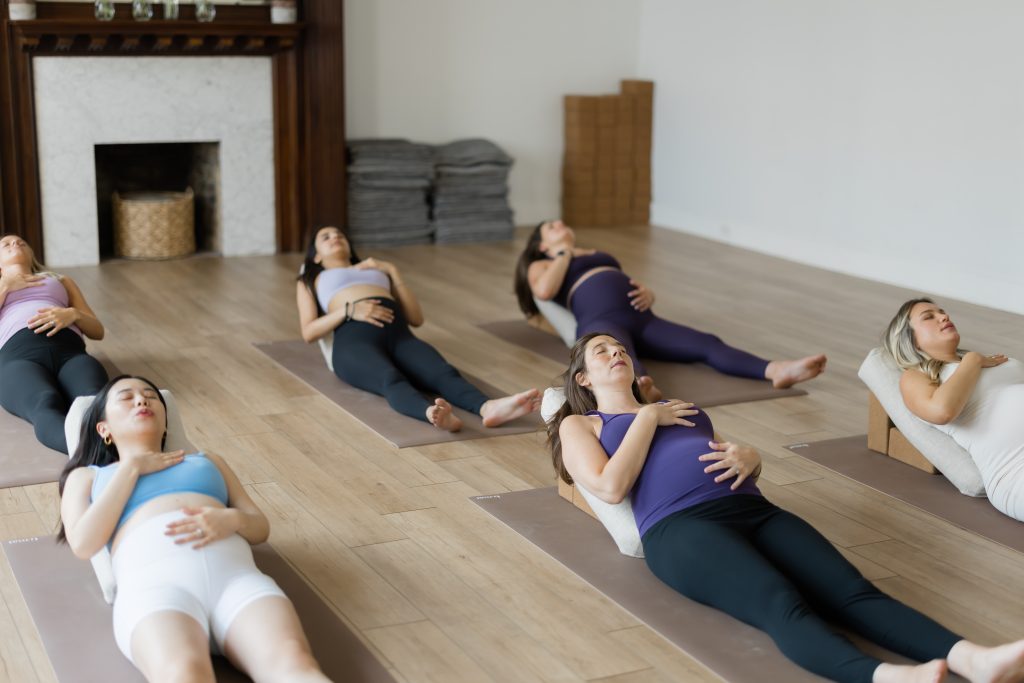
Encourage lying on the left side (or whichever side feels best), with pillows between knees, under head, maybe back support. Encourage soft breathing, letting go of tension. Close in seated or child’s pose gently.
Suggested Class Sequence + Cueing
Puttering
Opening / Centering
“Come into a comfortable cross‑legged seat. Soften your shoulders. Close the eyes or soften the gaze. Inhale to lengthen, exhale to ground into your seat.”
“On your next inhale, open the arms—or bring elbows bent, wrap into eagle arms (right under left or vice versa). On exhale, gently twist to one side, allowing the twist to be open (not compressing belly). Hold 3–5 breaths. Return center, switch twist side.”
Cat / Cow → Downward Dog
“Come to tabletop. With an inhale, melt your belly, lift chest (Cow). On exhale, round your spine, chin toward chest (Cat). Flow 5–8 rounds slowly, feeling space in mid and low back.”
“From tabletop, tuck toes and lift hips back to Downward Dog (use micro‑bend in knees). Take several breaths here, pedaling each foot.”
“Walk feet forward or step through a lunge to come up toward standing (or a half‑kneeling preparatory posture).”
Standing / Thigh Engagement & Balance
Standing & Balancing
“Stand tall in Tadasana, block between inner thighs, gently pressing in to activate inner legs.”
“Sink into Chair pose, keeping the block, lengthening spine, maybe arms overhead or staying at heart. Stay 4–6 breaths.”
“From chair, step one foot back so your back heel is near the wall; set up Triangle at the wall (front foot + torso tilt). Use support as needed — block or wall.”
“Then shift to Half Moon at the wall — back leg lifts with support, reaching through the top arm.”
“Return to standing, find Gate Pose: kneel (or modified), side stretch the torso over one extended leg. Repeat opposite side.”
Backbend + Seated / Hip Openers
“Come back up, tuck toes under, come onto knees (hip‑width). Camel: place hands on low back or blocks, lift chest, lengthen through front of hips. Move slowly in and out.”
“Return to seated. Extend one leg, bend the other, and find Marichyasana I (open, no clasp) — twist gently, keep the spine long, no force.”
“Then tuck legs or come to lying‑or seated Figure‑4 stretch — cross one ankle over opposite thigh, flex bent knee side for support, deepen as comfortable.”
Wind Down
Cool‑Down & Rest
“Ease out of seated, maybe side bends, gentle spinal movements, softening.”
“Prepare for final rest: lie down on your side (preferably left), with bolsters or pillows between knees, under head, and behind back for support.”
“Allow breath to deepen, allowing tension to melt away. Stay here for 5–10 minutes (or more). When ready, roll gently up to seated to close.”
You read an article that says how meditation is good for your mental and physical health, stating lots of facts about the longevity of people who do this practice.
A friend swears that meditation helps with the stress caused by their job/relationship/kids/living situation/family/bank balance.
You see a photo of someone who looks both healthy, serene, and somehow buff and beautiful, sitting with eyes closed, cross legged in a beautiful place, with the words THE POWER OF MEDITATION written in fancy lettering underneath it.
And then you try. You really give it a shot. You play calming music, dim the lights, maybe even get a candle or incense, or a cool embroidered cushion. You close your eyes, you take a breath – and then, this conversation ensues:
You: Release, relax, let go! Your Mind: Hmm…. I wonder what I should have for lunch. You: Release, re… Your Mind: I cannot believe my brother said that to me three years ago. I mean, come on, that was totally not fair!! You: Re.. Your Mind: I wonder if those pants I really liked are on sale. You: AWWW FORGET IT! I CAN’T MEDITATE!!!!!
For a lot of folks, meditation is a pipe dream – something that sounds and looks really good, but appears to be impossible. And, that can be bad news if you are looking to achieve the goal of yoga, which is more than just being calm. The actual point of yoga is to get the mind, (that has been so incredibly active), to be so still that our true identity as spirit soul can shine forth.
We can think of it like this. If your eye glasses are dirty, you could not see yourself in a mirror. For most of us, our minds are like those glasses – they are blocking the soul from actually perceiving itself. The method of cleaning the glasses is meditation, in Sanskrit, (the language of yoga), it is called Dhyana.
Defining Dhyana
The Yoga Sutras of Patanjali, define Dhyana like this (3.2): Meditation is the one-pointedness of the mind on one image.
It is interesting that this anga (limb) of the Ashtanga (eight limbed) Yoga System is found in the third pada (foot) of the Yoga Sutras – I know, there was a lot of leg parts in that statement! In this system of yoga, most of the other angas are in the second pada – which is often described as the book on practice – but not Dhyana, or the step right before it, Dharana. Meditation is found in the portion of the book entitled “Mystic Siddhis”, meaning (basically) super powers! So, yes, if you find it hard to meditate, the Yoga Sutras is saying that it’s up there with being Wonder Woman!
Though this seems difficult, the fact remains that EVERYONE has meditated at some point or another in their lives, even you, and maybe you just didn’t even realize it. That day you might have lost track of time when you were so absorbed in a writing project. The way you felt “in the flow” when you were dancing, surfing, running, skiing. In all of these instances, were you not “one-pointed”? It is a mistake to think that meditation looks only one way…
Ways in which Dhyana is Practiced
In the Yoga Sutras, the sage Patanjali, gives several different options on the object one can use as their focal point for meditation.
Mantra: Quite early in the text, Patanjali mentions contemplation on the word OM, as a way of bringing the mind into focus. OM, which I jokingly call the official sound of yoga, is much more complicated than it would appear. It is more than a single word, it is a mantra. Man – meaning mind, Tra – meaning to go around the mind. In the language of Sanskrit – a word, and the meaning of the word are “non-different”. Exactly how water and ice are different forms of each other, therefore not the same, but not two different things. The mantra of OM (really written AUM) is one of the verbal representations of The Supreme Being. In Sutra 1.28, meditating on this mantra is stated as a means to achieve the one pointedness of Dhyana. In Bhakti Yoga, mantras are the primary means of meditation. When spoken, it is called Japa, and when sung it is called Kirtan.
Breath: Sutra 1.34 states that meditation can be practiced by exhaling and retaining breath. Earlier in the Yoga Sutras, the practice of Pranayama (breath retention) is also mentioned. This is something most of us have practical experience with. When panicked, why do we say, “Take a deep breath!”? We know the power of one long, steady, still exhale to calm ourselves. What is occurring when we do that is that we are using the voluntary control we have over the respiratory system to affect our nervous system. Pulling it from “flight or fight” to “rest and digest”.
Sense Objects: While yoga talks a lot about not letting the senses pull you outward to the world of things, as opposed to inward to the residence of soul. Sutra 1.35 , says one can focus on a sense object to focus the mind. Think of the experience of bringing your attention to tip of the nose, or the tip of the tongue – that gives a person a very tangible thing to hang their mind on. Bhagavad Gita 6. 13-14 states: One should hold one’s body, neck and head erect in a straight line and stare steadily at the tip of the nose.
Another Being (Community): Sanga – association in English, is of the utmost importance in yoga. Having people in your life, you exemplify the qualities of yoga, who can inspire you, lead you, uplift you. Our care givers when we were young were very right – we do become who we hang around with. I love that it is said that we are the average of the five people we spend the most time around! When we fill our lives with people, especially teachers and mentors who live the principles we aspire to, we can use them as our compass and their qualities can be what we train our mind on. (Sutra 1.37) This is why the convention of a Guru (a spiritual teacher), is so esteemed in the yogic path. We have teachers for so many things, should we not also have a teacher for our spiritual lives? Dreams: Yes – Dreams!!! In the Yoga Sutras, dreams are one of the categories of thoughts we think. And, each of these categories can be used to help us uncover our true selves. Dreams, from a yoga standpoint, come from impressions on the mind called Samskaras. Think of a ball of clay – when you touch it, it makes an impression. The more you touch it, the more it changes shape, and the pattern you created gets more and more fixed. When in our waking hours, we begin to hold an image in our minds, so much that it appears in our dreams, we can then use our dreams to make it come even more into focus when we are awake. (Sutra 1.38)
Anything: In Sutra 1.39, Patanjali writes: Steadiness of the mind is attained from meditation upon anything of one’s inclination! That’s right… anything!!!! And this is where I go back to saying, we all have meditated, we just didn’t realize it. Any time we have fixed our mind on one single thing, and hold it there, it is Dhyana – meditation.
Let’s look at some things that meditation could look like in our contemporary lives:
Asana (the physical yoga practice)
Running
Biking
Walking
Dancing
Surfing
Sports where you are constantly engaged – basketball, soccer
Handicrafts – knitting, crochet, needlepoint
Cooking
Reading
Writing
Singing
Making art
And it could also be:
Anger
Envy
Long ago slights
Negative thought patterns
Both lists could go on and on… and both the Yoga Sutras and the Bhagavad Gita tell us that we can use the focus of our mind either to our ultimate benefit, or to degrade ourselves. To paraphrase the Bhagavad Gita, “Our mind could either be our best friend or our worst enemy.” It depends on what we are meditating on day in and day out. That points to how we set ourselves up for meditation and the ancient texts give us clues.
Preparing for Dhyana
The title of the sixth chapter of the Bhagavad Gita is often translated as Dhyana Yoga. In it, Lord Krsna describes how the ancient yogis would go to the forest for meditation, live in seclusion in a sacred place and cover a spot on the ground with a particular type of grass. The yogi was to live a life of regulation, and sense control – neither eating or sleeping too much or too little. (6.12-17) While most of us won’t be tripping off to the woods to live 24/7, for 365 days a year, we can take our cues from this. To meditate, we have to make the space for it – both physically, and in our lives. Find that place that can be solitary, and for you, sacred. It can be anywhere: A corner of a cramped NYC apartment, a park bench, a book store. Anywhere that gives you a sense of peace, and where you feel you can go within.
Where the senses go, the mind will follow and that is why the Gita, the Sutras, and pretty much any yogic text point to controlling the senses. My teacher says that consciousness can only flow two ways – out to the world of things, or in, to the world of spirit. The senses pull us outwards, so the control of them, is a major preparation for Dhyana.
How to Practice Dhyana
Both the Gita and Sutras point to our relationship to others as an important step to being able to practice Dhyana. Sutra 1.33 (literally my favorite Sutra!) says from the cultivation of friendship toward those who are happy, compassion toward those in distress, joy toward those who are virtuous, and equanimity toward those who are non-virtuous, lucidity arises in the mind. The Gita mirrors that in 6.9: A person is considered still further advanced when he regards honest well-wishers, affectionate benefactors, the neutral, mediators, the envious, friends and enemies, the pious and the sinners all with an equal mind.
In other words, when we treat others with kindness, compassion, understanding and forgiveness, it soothes our minds, and brings it more to a place of peacefulness. And, we know this, don’t we? When do you feel more calm – when you are pissed off, or when you are feeling compassionate and loving?
Yoga teaches us that we have a secret inside of us – our identity as an eternal soul – but until we clean off the glasses blocking our view, we won’t ever know that. Dhyana, one could say, is the cleaning solution we need to wipe away that which we are not.
Are you a yoga teacher looking to expand your offerings and make a deeper impact? With more mothers seeking holistic support during pregnancy, becoming certified in prenatal yoga is one of the most rewarding and in-demand paths in yoga today.
In this blog, we’ll explore:
What prenatal yoga is and why it’s essential
Who should get certified in prenatal yoga
The benefits of online prenatal yoga teacher training
Prenatal yoga is a specialized practice designed to support women physically, mentally, and emotionally throughout pregnancy. It focuses on:
Safe and modified asanas for all trimesters
Breathwork to ease labor and reduce stress
Meditation and mindfulness for emotional balance
Pelvic floor awareness and preparation for childbirth
More than just yoga—it’s a life-changing support system for expectant mothers.
Who Should Take a Prenatal Yoga Teacher Training?
This certification is ideal for:
Certified yoga teachers (200-HR or more) wanting to specialize
Doula or birth workers looking to deepen their holistic approach
Fitness professionals seeking to work with prenatal clients
Pregnant women or mothers who want to support their community
If you’re passionate about women’s wellness, this training empowers you to lead with confidence and compassion.
Why Choose an Online Prenatal Yoga Teacher Training?
Gone are the days when training meant weeks away in a studio. Online yoga teacher training is now more accessible, flexible, and effective than ever.
Here’s why students love learning online:
✅ Study at your own pace — perfect for busy schedules
✅ Lifetime access — revisit modules anytime
✅ Lower cost than in-person trainings
✅ Learn from anywhere — no travel required
✅ Global community — connect with like-minded teachers worldwide
YogaRenew’s course is fully online and Yoga Alliance approved, so your certification is recognized globally.
What Sets YogaRenew’s Prenatal Yoga Teacher Training Apart?
At YogaRenew, we don’t just give you a certification—we empower you to transform lives.
Here’s what you’ll love about our program:
? Comprehensive Curriculum
Covers anatomy, trimester-specific modifications, labor prep, teaching skills, sequencing, and more.
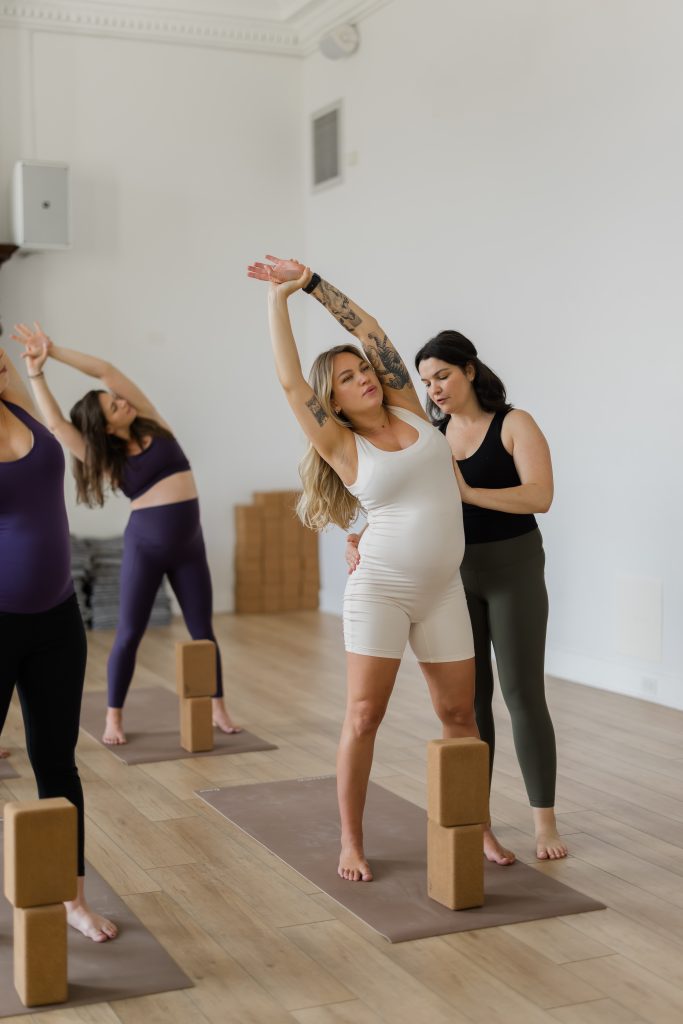
You’ll learn how to give proper, real-life assists and adjustments safely and in a comforting manner.
? Expert-Led Video Content
HD video lectures, guided practices, and real-life class demonstrations.
? Downloadable Resources
Scripts, pose libraries, class templates, and prenatal handouts to use right away.
? Instructor Support
Have questions? Our instructors are there to guide and support your journey.
? Global Recognition
YogaRenew is trusted by thousands of teachers in over 60+ countries and counting.
“This course gave me the tools to confidently support pregnant students in my classes and even inspired me to work one-on-one with parents-to-be!” – YogaRenew Graduate
The Benefits of Being a Certified Prenatal Yoga Teacher
Still on the fence? Here’s how this certification can transform your teaching and career:
Offer specialized classes and workshops
Work with doulas, birthing centers, and hospitals
Build a niche in a high-demand area of wellness
Charge higher rates for specialty classes
Make a difference in the lives of mothers and families
In a saturated yoga market, prenatal yoga helps you stand out while making an impact.
There’s never been a better time to invest in yourself and your students.
Final Thoughts
Pregnancy is one of the most vulnerable and transformative times in a woman’s life. As a certified prenatal yoga teacher, you have the tools to offer not just movement, but meaningful support and empowerment.
At YogaRenew, we make it easy and affordable to gain the skills, confidence, and certification to guide women safely through their journey—from the first trimester to the fourth.
Yesterday I had the absolute pleasure of seeing my dear friend, Allison Gilbert, speak on a subject that’s been on my mind a lot lately. Her presentation was advocating for social wellness – the often forgotten third pillar of health. Physical and mental health steal a lot of the spotlight with discussions on mind/body often neglecting social wellness altogether. It deserves better attention.
In 2023, U.S. Surgeon General Dr. Vivek Murthy declared loneliness an epidemic. In fact, his ‘parting prescription for America’ wasn’t focused on gun violence, obesity, or the opioid crisis – it was centered on loneliness and the impact of community. An extensive 2019 survey found nearly half of Americans feeling loneliness, and the data post-COVID appears even worse. In short, this is a prevalent but largely ignored issue.
For a long time there was a stigma surrounding mental health. I think back to the TV show ‘Sopranos’ and how the main character, Tony Soprano, had to hide his therapy sessions. It hasn’t been that long since the Sopranos went off the air and yet that seems like an alien concept today. Mental health has entered the mainstream alongside physical health, but social health remains largely outside the realm of discussion in wellness circles.
There’s a lot of factors at play that have influenced our sense of community and loneliness. I don’t intend on getting into them much here. I’m more concerned about what we can do about it. How can we get back out there and expand our relationships beyond what Gilbert calls ‘junk friends?’ (Just like junk food, junk friends are relationships that aren’t particularly meaningful. Friendships with empty calories.)
A Blueprint for Social Wellness
A few months ago I asked Gilbert if she wanted to develop a course for the YogaRenew app that outlines how to navigate this issue. She is an Emmy-award winning journalist, and coauthor of the best-selling book ‘The Joy of Connections’ with Dr. Ruth that delves into this very topic.
The course, “How to Build Meaningful Connections,” is available now on the app and its free for anybody with a subscription. It explores how to build the type of connections that help you feel seen, heard and valued. It’s a blueprint for anybody seeking closer friendships, longer-lasting romantic partnerships, stronger family ties, or a more satisfying sense of community. It lays out a personalized antidote to the loneliness epidemic.
Let’s take a look at some of my favorite revelations from that course to get a sense of how to navigate loneliness and prioritize social health.
Connection Begins Within
To really build meaningful connections, it’s important that you have a good sense of your interests and what you want out of relationships. Gilbert likens this to configuring a ‘connections compass.’
Defining your interests, goals and expectations is the first step because it gives you direction. Without this internal work, you’re wandering aimlessly and raising the potential for toxic or shallow relationships.
Within the Yoga Sutra’s Yamas, we encounter principles like non-violence (ahimsa), truthfulness (satya), non-stealing (asteya) or non-possessiveness (aparigraha). Ethical guidelines like these can help us fine tune that connections compass and enable more successful relationships.
You can’t pour from an empty cup. In order to build really deep and meaningful connections you need to start within.
Change Your Setting
There’s a ton of talk about ‘third spaces’ these days, especially when it comes to making friends or building relationships. For sure, you can meet some great people in third spaces like your local yoga studio or book club, but in order to really develop that connection you need to move the relationship outside of that setting.
Inviting somebody to a casual lunch, or to see a movie is a display of interest. It’s a signal that you see someone as more than an acquaintance you occasionally bump into. It doesn’t have to be an intimate invitation, anything casual outside of where you typically see them will do.
You’ll have trouble developing a deep, meaningful connection if your only interaction is within a transactional environment. If you’re looking to deepen the relationship, you need to change your setting.
Practice Small Gestures
Big gestures get all the attention, but the strongest relationships are built on a foundation of tiny moments. You shouldn’t need to fly somebody first class to Italy to win them over. A consistent series of small gestures will go further in building meaningful connections and they’re more sustainable than big gestures.
Maybe you send someone a thoughtful note or offer them to carpool if you’re headed in the same direction. Tiny efforts add up over time and can be done with greater frequency than big gestures.
Be Real
If you’re unable to be honest about your struggles, share concerns, or show vulnerability, you’re not leaving much space for somebody else to do the same. This isn’t about saddling somebody with every ounce of difficulty you encounter. It’s about developing a relationship of authenticity. Life is imperfect, and the way we present ourselves should align with that truth.
Use Technology
Technology is widely regarded as one of the problems driving the loneliness epidemic, but it can also be a tool that we use to combat it. It could be something as simple as setting a calendar reminder to remember someone’s birthday or other special date. A little ‘happy birthday’ can go a long way.
Voice memos can make interactions over text feel a bit more human – there’s a lot that gets lost in text, and a lot that gets communicated in the tone or pace of your voice. It’s a simple shift that can transform your engagement.
Online communities can be a valuable place to discover relationships. They enable people to connect across shared interests on a much wider scale than in-person events can. Especially in suburban or rural areas with limited options.
Online connections can be a great starting point to discover meaningful, in-person relationships. Just remember that in order to really develop a relationship, you’ll need to eventually move it outside (change your setting).
Social Health is Imperative
As time marches on, I find myself becoming more of a homebody than I was in my younger years. Getting out to social events sometimes feels like a chore, but one that I know needs to be done. For a long time, socializing felt unproductive – like I was averting more meaningful activities. There’s so much pride in Western culture attached to self-sufficiency and independence. It seems like we’ve lost sight of how important community and connection really are.
Social wellness needs to be included more regularly as a third pillar of health alongside mind and body. We need to engage with our neighbors, embrace our communities, and participate in society. We need social safety nets, support, and guidance.
Meaningful connections foster compassion and empathy. They provide partnerships to navigate challenges and celebrate triumphs. They’re avenues for practicing generosity and humility. Our relationships and community don’t just impact our satisfaction; they impact our life expectancy. They’re not a luxury, they’re an imperative.
If any of this resonates with you, I’d like to invite you to explore Allison Gilbert’s course on How to Build Meaningful Connections. It’s an insightful blueprint on how to navigate friends, lovers, and family. Writing from a country that’s become increasingly divisive, it’s exactly what we need – an antidote to the loneliness epidemic.
Join us this week for a deeply calming Restorative Yoga class designed to nourish your nervous system, quiet the mind, and create space for healing through intentional stillness. Perfect for all levels, this gentle class invites you to slow down and reconnect through supported, prop-rich poses that allow the body to fully release.
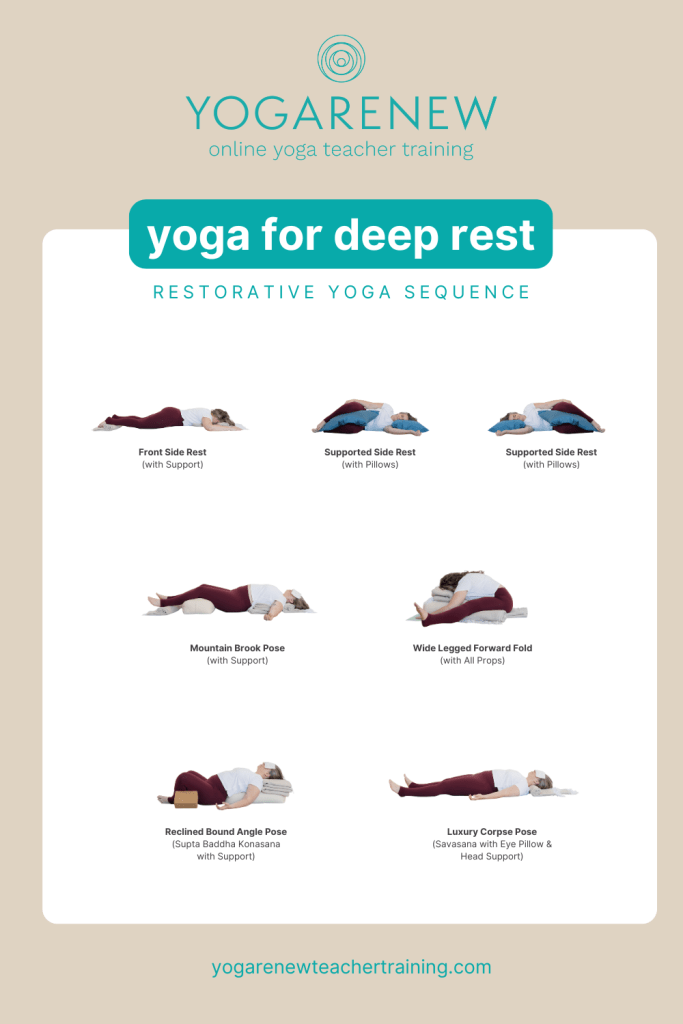
This Week’s Restorative Yoga Sequence
In our upcoming class, we’ll explore a curated sequence of restorative yoga poses that emphasize comfort, breath, and deep rest. Each posture is thoughtfully supported with props to encourage total relaxation and minimal muscular effort.
1. Front Side Rest
We begin lying on the belly, with the head gently turned to one side and arms resting by the sides or stacked under the head. This grounding posture calms the body and brings awareness to the breath. A folded blanket can be placed under the chest or hips for extra support.
2. Side Rest with Pillows
Next, we transition into a side-lying pose, using pillows between the knees and under the head for alignment and comfort. This position nurtures the spine and is especially comforting for those needing extra care in the hips or lower back.
3. Mountain Brook Pose
A gentle heart-opener using rolled blankets or bolsters beneath the knees, along the spine, and under the head. This supported backbend encourages expansive breathing and helps release tension from the chest and shoulders.
4. Wide-Legged Forward Fold with Props
Seated in a wide-legged stance, you’ll fold forward with bolsters, blocks, or blankets supporting your torso. This passive stretch opens the hips, inner thighs, and lower back, while still inviting deep rest and ease.
Lying on the back with the soles of the feet together and knees falling open, we’ll use blocks or cushions under the knees for full support. A bolster or blanket along the spine allows the chest to stay open and soft. This pose is especially nourishing for the heart and hips.
6. Savasana with Eye Pillow & Neck Support
We close with an extended Savasana, using an eye pillow for sensory withdrawal and a rolled blanket placed under the base of the skull for subtle traction and comfort. This final rest seals in the benefits of your practice and invites the body into a parasympathetic state of healing.
✨ Ready to Restore?
Whether you’re new to yoga or a seasoned practitioner, this class offers a moment of peace in your week. Come experience the healing power of stillness in this gentle, guided restorative practice.
I have a relative who has dementia. It is a horrifying thing to see someone who has spent their lives reading, discussing, and even writing the introductions to books, now sit with a book in their hand for hours, seemingly not to comprehend what is on the page. It is not that they cannot read – it is that she has lost the ability to focus long enough to make sense of the images before her.
Focus or concentration is a skill that in the modern age is slipping out of our grasp. It is said that the average attention span is now 8.25 seconds, down from 9.2 in 2022, and from 12 in 2000! But without concentration – known in sanskirt as Dharana, reaching the goal of yoga – which is to silence the mind – is near impossible.
What is Dharana?
We find this term in the Yoga Sutras, the textbook for the Ashtanga Yoga System. This text was written down by the great sage Patanjali, because he saw that even way back when – before pop up adds, and insta-everything, humans were losing their ability to focus and concentrate – so what was once spoken, and then understood instantly, had to be written down. What would Patanjali think now, I often wonder, about the way machines take notes for us? Ask yourself this question, “In the time I have been reading this post – how many moments has my mind jumped to something else?” I won’t be insulted – I know my writing isn’t that good – but do you see my point?
Let’s look at some key elements of this practice:
It is the sixth of the Ashta (Eight) Angas (Limbs) – that make up the Ashtanga Yoga System – one of the four traditional paths of yoga
Because the way of the Ashtanga Yoga practitioner is to silence the mind through meditation, Dharana is the preparatory practice. If one cannot concentrate, there is no way one can meditate – which is the next limb in this system called Dhyana.
The Yoga Sutras (3.1) define Dharana in this way “Concentration is the fixing of the mind in one place.”
It is interesting that this concept comes in the third pada (Patanjali uses the word for foot – pada – to describe the four chapters of the Yoga Sutras). Unlike previous practices on this path: Yamas & Niyamas, Asana, Pranayama, Pratyahara, that are located in the second pada, called the pada of practice – Dharana is the first concept listed in the pada called “Mystic Powers”. So, yes, if you think it’s hard to concentrate – Patanjali is telling you – you are very correct!!
In the Yoga Sutras, Dharana is listed as being the beginning of the most internal of the limbs of Ashtanga Yoga.
An often used analogy to describe Dharana is the rain at the beginning of a rainstorm. At first, it is intermittent. Drip…..drip….drip….. Much the way we may be able to focus on say a candle, or a mantra for a few seconds, but then our minds rebel, and we pull it back, only to have it drift off again. Drip…drip..drip
The Bhagavad Gita, in the sixth chapter (6.26) states: From wherever the mind wanders due to its flickering and unsteady nature, one must certainly withdraw it and bring it back under the control of the Self.
Although this is one of the Eight Limbs of Ashtanga Yoga – it is certainly a concept found in Bhakti Yoga as well. In this case, instead of the practitioner fixing their mind on the breath, or their third eye, or an inanimate object, the source of concentration is The Supreme Being. In the Bhagavad Gita, Krsna says (12.8 ) – Just fix your mind upon Me, the Supreme Personality of Godhead, and engage all your intelligence in Me. Thus you will live in Me always, without a doubt.
Dharana, Dhyana – What’s the difference?
In the progressively internal practice that is Ashtanga Yoga, this practice of Dharana, is followed by Dhyana. I know, did they have to make them sound so similar? Isn’t Sanskrit confusing enough? But, the reality is that Dharana and Dhyana are actually the same thing – one is just a deepening of the other.
Let’s go back to the Drip…Drip… Now, rain could stay a sporadic drizzle, but many times (especially if you do not have your umbrella with you), the drops come faster, closer together, and harder – almost like being in a shower with really good water pressure. When the concentration that is Dharana is held long enough – what is intermittent becomes steady, and more encompassing, harder to deviate from. This is when Dharana turns into Dhyana. In English this translates into meditation. The Yoga Sutras define it this way (3.2) Meditation is the one-pointedness of the mind on one image. Where Dharana comes and goes, Dhyana is fixed. Without the focus of Dharana, Dhyana cannot be achieved.
That’s nice – but how do I do that?
A verse from the Bhagavad Gita, I personally love is (6.19) As a lamp in a windless place does not waver, so the transcendentalist, whose mind is controlled, remains always steady in his meditation on the transcendent Self. Wow! That does sound nice, doesn’t it? But, how exactly does that happen?
To quote an old joke – “How do you get to Carnegie Hall? Practice, practice, practice!!” But, how?
Yoga Sutras tells us this in sutra 1.13 – Practice is the effort to be fixed in concentrating the mind.
And what is practice? Sutra 1.14 tells us – Practice becomes firmly established when it has been cultivated uninterruptedly and with devotion over a prolonged period of time.
So what the yogi attempts is to take the strands of thoughts that roll around in our heads – things that are long gone, things that have never happened, things that will never happen, but we fixate on over and over again – and gather them to bring them into one point. Think of braiding a head of thick hair, or, for most of us, more like herding cats!
And, as sutra 1.14 tells us – this practice has to be done again, and again. People used to say it takes 21 days to break a habit – but studies, and you yourself, probably know it takes a lot longer than that. The tendency to let the mind wander hither and yon without any focus, is so imbedded in most of us, it would take a considerable amount of time, indeed! And, from a yogic perspective, that means lifetimes, not years.
Sutra 1.14 – also uses the words “with devotion” – this makes so much sense to me – because we don’t tend to do what is just good for us. Or what we think we should do. Or certainly not what we are told to do. No, we do what we feel in our hearts. And so, any of the practices of yoga would entail us acting from not just our heads, but our hearts.
Bringing Dharana into your everyday life
So, we understand that Dharana is a practice, and we feel in our heart that this is something we REALLY want to do strive for in our daily lives. What are next steps? I hesitate to write this next part, because I bet you already know the first thing I am going to say, but here it is:
Put your phone down – EEEK!! But, like I said – you knew that, didn’t you? A friend of mine calls the little devices that we are ridiculously attached to “weapons of mass distraction”. How many times have we not been able to concentrate on a meal, some work, or your partner, because of the pesky little alerts from your phone? Turning the phone off, putting it in another room, and really dedicating yourself to a task or a conversation, is a super way to focus the mind, as a preparation for meditation.
At the end of each day, ask yourself – how much was I present and concentrated in my activities? Was my body in one place, and my mind in another most of my waking hours? Set a goal to do better the next day.
Pick something to read (perhaps a YogaRenew blog hahaha!) Don’t skim, really read. After you have finished, ask yourself – how much do I remember? Keep trying to read with absorption, and then, either write down or repeat what you read out loud.
When you eat, really focus on the food – notice the textures, colors, flavors – don’t let you mind race ahead to the next bite.
Don’t beat up on yourself! If your mind drifts. Remember it is a practice – not a perfect!
What’s the payoff?
If the concept of focusing your mind seems too daunting – and, I totally get that – Patanjali gives us some motivation in sutra 1.4. He writes, if we don’t gather those strands of thoughts – “Otherwise, at other times, the seer (your soul) is absorbed in the changing states of the mind.” In other words, your mind continues in a loop that may resemble a hamster in a wheel. And, if that is the case, the goal of yoga – to silence the mind, so the soul can see itself, can never be reached. My teacher says, “Where attention goes, energy flows.” Through the practice of Dharana, we can begin to attune to that which is not just more internal, and, yoga tells us eternal, but ultimately who we really are.
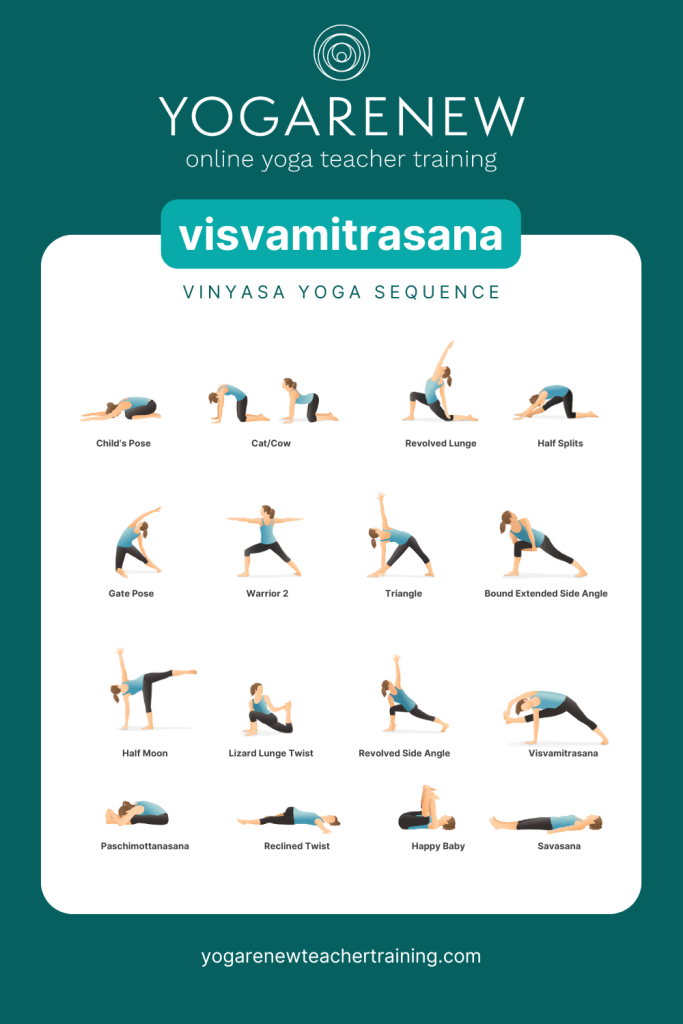
This week’s peak pose is the bold, beautiful, and wildly demanding Visvamitrasana—a hybrid asana that blends hamstring flexibility, shoulder stability, side-body length, and an adventurous spirit. Named after the sage Visvamitra, this pose invites us into the mythological realm where effort, vision, and patience come together.
“Visvamitrasana is where strength meets surrender, and effort meets elegance.”
Why Visvamitrasana?
Builds deep hamstring flexibility (especially in the extended front leg)
Opens the side body and strengthens obliques
Improves shoulder mobility and stability
Enhances balance and mental focus
Offers a full-body integration challenge for experienced yogis
Warm-Up & Prep
Since Visvamitrasana is a complex posture, the warm-up should emphasize hip mobility, hamstring opening, lateral stretching, and shoulder prep.
Child’s Pose with side stretch
Cat/Cow → Thread the Needle (shoulder mobility)
Low Lunge with Side Body Reach
Revolved Lunge with a twist (prep for arm placement)
Half Splits & Pyramid Pose for hamstrings
Gate Pose (Parighasana) for lateral stretch
Suggested Class Sequence
Sun Salutation A x3 — warm up the full body
Warrior 2 → Triangle Pose
Add Extended Side Angle with a bind (introduce shoulder engagement)
Add Half Moon with a bind (to explore leg extension + balance)
Lizard Lunge with a twist → Revolved Side Angle → Arm thread
Peak Pose: Visvamitrasana
From a lunge, thread arm under front leg
Step back foot out to the side for balance
Extend front leg while balancing on supporting hand and outer edge of back foot
Lift top arm skyward or bind behind the back if accessible
Modifications & Props
Use a strap: Loop around the foot of the extended leg to hold onto if the bind isn’t available
Blocks under the bottom hand: Brings the floor closer for better leverage
Bend the front knee slightly: Helps reduce strain if hamstrings are tight
Back knee on the ground: Creates a supported version for newer students
Cool-Down & Integration
Seated Forward Fold (Paschimottanasana)
Reclined Twist with arm reach overhead
Happy Baby Pose
Savasana (5–10 minutes)
Thematic Layering
Weaving in the story of Sage Visvamitra can add depth and reflection to your class. Visvamitra began life as a king, but through intense personal discipline and inner transformation, he earned the status of a rishi (sage). This story mirrors the effort and humility needed to approach the posture.
“Visvamitrasana reminds us that the path to greatness is not linear—it is earned through commitment, challenge, and self-discovery.”