How to Become a Yoga Instructor: The Ultimate Guide

By Yoga Teachers

I’m always surprised at how many people enroll in one of our yoga teacher training programs because they were unsatisfied with another course they started or completed elsewhere.  If you’re looking to become a yoga instructor, do yourself a favor and take a look through this guide first. 

Whether you’re looking to teach online yoga classes, in a studio, gym, corporate environment or anywhere else – everything is covered. I promise it will help clear up anything you might be confused about and will save you a ton of headaches so you’ll know exactly how to become a yoga instructor with minimal stress.  If you still have any questions by the end of this guide (and we doubt you will) you can reach out to us directly and we’ll get them answered for you. Clear and simple.

The secret on how to become a yoga instructor

There’s a TON of noise out there about becoming a yoga instructor and sometimes it seems like each piece of information conflicts with the rest. It might be poor information, or it might be poor communication but it sure seems like there’s a drought of clarity sometimes. For example, did you know that you actually DON’T need a certification to teach yoga? Probably not, but we’ll explain more on that later. We figured it was time to finally put together a guide on everything you need to know about becoming a yoga teacher. Let’s dive in!

Table of Contents:

  1. What are the requirements to teach yoga?
  2. What will a yoga studio look for in a yoga instructor?
  3. What is Yoga Alliance?
  4. What is the difference between a 200, 300, and 500 hour yoga teacher training?
  5. Do I need any prerequisites before enrolling?
  6. Can I complete a yoga teacher training online?
  7. How long does it take to complete a yoga teacher training?
  8. Does a yoga teacher training certificate expire?
  9. Do I need insurance to teach yoga?
  10. How much do yoga teachers get paid?
  11. Is it possible to complete a 200 hour ytt for under $500?

What are the requirements to teach yoga?

In the U.S. and most western countries, there is no ‘accreditation’ or governing body that you need to register with to teach yoga. This also means that you don’t need a specific certification to roll out a mat and lead a class, but don’t roll out that mat just yet.

There’s A LOT of reasons why you don’t see yoga teachers all over town without any training. First of all, most places won’t let you teach without a certificate. You’ll also need insurance for most studios. Even if you teach online or in a park, you are putting yourself in danger without insurance.

Students also want to know that their teacher has been trained properly. A yoga teacher training is more than simply learning a few postures. You learn important aspects of safety, anatomy, business and other areas important for any yoga instructor to have. Without proper training, trying to lead yoga classes isn’t just dangerous for you but it’s dangerous for the students as well.

What will a yoga studio look for in a yoga instructor?

Since the government doesn’t set the requirements for a yoga teacher, it’s really up to a studio to set those requirements. While each studio will have their own hiring criteria, generally speaking, they will want their students to have completed at least a 200 hour yoga teacher training. More frequently, studios are also looking for teachers with a 500 hour certificate.

One helpful tip is that studios will often run their own teacher training programs and look to hire students from within those programs. If there’s a specific studio you’d like to work with, stay late after class one day and ask them what they look for in their teachers. Oftentimes, you’ll hear a studio mention Yoga Alliance – but what is Yoga Alliance?

What is Yoga Alliance?

Yoga Alliance is a registration body for yoga schools and yoga teachers. There are a number of other registration bodies all over the world, but Yoga Alliance is the largest and most common.

As mentioned on their site, Yoga Alliance does not certify schools and they are not an accreditation body like you’d see with universities or in other industries. While they don’t actually certify the schools, they do sort of behave like an accreditation body in some ways. In order to register with Yoga Alliance, you’ll need to attend a training by a school registered with Yoga Alliance and the training will need to be conducted by teachers who are registered with Yoga Alliance.

The way a training will work is that Yoga Alliance has a set of standards that each school needs to follow, and each school will submit their curriculum to Yoga Alliance in order to have their training approved. For example, they will ask for a certain number of hours to be completed for anatomy, practice, or technique, etc. Yoga Alliance has a few different types of registration credentials which are aligned with the way training is typically conducted and you can read more about becoming a yoga instructor on their website.

Yoga Alliance requires a certain level of synchronous learning during a training program. For online courses, this means you’ll need to have a certain number of hours logged over live calls. A 200 hour course will require 30 hours of live calls, so if you are in an online course from a school that only has 1 live call/week you would need to stay in the course for at least 30 weeks to complete your Yoga Alliance requirements.

If Yoga Alliance is important to you, you’ll want to find a school with a lot of calls at times you’re available to attend them.

Learn more about Yoga Alliance:        yoga alliance 2025 new logo

What is the difference between a 200, 300 and 500 hour yoga teacher training?

I’ve seen many people get confused with these trainings, so let’s clarify quickly: A 200 hour yoga teacher training needs to be completed before anything else. Many people think you can start with either a 200 hour training, or a 300 hour training, but a 300 hour yoga teacher training should only be completed AFTER a 200 hour yoga teacher training has been completed. A 500 hour certification is a combination of a 200 and 300 hour yoga teacher training.

Typically, students will finish a 200 hour course before anything else. The 200 hour program might be focused on a specific area such as Vinyasa, or Hatha yoga or it might be a multi-style yoga teacher training course. If the school is registered with Yoga Alliance, it doesn’t really matter whether there is a specific area of focus for the training. Yoga Alliance will only recognize a ‘200 hour’ training (they won’t differentiate between a Vinyasa training and a Hatha training). Let’s take a look at the credentials that Yoga Alliance uses because those draw up a lot of questions as well.

RYT 200 & RYT 500 (or E-RYT 200, E-RYT 500)

RYT = Registered Yoga Teacher

It is a credential specific to Yoga Alliance and in order to list yourself as a RYT-200 you’ll need to complete a 200 hour yoga teacher training that’s been registered with Yoga Alliance. If somebody is an RYT-500, that means they’ve completed a 500 hour program. Or it could mean that they’ve completed a 200 hour course, and then afterwards they completed a 300 hour course. 200 + 300 = 500!

E-RYT is a newer credential by Yoga Alliance

There is an E-RYT 200 and E-RYT 500 and you become eligible for E-RYT 2 years after completing a training. In addition to completing a training, you will also need to complete 1,000 hours of teaching with a RYS-200 registration. Outside of RYT, you also might see the designation CYT. What does CYT mean? Funny you should ask…

What’s the difference between RYT and CYT?

RYT stands for Registered Yoga Teacher and is specific to Yoga Alliance, while CYT stands for ‘Certified Yoga Teacher’ and is a general designation. If somebody is listed as a CYT-200 then it would mean they have completed a 200 hr yoga teacher training, but they aren’t necessarily listed in Yoga Alliance’s directory.

In short, RYT and CYT are similar except that RYT is for people specifically registered in Yoga Alliance’s directory.

Do I need any prerequisites before enrolling?

No. A yoga teacher training is where you’ll gain a certification, so there aren’t really any qualifications that you’ll need to complete before enrolling. Students will typically come with quite a bit of experience, though.

A 200 hour training is not a walk in the park, so it’s good to have a sense of what you love about yoga and what you’re looking for out of a training before you commit to one. That will be helpful for you to determine which course is the best for you.

A lot of times, teacher trainings are broken out by the specific amount of hours it takes to complete the course, or they’re focused on a specific genre, or type of yoga. Here are some examples of teacher trainings and they all are completely separate (you don’t need to complete one before advancing to the others except going from your 200 hours to your additional 300 hours).

Can I complete a yoga teacher training online?

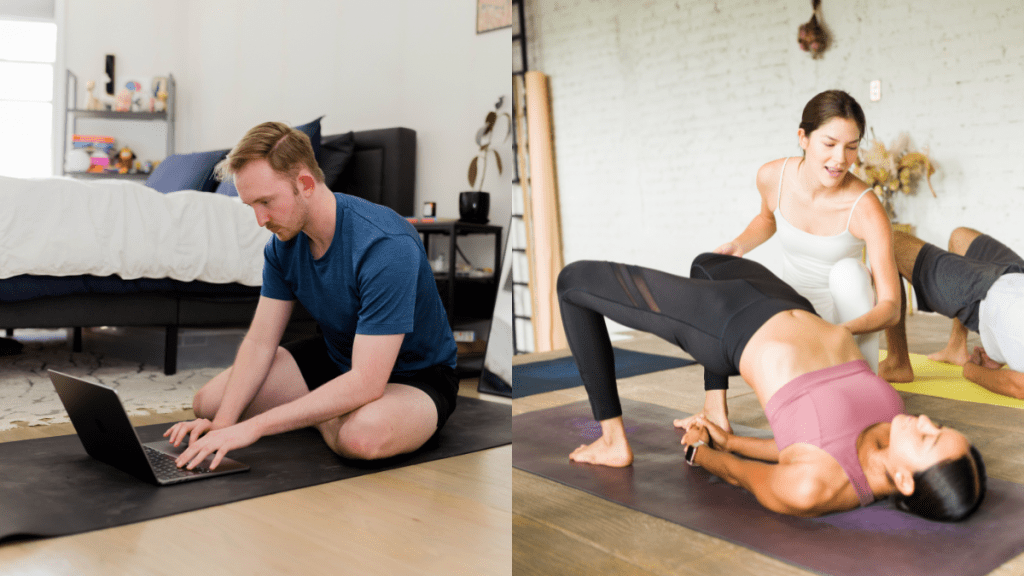
Girl researching how to become a yoga instructor on a laptop, sitting on a yoga mat

The first step towards becoming a yoga instructor through an online program is doing your research!

Yes, you can! Even before COVID-19, schools like YogaRenew had conducted yoga teacher trainings online.

200 hours engaged in a training is a large commitment. Most people can’t realistically complete such an extensive and long course unless it’s self-paced and online. This allows students to work at their own pace in between work, children, and other responsibilities.

Many people also live in remote locations, making attending an in-person training difficult. They also may be in an area where yoga isn’t as popular, so there are no “in-person” studios. Online training has solved both of these problems, making it more accessible than ever. Having the ability to access a yoga training from wherever, whenever is a subtle luxury that accompanies online yoga teacher trainings.

What’s the difference between an in-person yoga teacher training and an online yoga teacher training?

There’s going to be quite a few differences between attending a training in-person and online. Each will have pros and cons also. Every studio will have their own format and structure but we can provide some general insight based on the format of online vs in-person training.

An online training will typically provide much more flexibility because you will often have recorded material that you can review at your convenience in addition to any live or in-person sessions. Sometimes, you’ll even have lifetime access to all the recorded material. Many schools will have a limit on how long their students can access the content, so double check with the school first.

An in-person training is going to have a much different interaction than an online course, however. You can imagine that the way you’d interact with somebody in person is going to be different than the way you’d interact with them online. The same applies for a yoga teacher training. Both an online training and an in-person training should have live interaction with the trainers so that you can gain feedback from the instructors and ask questions through-out the course. If a training does not offer interactive elements and feedback from the instructors, it’s a red flag.

Online and in-person trainings can have a social element, but, as we’ve discussed, each is handled a little differently. Online trainings might have social elements during live sessions as well as through online groups, study buddies, and social media. In-person trainings will not typically offer online groups, or social media interaction since all of the interaction is handled on-site. It can certainly be helpful to have the online resources so that you can come back to them after completing your training, (again, double check whether the studio provides lifetime access to the material).

7 things to look for in an online yoga teacher training

There is a multitude of aspects to consider when selecting which online program to sign up for. Hopefully the considerations below can help prevent some headaches for you so that you know what to look for with an online yoga teacher training.

Here are a few items you’ll want to evaluate before enrolling in an online course:

  1. A proven program: Most schools should have some feedback or testimonials from their students. This gives you a good sense of whether it’s a good program for you. If the school is registered with Yoga Alliance, students will provide a review on the YA site when they register their certificate. The yoga instructors should have years of experience teaching as well. Take a look at the background of your instructors before enrolling. Each studio will have different trainers and styles of yoga. Find a studio with instructors that align with your interests.
  2. Teacher feedback & interaction: Whether the school is online or in-person, you’ll want to join a course that has some feedback and interaction between the students and teachers.
  3. Live calls: In addition to feedback, you’ll also want the opportunity to join live calls with the instructors. Some online schools will have calls that you can attend at different times so that you have flexibility to work at your own pace but the availability of live sessions. For a 200 hr course, Yoga Alliance requires 30 hours of live calls. If a school only offers 1 or 2 calls/week it could take a very long time to complete those requirements. We offer around 30 live calls each week in our 200 hr course from experts in different areas like anatomy, philosophy, business, class management, sequencing, etc. We also have recordings that students can watch if they miss a live call as well. Some studios will have ‘office hours’ which is nice, but different from live training where you can actually ask questions on the spot as the training is being conducted.
  4. Community: One thing that’s important for me is to drive the sense of community in our training programs. Live calls definitely help with this, but our groups are where people really connect with each other. Either way, becoming a yoga instructor is an exciting journey and a big commitment. You’ll want to experience it with other people in a community setting. Find a course that offers an active community that you can stay with even after the training is completed.
  5. Accountability: With more online training programs becoming available, accountability has become more important than ever before. You need to know that you’re on the right track, and that you’re actually learning. I’ve seen students come into my studio quite confused after attending a training that didn’t have any accountability. Testing and feedback are important ways to stay accountable. Testing isn’t just about memorizing information and passing a quiz. You have to also make sure to give each student feedback on how they cue and run their classes.
  6. Resourceful information: One of the major benefits of attending an online training is that you can gain access to a TON of resources. I’d suggest finding a course that gives you lifetime access to the resources, but you also want to make sure that you have some good material that you can take with you into your training.
  7. Support: This one is obvious, but it’s a good idea to test out support with a school before enrolling. It might be as simple as sending over an email to see how quickly you get a response. Email support is really the bare minimum you’ll want to look for though. For example, we offer our live calls for students to interact in real time, and our community provides a place for students to connect locally or online. We provide a place for students to connect with each other to form ‘study groups’ as well. Feedback is provided to each individual as well. General feedback in a group setting is nice, but individualized feedback is even better.

Research the company online

A great online teacher training will be continually adding new resources into their training programs, so even if you graduated a couple years ago you might still find some helpful sequences or resources that you can bring into the classroom as an instructor.

Here’s a short video we created for when it does come time to start teaching your own classes:

For additional information, you can check out this article: What To Look for in a Yoga Teacher Training

Be sure to also check out articles that help you weigh different online yoga teacher training prices and options: Best Online Yoga Teacher Training Programs

How long does it take to complete a yoga teacher training?

Well, a 200 hour yoga teacher training should take 200 hours and a 500 hour program is the accumulation of the 200 hours and the additional 300 hours in the next program. In-person training courses will typically have a start date and end date. Online programs will usually allow students to work at their own pace but some might have a start date and end date. Self-paced schools sometimes have an expiration date as well.

Students enrolled in our courses have lifetime access to all of the material, and we don’t charge anything if it takes a little bit longer for somebody to finish a course. Some students might take 40 days and others might take 400 days to go through a 200 hour program online. It really depends on how much availability you have and how quickly you’re able to work through the material.

Does a yoga teacher training certificate expire?

A yoga teacher training certificate will not typically expire. While we can’t speak for every school out there, it’s rare to see certificates that expire. Once you complete a 200 hour course, you have a 200 hour certificate. It is like a college degree, you’ve earned it and it is yours to keep!

Once you complete a 500 hour course, you have a 500 hour certificate. While your certificate probably won’t expire, there are options for continuing education. Yoga Alliance and certain registration bodies have some continuing education requirements to encourage ongoing learning. They’ll ask you to take continuing ed classes to stay registered with them but you don’t technically need to register with Yoga Alliance in order to teach. Most studios will be okay with hiring you if you’ve already completed a 200 or 500 hour training.

Do I need insurance to teach yoga?

beYogi insurance logo

beYogi is the most well-known yoga insurance program

Yes, insurance is critical for any yoga instructor. First of all, you’ll need insurance to teach at any physical location. At a yoga studio, the teacher will be the one who purchases the insurance. A yoga studio will have their own insurance, but typically they’ll require teachers to bring their own insurance as well. This puts responsibility on the teacher to ensure that the class is conducted in a safe manner. Even if you want to rent your own room, the building will typically ask to see some insurance in order to use the space. This is to protect themselves from lawsuit and is standard.

We have a partnership with BeYogi insurance for our students to gain insurance at a discount. Studios will often have some insurance that they offer to their students or graduates that makes it easy to find a provider.

How much do yoga teachers get paid?

Yoga teachers are compensated in a number of different ways, but in a studio setting there are usually a few different ways that teachers are compensated. They might be compensated a flat rate, a flat rate plus an additional rate per student, or they might simply be paid a flat rate per student.

If you’re interested in learning more about yoga teacher compensation and how to earn money as a yoga instructor, check out our blog: How Much Do Yoga Teachers Make?

Is it possible to complete a 200 hour ytt for under $500?

Yes. Online training has enabled students to become a certified yoga instructor for decent prices and there are some incredible courses at great prices now. I’ve seen plenty of students spend thousands of dollars and attend a training they were unhappy with, so price is not always an indication of quality.

A yoga teacher training is incredibly important, so you don’t want to sacrifice quality – and you don’t need to either. Make sure that there are regular zoom or live sessions that you can attend to interact with instructors. You should be able to ask questions, get feedback, and have trainers available to interact with.

Good schools will have some reviews and testimonials on trusted sites, like TrustPilot, that you can check out before you enroll also.

More Yoga Resources

Do. Your. Research. The more you know before jumping into any yoga teacher training, the better prepared you’ll be. The yoga sphere is constantly shifting as well, so staying up-to-date with resources and information will be extremely helpful on your journey towards potentially becoming an instructor.

We’ve also compiled a bunch of yoga teacher resources to help you stay up to date with what’s happening in the yoga landscape across the board. In this cozy pocket of our website, you’ll be guided towards our blog, Off The Mat that includes a plethora of weekly class themes, tips for yoga teachers, and so much more!

Download Your Guide!


Frequently Asked Questions

What are the steps to become a certified yoga instructor?

Start with a consistent personal yoga practice → choose a yoga style → enroll in a teacher training (like a 200-hour YTT) → complete training (anatomy, philosophy, teaching methodology) → practice teaching → register (e.g., with Yoga Alliance) or teach independently.

How much does a yoga teacher training cost?

It depends on the school and format. Online 200-hour yoga teacher trainings typically range from $300 to $3,000+, depending on inclusions (live coaching, mentorship, materials, etc.). (Note: adjust with your real pricing.)

Do I need prior yoga experience to join a 200-hour teacher training?

Not necessarily. Many programs welcome beginners who have a regular personal practice. However, some familiarity with basic yoga postures helps.

How long does it take to complete a 200-hour yoga teacher training?

It varies. Some trainings run full-time (intensive over a few weeks), others are part-time or self-paced over several months. Online courses often span 3–6 months, depending on how you schedule.

Is an online yoga teacher training as good as an in-person one?

Yes — if it’s well structured. Quality online YTTs include live sessions, video lectures, mentoring, assignments, and practice teaching. They can be equally recognized, especially if Yoga-Alliance approved.

What is Yoga Alliance, and do I need to register with them?

Yoga Alliance is a widely recognized organization that sets standards for yoga teacher training programs (e.g., 200, 500 hours). Registering as a Registered Yoga Teacher (RYT) can boost credibility, help you get studio teaching gigs, and be valued by students.

What topics are covered in a 200-hour yoga teacher training?

Common curriculum: yoga philosophy, anatomy & biomechanics, alignment & posture, teaching methodology, sequencing, adjustments, pranayama (breathwork), meditation, teaching practicum, ethics.

Can I teach yoga professionally after a 200-hour certification?

Yes. A 200-hour certificate is the most common entry-level credential for teaching yoga. After certification, you can teach in studios, gyms, community centers, online, or offer private classes.

Should I continue with more training after the 200-hour course?

Many teachers choose to deepen their knowledge via a 300-hour or 500-hour YTT, or specialize in areas like prenatal yoga, yin yoga, trauma-informed yoga, meditation, etc.

Do I need business skills to be a yoga instructor?

Yes — to run a sustainable yoga teaching practice, you should learn basic marketing, client management, pricing, insurance, and possibly how to run retreats or workshops.

Online Yoga Teacher Training Courses:

200 Hour Online Yoga Teacher Training
300 Hour Online Yoga Teacher Training
500 Hour Online Yoga Teacher Training
How do I properly perform the Malasana squat for beginners? PDF graphic

How do I properly perform the Malasana squat for beginners?

By Yoga Asana, Yoga Poses

We get asked all the time, “How do I practice yoga as a beginner?” or, “Half Moon Pose for beginners.” So, we decided to dedicate this week’s Weekly Class Theme to the prompt, “How do I properly perform the Malasana squat for beginners?”

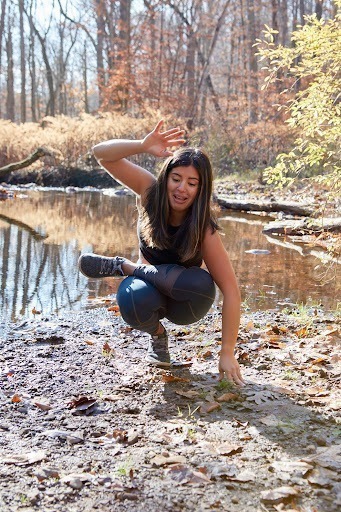
Malasana is also known as “yogi squat” and it is a popular pose for stretching the hips (namely hip flexion) and bending the knees (knee flexion). It can be a preparatory pose for poses like Crow (Bakasana), Side Crow (Parsva Bakasana), Firefly (Tittibhasana) and Headstand (Sirsasana), among others. It allows the body to get comfortable with using the tension of the arms pressing into the legs and legs pressing into the arms to provide support, strength, and stability while also allowing the hips and knees to awaken.

There are several ways to practice Malasana for beginners properly, but in this article we will explore one way of coming into the pose. Try it out and let us know how it goes!

Step 1: Start in Tadasana (Mountain Pose) with your feet about hips-width distance apart

Step 2: Fold over your legs (Uttanasana). If you feel any sort of discomfort here, position your feet to find more space or mobility within your body.

Step 3: Send your seat towards your heels while turning your toes slightly out. This will differ person to person, so find a positioning of your feet that makes you feel grounded and steady.

Step 4: You can add a block under your seat if you want to feel the pose from a supported place rather than getting right into it. A block under your seat is also helpful if you have any strain or trouble with bending down either in your hips, knees, or both.

Step 5: Bring your hands into a prayer at heart’s center, keeping your elbows bent. Have your arms inside your legs so that you can press your arms into your legs and your legs into your arms. This tension may allow you to lift your chest and sit more upright.

Step 6: Distribute your weight evenly and find a comfortable stance on all four corners of both of your feet. If you can, allow your spine to be long, lifting your chest as you press your arms into your legs like mentioned in step 5.

That’s it! We always encourage you to find the setup that works for you. There is no right or wrong way to perform a pose, just ways that can be more accessible for you. If you enjoyed practicing this pose, you can try a class that leads up to one of the peak poses mentioned above where Malasana (yogi squat) will be incorporated as a supporting pose.

Happy practicing!

Don't miss a beat! Sign up for our weekly newsletter.
mindfulness for anxiety

Mindfulness for Anxiety

By Mindfulness

Over the past few decades, mindfulness has moved from a niche contemplative practice into a wellresearched approach for supporting mental and physical health. A growing body of studies shows that regular mindfulness practice can improve cognitive functioning, strengthen the immune system, support better sleep, reduce chronic pain, and ease symptoms of depression and anxiety.

As the benefits of mindfulness have become clearer, researchers have begun asking an important question: How does mindfulness compare to the treatments we already rely on for anxiety? That curiosity led to one of the most compelling studies to date.

Mindfulness can be just as effective as medication

One of the most striking recent findings comes from a 2022 study published in the Journal of the American Medical Association (JAMA). Researchers conducted the first-ever direct comparison between a standard anxiety medication, escitalopram (the generic form of Lexapro) and a mindfulness-based stress reduction program (MBSR). Their question was simple: Is mindfulness meditation as effective as medication for treating anxiety disorders?

The answer was yes.

The study followed 276 adults diagnosed with generalized anxiety disorder over the course of two months. Half took a daily dose of escitalopram, while the other half participated in an eightweek MBSR program. By the end of the study:

  • Both groups showed moderate, meaningful improvements in their anxiety.
  • Both experienced roughly a 20% reduction in symptoms.
  • Neither treatment outperformed the other, they were equally effective.

These results align with what we see in many medication studies for anxiety: consistent, measurable relief. What’s remarkable is that mindfulness meditation matched that level of benefit without the side effect profile that often accompanies medication.

This doesn’t mean mindfulness replaces medication for everyone. But it does mean mindfulness is a legitimate, evidence-based option. One that can stand alongside traditional treatments as a powerful tool for managing anxiety.

Before exploring how mindfulness helps with anxiety on a practical level, it’s helpful to understand what mindfulness actually is.

What is ‘Mindfulness’?

Mindfulness is the practice of bringing gentle, nonjudgmental awareness to the present moment exactly as it is. When anxiety pulls your mind into the future or into spirals of “what if,” mindfulness invites you to return to what is actually happening right now in your body, your breath, and your surroundings. Instead of getting swept up in predictions or fears, you learn to observe your thoughts, emotions, and sensations with curiosity rather than resistance.

This shift in attention creates a powerful space between you and your automatic reactions. In that space, you can see your anxious thoughts as thoughts—not facts—and you can feel the sensations of anxiety without assuming they mean danger. That clarity makes it easier to respond to anxiety with steadiness instead of getting carried away by it.

At its core, mindfulness isn’t about forcing yourself to feel calm. It’s about learning to stay with your experience, even when it’s uncomfortable. You don’t have to feel peaceful or positive; you only have to notice what’s here. Over time, this practice reduces reactivity, increases emotional awareness, and helps you build a more stable inner foundation.

For people living with anxiety, mindfulness becomes a way of meeting yourself with understanding rather than judgment. When you can pause, breathe, and witness your experience with kindness, you create the conditions for relief, resilience, and a more compassionate relationship with your own mind.

To appreciate why mindfulness is so effective, we also need to understand the nature of anxiety itself, how it arises, why it persists, and what keeps it looping in the mind and body.

Understanding anxiety

Anxiety is more than just feeling nervous, it’s a complex emotional and physical response that shows up when something feels uncertain, important, or out of our control. The American Psychological Association describes anxiety as “an emotion characterized by feelings of tension, worried thoughts, and physical changes like increased blood pressure.” That definition captures the basics, but to really understand anxiety, it helps to look at how it operates in our minds and bodies.

Anxiety as a ‘state’ and a ‘trait’

Anxiety can show up in two different ways:

  1. State anxiety: A temporary reaction to a specific situation, like feeling nervous before an interview or a difficult conversation. It rises and falls depending on what’s happening.
  2. Trait anxiety: A more enduring tendency to feel anxious across many situations. It’s part of someone’s temperament, a long-term pattern rather than a momentary spike.

Most people experience both to some degree. Some feel anxious only in certain contexts, while others are naturally more prone to anxiety in general.

Generalized Anxiety Disorder

There’s also generalized anxiety disorder, which is different from both state and trait anxiety. It involves persistent, excessive worry about everyday situations for at least six months, often accompanied by symptoms like restlessness, fatigue, irritability, muscle tension, and trouble sleeping. Many people experience anxiety disorders, yet fewer than half seek professional support, even though therapy can be essential for understanding and managing these patterns.

Why does uncertainty increase anxiety about certain things?

A major driver of anxiety is intolerance of uncertainty. When we struggle with not knowing how things will turn out, our minds try to fill in the gaps. That’s when anxiety tends to spike, because the future is inherently uncertain, and our minds don’t like that.

This discomfort often leads to two common coping strategies:

  1. Worry: The mental side of anxiety, a chain of negative thoughts about what might go wrong.
  2. Avoidance: Steering away from situations that feel overwhelming or threatening.

Both feel protective in the moment, but neither actually helps.

Why worrying doesn’t work

People who worry often believe it helps them prepare or stay safe. But research shows:

  • Worry doesn’t prevent bad outcomes.
  • Trying to suppress worry makes it stronger.
  • Worry amplifies the feelings of anxiety.

Worry is not the emotion itself; it’s the thinking part of anxiety. And the more we try to push it away, the more it rebounds. The real work is turning toward the underlying emotion with curiosity rather than fighting the thoughts.

Why avoidance makes anxiety grow

Avoidance is the behavioral side of anxiety. It’s the zigzagging around the thing that scares us, canceling the meeting, postponing the task, distracting ourselves instead of facing the discomfort.

Avoidance feels soothing in the short term, but it reinforces fear over time. As Dr. Harriet Lerner writes, “It is not fear that stops you from doing the brave and true thing… the problem is avoidance.” Avoidance keeps us from living fully and makes the feared situation loom even larger.

Anxiety is a blend of:

  • Physical sensations (tension, restlessness, racing heart)
  • Thought patterns (worry, predictions, self-doubt)
  • Behaviors (avoidance, distraction)
  • Attention habits (fixating on the future, resisting the present moment)
  • Underlying sensitivity to uncertainty

Understanding these layers helps us see anxiety not as a personal flaw but as a pattern we can work with. When we recognize how anxiety operates, how it loops, how it grows, and how it quiets, we’re better equipped to meet it with clarity, compassion, and skill.

With this foundation in place, we can now look at how anxiety shows up in everyday life and how mindfulness helps us work with it in real time.

Mindfulness for Anxiety- Practical Application

Anxiety often shows up when we care deeply about an outcome, we can’t fully control. Imagine you’re starting a new project, tackling a difficult task at work, or trying to write an essay for class. You want it to go well, but you’re unsure where to begin, how good it will be, or how it will be received. It’s the perfect setup for anxiety: high stakes, lots of uncertainty, and no guaranteed outcome.

Sometimes the anxiety gets so strong that it becomes hard to actually do the work. You sit down to write or plan, but anxiety tightens around you. Instead of starting, you find yourself checking email, scrolling the news, snacking, anything to get temporary relief from the discomfort. You’re not lazy; you’re anxious. And you need a way to work with that anxiety so you can move forward more effectively.

Breaking Down the Experience

When you look closely, your experience has a few key components:

  • Feelings: You’re anxious, agitated, restless.
  • Thoughts: “I can’t do this.” “They won’t like it.” “I’m going to fail.” These are the stories the mind tells.
  • Actions: You try to work, but you also avoid the task because it feels overwhelming.

These three elements reinforce each other. Anxious thoughts fuel anxious feelings, which lead to avoidance. Avoidance brings short-term relief, but in the long run it strengthens the belief that you can’t do the task, so the anxiety grows.

  • Attention: Another important piece, most of your attention is in the future. You’re imagining what might happen, how things could go wrong, and all the possibilities you can’t control. This future-focused attention multiplies worry because the mind can generate endless “what ifs.”
  • Resistance: There’s also a subtle resistance to the present moment. The difficulty of the task feels like it shouldn’t be happening. The struggle feels like a problem you shouldn’t have to deal with. That resistance adds another layer of suffering and pushes you toward distraction.

So now we have the full picture: anxious thoughts, anxious feelings, avoidance, attention pulled into the future, and resistance to the present moment.

How Mindfulness Helps

1. Returning to the Present Moment

Mindfulness begins by bringing you back to what’s real and immediate. You take a gentle breath in and out. You reconnect with your body, your breath, your surroundings. Instead of labeling everything as “anxiety,” you get curious:

  • What sensations are actually here?
  • Is there a buzzing or tightness in the body?
  • Are there images of failure or imagined reactions from others?
  • Is there an urge to escape?

As you observe these experiences directly, the anxiety becomes less solid. It’s no longer a single, overwhelming thing, it’s a shifting collection of sensations, thoughts, and energy patterns. By moving toward the experience instead of away from it, you discover that anxiety is not as threatening as it first appeared.

2. Working with Anxious Thoughts

From this steadier place, you can look at your thoughts with more clarity. You name them: predictions, worries, assumptions. Then you ask:

  • Are these thoughts definitely true?
  • Is this outcome guaranteed?
  • Could things turn out differently?

This isn’t forced positivity; you’re not trying to brainwash yourself into believing that all will be well. It’s simply thinking more accurately, more inline with reality. When you look at your track record, you see that things usually turn out reasonably well.

But the mind still whispers, “What if this time is different?” Instead of trying to argue with that doubt, you open to uncertainty:

  • Can I be okay even if this doesn’t go perfectly?
  • Could I handle a disappointing outcome?

You remember that you’ve faced setbacks before and made it through every one of them. You’re still here.

From here, you ask a simple, grounding question:

  • What needs to be done right now, with the thoughts and feelings I’m having?

Usually, the answer is small and doable: draft the first paragraph, outline the project, write the first sentence. Not the perfect version, just the beginning. You can do that, even with anxiety present. The anxiety can come along for the ride. And once you start, continuing becomes easier.

How can I incorporate mindfulness into my daily life?

Bring to mind something in your own life that you’ve been avoiding because of anxiety. Take a slow breath in and out. Notice the sensations in your body, getting curious about your sensations, questioning your thoughts, and opening to uncertainty. Then identify one small step you can take with awareness and acceptance, one step that moves you toward what matters, even if anxiety is present. Then simply see what happens next.

These small, mindful steps may seem simple, but they add up. And when we zoom out, a larger picture emerges, one that offers genuine hope for anyone living with anxiety.

Mindfulness really does work…

The growing research on mindfulness offers something genuinely hopeful for anyone living with anxiety. For years, medication has been one of the most reliable, evidence-based treatments we’ve had, and it still is. But now we also know that mindfulness-based practices can offer comparable relief, giving people another path toward healing that is accessible, empowering, and rooted in their own awareness.

Mindfulness doesn’t promise a life without anxiety. What it offers is a different relationship to anxiety, one where you’re not fighting your thoughts, bracing against sensations, or trying to control every uncertain outcome. Instead, you learn to meet your experience with steadiness, curiosity, and compassion. Over time, that shift can loosen anxiety’s grip and open up more space to live, work, and connect with greater ease.

The study comparing mindfulness to escitalopram doesn’t mean everyone should replace medication with meditation. It means we now have more than one effective option, and that’s good news. Some people will benefit most from mindfulness alone. Others will find that mindfulness works best alongside therapy, medication, or other forms of support. What matters is finding the combination that helps you feel grounded, capable, and connected to your life.

Mindfulness is not about perfection or constant calm. It’s about learning to return to your breath, your body, your present moment, again and again, especially when anxiety rises. Each return is a small act of courage. Each moment of awareness is a step toward freedom.

If you’d like to deepen your understanding of mindfulness and learn how to integrate these practices into your daily life, you’re warmly invited to enroll in my Mindfulness Certification Course. It’s a supportive, structured way to continue this journey with guidance, community, and meaningful practice.

The Perfect Yoga Pose for your Zodiac Sign

By Yoga Asana

Do you know your zodiac sign? Typically, your zodiac sign is described as your sun sign. Your zodiac sign is determined based on where the sun was on the day you were born. A lot of interest is placed here with all the hype on sun signs and horoscopes. However, all the planets, asteroids, moons, stars, etc. have a place in your birth chart.

Whether you know more about your placements or not, we can all relate to the twelve zodiac signs in some way. They all offer different insights and teachings that we can apply to our own life. In Astrology there are 12 Zodiac signs and 4 elements. The 12 signs are categorized by one of the 4 elements. That means each element rules 3 signs. If you enjoy both Yoga and Astrology, you can practice these poses to embrace the energy of fire, earth, air and water!

Fire Signs: Standing Poses

The fire signs are Aries, Leo and Sagittarius. Fire signs represent movement and driven energy. Fire signs share the teachings of creativity and self-expression. However, fire signs don’t always have to be in movement to be strong and vibrant. Have you ever seen a campfire? It burns brightly in place. Practice these poses and explore them for 3-5 breaths. Feel the heat rise!

♈️ Aries: Warrior 1
Sanskrit: Virabhadrasana I

Girl in Warrior 1 Pose

In Yogic tradition Warrior 1 represents the hero arriving at a ceremony with two swords in hand. In Astrology, Aries also represents a hero. Aries represents the first, the beginning of consciousness, and this energy respects bravery. Aries teaches to be the hero/heroine of your own story. Yet, not all battles are yours to fight. Be committed to your growth and also have the strength to say no without guilt or fear.

♌️ Leo: Warrior 2
Sanskrit:
Virabhadrasana II

Girl in Warrior 2 Pose

Leo energy also taps into the warrior spirit, with loads of enthusiasm. Think about what is worth fighting for. The wisdom of Leo shares the significance of expressing your uniqueness and originality. Shine your light for the world to see. What brings you joy? Go after it. In Warrior 2 feel the heart space and solar plexus open as your arms expand, tapping into your self-confidence, generosity and love.

♐️ Sagittarius: Warrior 3
Sanskrit: Virabhadrasana III

Girl in Warrior 3 Pose

Sagittarius is known as the Archer symbolized as a bow and arrow. Sagittarius is depicted as a Centaur, half human-half horse who was also a warrior and a healer and teaches us to explore and create adventures for ourselves. Sometimes the arrow will have an exact target and other times you are trusting faith to bring you in the right direction. When practicing Warrior 3, feel like the bow and arrow of your destiny and dharma. Trusting what you can see and having faith in the direction you are being guided in.

Earth Signs: Grounding Poses

The earth signs are Taurus, Virgo, and Capricorn. Earth signs represent grounded energy. They bring stability and reliability. Practice these poses and explore them for 3-5 breaths. Feel your feet connecting to the earth beneath you. Earth signs stay focused on their goals and desires and want to deliver their best work, but we all make mistakes. Offer yourself patience and grace when practicing these postures.

♉️ Taurus: Tree
Sanskrit: Vrksasana

Girl in Tree Pose

Feel the connection of your body from head to toe as you balance in this pose. One foot on the earth and one foot connected to your body. Feel the extension of your arms reach towards the sun. Notice the beauty of nature, and feel that same beauty within yourself. Taurus energy shares the wisdom of beauty, abundance, and self-worth. What are your values? Allow your values to change and evolve with you like the growth of a tree.

♍️ Virgo: Goddess with cactus arms
Sanskrit: Utkata Konasana

Lindsay Monal in Goddess Pose

Feel the strength and stability flowing through the body. Virgo energy is mostly described as organized and clean, but there is so much more to the wisdom of Virgo. Virgo energy teaches us the beauty within the mundane. The smallest of details are grand and life changing. Your daily tasks and rituals can be done with pure love. Virgo also shares the importance of service to others. We are perfect exactly as we are. How can we help transform suffering by being of service to others and the world?

♑️ Capricorn: Garland Pose
Sanskrit: Malasana

Girl in Malasana

The wisdom of Capricorn reminds us to look at our responsibility to the world outside ourselves. What can our form of “work” be to create a better world for us all? Being dependable and reliable is important. Feel your inner strength as you practice malasana. Imagine yourself as a strong mountain. Let your hands in prayer at heart center help express your devotion. Capricorn energy teaches us that our hard work, every day efforts, and dedication helps to manifest our visions and goals.

Air Signs: Twists & Binds

The air signs are Gemini, Libra and Aquarius. Air signs are perceptive and always ready to learn. They represent thinking, reflecting, and analyzing. They share the teachings of communication. Air signs express the importance of sharing thoughts and ideas, as well as practicing the art of listening. How can you welcome more curiosity into your life? Practice these poses and explore them for 3-5 breaths. Tune-in to what your body is expressing to you. Practice listening to your body and breath. Notice the sensations of engagement and stretch that you feel.

♊️ Gemini: Half Lord of the Fishes Pose
Sanskrit: Ardha Matsyendrāsana

Girl in Ardha Matsyendrāsana

Twists help to relieve heaviness and sluggishness in the body; helping to create the space for air and breath. Gemini teaches us about being the student. Gemini guides us to learn, ask questions and collect information to form an understanding of the world around us. The wisdom of Gemini energy also shares that we each have our own story to tell the world. In Yogic tradition, a fish was listening to Shiva tell stories to Parvati and so he blessed this fish as the Lord of the fishes.

♎️ Libra: Marichi’s Pose (Sage’s Pose)
Sanskrit: Marichasana I

Girl in Marichyasana I

For Libra, practice Marichasana. Libra energy teaches us about balance; giving and receiving, creation and refinement, leading and following etc. Libra is mostly known as the sign of partnerships and relationships. How does your Yoga practice help build the relationship with your body, breath, mind and heart? In Marichasana you will need to find the balance between stretching and engaging. Honor the balance between what you feel in the hamstrings as you fold and feel in the shoulders as you bind.

♒️ Aquarius: Revolved Abdomen Pose / Supine Spinal Twist
Sanskrit: Jathara Parivartanasana

Girl in Supine Spinal Twist

For Aquarius, practice supine spinal twist. Aquarius is often described as the black sheep, but there is more to Aquarius than what meets the eye. At its core, Aquarius energy is the revolutionary and the liberator. Aquarius wisdom asks, ‘how can you break free from conditioning and patterns that inhibit your growth?’ Although, Aquarius is an air sign it is resembled as the water bearer. In this reclined twist allow your body to be the pitcher and your arms be the flow of water and unconditional love pouring out of your open heart.

Water Signs: Backbends

The water signs are Cancer, Scorpio and Pisces. Water signs guide us to feel. They teach us how to view emotions through the lens of love, compassion and empathy. Reflecting and honoring our emotions helps us to connect with ourselves and others. Tune in to your heart and let yourself feel as you practice these poses and explore them for 3-5 breaths.

♋️ Cancer: Reclined Bound Angle
Sanskrit: Supta baddha konasana

Girl in Supta Baddha Konasana

For Cancer, practice supta baddha konasana. When we are under stress, our breath also shortens. During this stretch practice slow, deep breaths. Any unnecessary tension in the hips also causes unnecessary tension in the diaphragm, thus causing a shortness of breath. The wisdom of Cancer teaches us to nurture our mind, body and heart. This teaching reminds us of the responsibility we have to take care of ourselves. Relax into this posture to welcome deep rest and nourishment.

♏️ Scorpio: Supported Bridge 
Sanskrit: Setu Bandha

Girl in Supported Bridge Pose

For Scorpio, practice supported bridge. Supported bridge is helpful to relax the low back and improve circulation in the body. The wisdom of Scorpio teaches us to embrace transformation and to notice how we use our energy. To scorpio, energy is currency. How do you spend and invest your energy? At one time the constellation of scorpio was blended with the constellation of libra. It was seen as the bridge between balance and harmony.

♓️ Pisces: Supported Fish 
Sanskrit: Matsyasana

Girl in Fish Pose

For Pisces, practice fish pose. This is another posture to feel the heart supported. Fish pose is a backbend that helps to open and create space in the spine, ribs, heart and throat. Pisces teaches us to live from the heart and to realize how we are all interconnected beings. The wisdom of Pisces guides us to honor the depths of our dreams and imagination.

Interested in learning more about Astrology?

Check out our Introduction to Astrology course where you can discover the qualities of each sign to inspire you classes, workshops, and everyday life!

Related Courses:

Don't miss a beat! Sign up for our weekly newsletter.
benefits of breathwork

Benefits of Breathwork

By Breathwork

Breathwork, or pranayama, has long been an important part of yoga practice. Working with your breath offers powerful health benefits, which you might not be aware of. These can include:

  • Dramatically improving your ability to deal with stress
  • Increasing your heart rate variability
  • Letting go of unconscious negative breathing habits
  • Learning to breathe with more ease

In this article, we’ll look at each of these in more detail.

Why practice breathwork?

One of the reasons yogis put so much attention on the breath is that they recognized that while we have some voluntary control over the breath, most of the time breathing is unconscious. They saw the breath as a way to link conscious and unconscious aspects of ourselves.

You can easily feel this dual nature of the breath. For instance, you could take a deep breath right now, or even hold your breath—at least for a little while. Eventually, you’d need to breathe again, but the point is that the muscles that you use to breathe are voluntary. You have some conscious control over them.

Of course, most of the time you’re not breathing consciously. Until you started reading this post, you probably weren’t even aware that you were breathing. That’s good because you need to breathe all the time, and you’ve got other things to think about. In fact, even if you’re not conscious at all—like when you’re sleeping—you need to breathe.

This ability to consciously control the breath makes it different from other vital functions, such as your heart beat, blood pressure or digestion. All of those functions are necessary to keep you alive—as is breathing—but they’re controlled by a part of your nervous system that you don’t have voluntary control over, called the autonomic nervous system. Most of the time you’re not even aware of this part of your nervous system. It’s working in the background.

The autonomic nervous system

The autonomic nervous system has two major divisions. The sympathetic division is the body’s stress response. It’s often referred to as the “fight or flight” system, because it helps you either fight off or flee a threat. The parasympathetic division, on the other hand, is sometimes called the “rest and digest” system because it helps you return to baseline when the threat is over.

Imagine you’ve just finished having dinner with your friends at a restaurant. You’re walking home and you pass a dark alley. You see someone lurking in the alley. They might be a threat, so your sympathetic nervous system kicks in.

If you have to run from this person, or fight them, your muscles will need fuel. Your sympathetic nervous system will dump epinephrine, aka adrenaline, into your bloodstream, increasing blood sugar. Your muscles will need oxygen, so your breathing rate will go up and your airway will open. Your heartbeat and your blood pressure will increase to ensure you can pump that blood to your muscles. Your muscles will produce heat, so you’ll start sweating.

At the same time, your dinner is sitting in your stomach. It’s going to take hours to digest that meal, so it’s not going to help you run right now. The blood flow to your digestive organs will be reduced.

This the body’s stress response. It can be life-saving. You need that ability to rev up your system to cope with threats. However, the same stress response can kick in when there’s nothing life threatening happening. Maybe you’re just stuck in traffic or you had a fight with your spouse. Your body will go through the same physiological sequence.

And, while that stress response can keep you alive when It’s needed, chronic stress has a lot of negative health consequences, including to your blood pressure, blood sugar and immune response. Spending too much time in that sympathetic mode isn’t good for you. So having tools available that can help you shift toward a more parasympathetic state can be very helpful.

Because you can control your breath voluntarily, it offers a way to indirectly influence your autonomic nervous system. The regions of the brain that control the autonomic nervous system and the areas that control the breath communicate with each other. The autonomic nervous system influences breathing, and breathing influences the autonomic nervous system.

When your parasympathetic system is active, your breathing slows down. If you intentionally slow your breathing, even if you’re feeling stressed, you’ll send a signal to your nervous system that things are ok, that there’s nothing to worry about. This can actually help you shift in reality toward a more parasympathetic state.

Heart rate variability

A marker of the health of your autonomic nervous system is heart rate variability. You might imagine that having a steady, metronome-like heart beat would be healthy, but in fact it’s not. A healthy heart rate varies from beat to beat.

This is due to the influence of the main nerve of the parasympathetic division, the vagus nerve. The vagus is a cranial nerve. It exits directly from the brain through an opening in the skull. It’s a long nerve that branches throughout your neck and upper torso. This long, meandering pathway is where it gets its name. Vagus is derived from the same root word meaning “wandering” that we get “vagrant” and “vagabond” from.

The vagus runs to most organs in the upper part of the torso, including the heart and lungs. When the vagus is active, is slows your heart rate.

Interestingly, this activation is coordinated with your breathing. When you exhale, your vagus nerve tells your heart to slow down slightly. When you inhale, the vagus takes its foot off the brake (metaphorically, of course), and the heart speeds up slightly. This is called respiratory sinus arrythmia.

When you see “arrhythmia,” that may not sound like a good thing, but it is. Respiratory sinus arrythmia is normal, and a sign of a healthy autonomic system. It indicates that the sympathetic and parasympathetic divisions can switch back and forth smoothly.

This link between the exhalation and the parasympathetic response offers another way to indirectly influence the nervous system. While slowing your breathing down overall can help you cope with stress, lengthening the exhalation in particular can help even more.

Breathing muscles

Another benefit of breathwork is that it can train the muscles you use for breathing and help you identify habits that may be making it harder to breathe than it needs to be.

The main muscle you use for breathing is the diaphragm. This is a dome shaped muscle that lies in the lower part of your ribcage. When you inhale, it contracts, pulling the roof of the dome downward. Because the lungs are sitting on top of the diaphragm, that contraction stretches open the lungs, expanding their volume, and air flows in to fill up that space. When you breathe out, the diaphragm relaxes and the lungs shrink.

The diaphragm is very efficient. It contracts multiple times every minute over your entire lifetime, and it never gets tired. So, in general, the diaphragm should do most of the work of breathing.

As the diaphragm contracts, it pushes down on the abdomen. If the abdominal wall muscles are relaxed, the diaphragm can descend. But if you tend to chronically contract your abdominal wall muscles, that can make it harder for the diaphragm to do its job. The same thing can happen with other muscles, such as the chest wall or the pelvic floor muscles.

Many of us habitually hold unnecessary muscle contraction in these areas, making the diaphragm work harder than it needs to. However, we’re often we’re not aware of those habits.

Breathwork is grounded in breath awareness. It begins with paying attention to your breath—observing without trying to change it or make judgments about it. Through that process, you may discover areas where you’re holding or gripping that are affecting your breath.

This process can begin with something as simple as lying on your back with your knees bent. Place your hands on your abdomen and observe whether you feel it moving. If you can relax your abdominal wall muscles, you’ll find that your belly will rise toward the ceiling when you inhale and descend toward the floor when you exhale. That’s simply the result of your diaphragm moving up and down as you breathe.

You may find it’s not so easy to relax those muscles, if your habit is to keep them contracted. The process begins by simply noticing, but eventually those muscles can learn to let go, and you’ll find that you can breathe with more ease.

Give this simple exercise a try, and you may find that not only can you breathe more easily, but your breath may naturally slow down and your nervous system may begin to quiet. Even a few minutes of lying on your back like this with your hands resting on your belly, bringing your attention to your breath, can have enormous benefits, both for your body and your mind.

Don't miss a beat! Sign up for our weekly newsletter.

Online Yoga Teacher Training Courses:

Breathwork Certification
300 Hour Online Yoga Teacher Training
500 Hour Online Yoga Teacher Training

Weekly Class Theme: Restorative

By Restorative Yoga

In a world that constantly asks us to do more, move faster, and push further, restorative yoga offers something radically different: an invitation to pause.

This week’s class is centered around restorative yoga, a practice designed to support the body completely so the nervous system can soften, the breath can deepen, and the mind can settle. With the help of props like bolsters, blankets, and blocks, each pose becomes an opportunity to release effort and receive support.

Rather than stretching deeply or building strength, we’ll focus on stillness, comfort, and ease—allowing the body to unwind naturally.

What to Expect

This class is slow, grounding, and deeply nourishing. Each posture is held for several minutes, giving your body time to shift out of “doing mode” and into a state of rest and repair.

  • Slow your breath
  • Release muscular tension
  • Support your joints fully
  • Cultivate awareness without effort

This is a practice of letting go, not pushing further.

The Sequence

Supported Child’s Pose (Salamba Balasana)

We’ll begin in a gentle, grounding shape using a bolster to support the torso. Supported Child’s Pose encourages a sense of safety and ease, helping to quiet the mind and gently stretch the back body.

Allow your weight to fully melt into the props and bring awareness to the rhythm of your breath.

Supported Seated Wide Legged Forward Fold (Upavistha Konasana)

Moving into a seated position, you’ll fold forward over a bolster, allowing the spine to round softly.

This variation removes any strain and invites a passive release through the back body, calming the nervous system and encouraging introspection.

Supported Side Body Twist (Salamba Bharadvajasana) – Both Sides

Twists in restorative yoga are less about depth and more about gentle unwinding.

With the support of a bolster, this reclined twist allows the spine to softly rotate while the body remains completely held. This pose can feel like a reset—wringing out tension while maintaining ease.

Take your time transitioning between sides, keeping the experience slow and intentional.

Supported Legs Up the Wall on a Bolster (Viparita Karani Variation)

In this variation of Legs Up the Wall, the legs are elevated using a bolster, allowing for a gentle inversion without effort.

This pose supports circulation, soothes tired legs, and deeply relaxes the body. Let gravity do the work while you rest into stillness.

Prone Supported Savasana

We’ll close the practice lying on the belly with a bolster supporting the body.

This variation of Savasana offers a grounding, cocooning effect—perfect for anyone who feels restless lying on their back. It encourages a sense of containment and can be especially calming for the nervous system.

Allow yourself to fully surrender here, with nothing left to do.

The Takeaway

Restorative yoga reminds us that rest is not a luxury—it’s essential.

By slowing down and supporting the body, we create space for healing, clarity, and balance. This practice is an opportunity to reconnect with yourself in a quieter, more subtle way.

This week, give yourself permission to do less—and receive more.

Don't miss a beat! Sign up for our weekly newsletter.

Online Yoga Teacher Training Courses:

200 Hour Online Yoga Teacher Training
300 Hour Online Yoga Teacher Training
500 Hour Online Yoga Teacher Training
Black man practicing alternate nostril breathing

Alternate Nostril Breathing and Pranayama

By Yoga

When people ask me what breathwork technique I’d recommend to help them settle and calm down, I often suggest alternate nostril breathing, or, as it’s called in Sanskrit, nadi shodhana.

If I’m feeling anxious, agitated or ungrounded, this is my go-to breathing technique. A few minutes of alternate nostril breathing will almost always help me feel more centered and grounded. I know I’m not alone. Many people have told me they have a similar experience. And in fact, research has also shown that alternate nostril breathing can help shift the nervous system toward a more relaxed state. Studies have consistently shown that nadi shodhana helps to reduce blood pressure and heart rate, as well improving focus and reducing stress.

More about that later, but first, let’s look at how to practice alternate nostril breathing.

How can I learn the correct technique for nadi shodhana?

Traditionally, yogis would sit on the floor, usually in a cross-legged posture, to practice nadi shodhana. However, if that’s not comfortable for you, sitting in a chair will work just as well.

Whatever your foundation, make sure that you’re sitting upright. If you’re on the floor, you may need to elevate your hips to sit without your back rounding. You can support your pelvis with a bolster, a folded blanket or a yoga block, depending on what feels stable and comfortable. If you’re sitting in a chair, don’t lean against the back of the chair. Come forward, so that you’re supporting yourself with your feet on the floor.

Traditionally, nadi shodhana is practiced with a specific mudra, or hand gesture. This is called Vishnu mudra; it’s formed by folding the index and middle fingers of your right hand into the palm, so that the thumb and fourth and fifth fingers are sticking up. You’ll bring your right hand up to your face, placing your thumb on the right side of your nose and the fourth and fifth fingers against the left side.

If you find the traditional mudra awkward, you can lightly press the tips of your index and middle fingers between your brows. Personally, I often prefer to practice with this modified mudra. It has an extra advantage of bringing a little pressure to what yogis refer to as the third eye center, which helps me feel more energetically centered.

Your left hand can just rest on your left thigh. If you like, you can also make another mudra by joining the tips of the left thumb and index finger together.

Using your right thumb, close off your right nostril. You don’t need a lot of pressure—just enough to lightly press the side of your nose against the septum (the part of the nose that separates the right and left nostrils). Breathe in through your left nostril, then close the left nostril and breathe out through the right side. Then inhale through your right nostril and switch to exhale through the left side.

That’s one round. Continue for as many rounds as you like. Try to keep the flow of breath slow and steady. If you wish, you can time your breath by counting silently to yourself, matching the length of the inhalation and the exhalation.

Here’s a video of our Ayurveda Counselor, Lisa Bermudez showing you how to practice nadi shodhana:

The nasal cycle

You may find that it’s more difficult to breathe in through one nostril than the other. This is a pretty common experience in nadi shodhana. Of course, it could be because you’ve got a cold or allergies, or even a structural issue in the nose, but it’s often simply due to what’s called the nasal cycle.

Try it right now: Close your right nostril and breathe through your left nostril, then switch. Can you breathe more easily through one side than the other?

Most people, most of the time, will probably notice a difference. However, if you wait an hour or two and try the same experiment again, you may discover that it’s now the other nostril that’s more open.

Nostril breathing through the nasal cycle

This is the nasal cycle. For many people, the two nostrils periodically switch dominance—i.e., which one is more open—throughout the day. The cycle and its timing varies, but it commonly switches over the course of several hours. However, there is a lot of variation between people. For some, both nostrils may be open at the same time, while for others, there’s no discernable cycle.

Why does this happen? It’s related to the autonomic nervous system. This is the part of the nervous system that regulates unconscious, involuntary vital functions in the body. It takes care of the stuff that happens behind the scenes in your body to keep you alive—functions like your heart rate, blood pressure, digestion and immune function.

The autonomic nervous system is divided into two divisions, called the sympathetic and parasympathetic divisions. The sympathetic division is your body’s stress response. Sometimes called the fight or flight system, it primes your body for activity, whether that’s to flee a threat or to begin a vigorous workout. The parasympathetic division is sometimes called the rest and digest system. It helps you return to baseline.

The sympathetic division generally tends to constrict blood vessels. You have a lot of blood vessels lining the inside of your nose. That’s why nosebleeds can bleed so much. When the sympathetic division is more active, blood vessels in your nose will be constricted. Therefore, your nasal passages will be more open, and you’ll be able to breathe more easily.

For some reason, the sympathetic and parasympathetic divisions tend to switch dominance between the two sides of the body throughout the day. When the sympathetic system is a little more dominant on the right side, your right nostril will be more open. Your left nostril will then be more occluded, because there will be more blood flow on that side. And later in the day, when that dominance changes, the left nostril will be more open.

So that’s how the nasal cycle works. But you might be wondering, why do we have a nasal cycle in the first place?

The short answer is that we don’t know for sure. It may have something to do with allowing nasal tissues to rest and recover, so that they can better filter and humidify the air before it reaches the lungs. Other hypotheses are that it might help optimize immune system function, or that it could help us detect a wider range of odors.

In any case, you may notice that when you practice alternate nostril breathing, it’s harder to breathe through one nostril than the other.

What can you do if you feel like you’re not able to get enough air in through one nostril? Just don’t close the more open nostril fully. That way you’ll be able to get enough air, while still attempting to direct the breath through the more closed side.

What are some other common issues of alternate nostril breathing?

Another common issue that can make alternate nostril breathing challenging is arm or shoulder fatigue. If you’re practicing for a long time, your right shoulder may become stiff or tired.

One solution is to use your left hand to support your right elbow. You can also support your right elbow with a cushion, bolster or yoga block (or even a couple of blocks, depending on your height), with the support resting on your thigh.

Or, you can try switching arms. While using the right hand to manipulate the nostrils is traditional, you don’t have to be bound by tradition. Particularly if you’re left-handed, or if you have an issue with your right shoulder, you may be more comfortable using the left hand.

If you find that it’s difficult to stay focused on the breath, you can try closing your eyes to reduce distractions. On the other hand, some people may find it’s easier to stay alert with the eyes open. Find what works for you.

Why is it called nadi shodhana?

The literal translation of nadi shodhana isn’t “alternate nostril breathing.” It actually translates as “purification of the energy channels.”

Yogis have traditionally linked the breath to prana—a vital energy that sustains life. They visualized this energy moving through channels in the body, called nadis, including a central channel, called the shushumna nadi, and two other channels, one ending at the right nostril and the other ending at the left nostril.

The right channel is called the pingala nadi. It’s said to be an activating, heating, solar channel, while the left channel, called the ida nadi, is a quieting, cooling, lunar channel. Yogis thought that by channeling breath through the right and left nostrils, they could affect the balance of these two aspects of the self.

These channels were seen as existing on a subtle level, within what’s called the energy body, or pranamayakosha. If you dissect a human body, you won’t find a pingala nadi or an ida nadi. Personally, I view them as a way of metaphorically describing the subjective experience of nadi shodhana.

All of this fits with my personal experience. Nadi shodhana generally leaves me feeling more balanced. If I’m feeling stressed or hyperactive, it helps me settle. At the same time, it doesn’t make me feel dull or sleepy. Rather, it leaves me feeling relaxed, but awake. I can see why yogis visualized it as way to balance “solar” and “lunar” energies in the body.

Why practice nadi shodhana?

So that’s my subjective experience. But has there been research about alternate nostril breathing?

Actually, there have been some studies. They show pretty consistently that nadi shodhana can help with de-stressing and calming down. It has been shown in several studies to acutely reduce blood pressure and heart rate. These are signs of shift toward a more parasympathetic, relaxed state in the nervous system.

Why is that a benefit? Remember that the sympathetic nervous system is your stress response. It’s important for survival because it helps us deal with threats. But it can also be activated when you’re not in physical danger. For instance, getting stuck in a traffic jam or worrying about paying your bills can initiate the same response. Chronic stress can have many deleterious health effects, including elevated blood pressure, poor digestion and sleep, and decreased immune system function.

So, alternate nostril breathing can be a useful tool to have at your disposal when you’re feeling stressed. It can help you make the shift from “fight or flight” to “rest and digest” mode, helping you cope better with stressful situations.

There’s also some evidence that alternate nostril breathing can have cognitive benefits too. It may help with focus and alertness. Again, this fits with my own experience of feeling both calm and awake after practicing nadi shodhana.

Some researchers have wondered whether directing the breath through specific nostrils could preferentially activate one division or the other of the autonomic nervous system. There have been a few studies about this question. Some have found links, while others haven’t. Overall, I think we don’t have enough evidence to draw firm conclusions about this yet.

Other researchers have wondered whether breathing through one nostril or the other could have an effect on the hemispheres of the brain. Some EEG studies have found more activity on the opposite side of the brain while breathing through one nostril. However, while this research is suggestive, I don’t think we have enough to draw firm conclusions here either.

While these mechanisms are fun to speculate about, at the very least, alternate nostril breathing helps to focus attention on the breath and slow it down. We know from lots of research that just doing that can have powerful benefits for the nervous system. It may work on other levels too; we’ll have to wait for more studies to find out.

Benefits of alternate nostril breathing

There are so many benefits to this type of pranayama, or breathwork. Typically, people who practice it consistently notice the following benefits:

  • Calms heart rate
  • Helps regulate blood pressure
  • Clears sinuses & enhances lung capacity
  • Calms the nervous system
  • Balances the energy in the body
  • Brings about a state of mental clarity

All of these benefits are experienced differently from person to person and not everyone experiences all of them in that order. Nadi shodhana is a productive way to calm the nervous system and improve your overall mental and physical wellbeing.

Which yoga practices incorporate alternate nostril breathing for better mental clarity?

Many yoga practices incorporate nadi shodhana. Vinyasa classes, hatha yoga classes, a restorative or yin yoga practice can all incorporate nadi shodhana at any portion of class. Some teachers will start out with this breathing practice to help you “drop in” to the environment of the class. Others will incorporate it at the end to further calm the body.

You’ll come across it in many different types of classes, varying from studio to studio (and even online classes). But in the meantime, I’d suggest giving nadi shodhana a try yourself at home, especially if you haven’t practiced it before. It may turn out to be your favorite breathing technique, too!

Breathwork and Pranayama Certification

Breathwork and Pranayama Certification
Don't miss a beat! Sign up for our weekly newsletter.

Free Classes, Tutorials & More
Download the YogaRenew App

Explore classes & pose tutorials for any style, format, duration or experience level with a free account in the YogaRenew app. Or subscribe and gain access to workshops, live classes and more.

peak pose: firefly pose yoga class pdf

Weekly Class Theme: Firefly Pose for Spring

By Weekly Class Theme

Peak Pose: Firefly Pose (Tittibhasana)
Class Focus: Hip opening, hamstring length, core strength, and arm balance integration
Class Level: Intermediate (with accessible modifications)

This class builds toward Firefly Pose by progressively opening the hips, lengthening the inner thighs and hamstrings, and activating the core and upper body. Students will move through a grounded, intentional flow that emphasizes control, breath, and stability.

Encourage patience—Firefly is less about “lifting high” and more about finding balance and integration.

Puttering section of class:

  • Begin seated in Butterfly Pose (Baddha Konasana)
  • Gentle forward fold to begin opening the hips (use a block or blankets for support if strained when leaning forward)
  • Wide-Legged Seated Forward Fold (Upavistha Konasana)
  • Child’s Pose (Balasana)
  • Downward Facing Dog (Adho Mukha Svanasana)
  • Plank Pose
  • Cobra Pose (Bhujangasana)
  • Downward Dog Split (Three-Legged Dog)
  • Lizard Lunge (let the upper back round)

Standing poses:

  • Triangle Pose (Trikonasana)
  • Wide-Legged Forward Fold (Prasarita Padottanasana)
  • Triangle facing the back of your mat
  • Extended Side Angle
  • Goddess Pose

The balance & twisting portion of class:

Bring students to the top of the mat.

  • Chair Pose (Utkatasana)
  • Revolved Side Angle
  • Malasana (Yogi Squat)

Prep for the arm balance part of the pose. Introduce Crow Pose (Bakasana):

  • Knees high on arms
  • Focus on forward lean
    Progression:

    • From squat → hands down
    • Lift hips slightly
    • Begin shifting weight into hands

Peak Pose: Firefly (Tittibhasana)

Wind down portion of class:

  • Incorporate a backbend (Wheel or Supported Bridge Pose)
  • Supine Twist
  • Savasana
Don't miss a beat! Sign up for our weekly newsletter.

19 Books Every Yoga Teacher Should Read

By Lifestyle & Wellness, Yoga Teachers

Learning is an important part of teaching yoga, and there are a ton of great books out there!  The ancient texts give us valuable insight on the philosophy of this incredible practice while modern books can teach us more about anatomy, business, and other elements of yoga. Whether you’re just getting started on your yoga teacher certification, or you have been teaching for years, here are 19 books that every yoga teacher should read:

1. The Bhagavad Gita

The Bhagavad Gita is a classic ancient Indian story about a dialogue between Warrior Arjuna and his spiritual guide, Sri Krishna. As Arjuna sets off into battle, he begins to seek answers about important questions about life from Sri Krishna.

the bhagavad gita book cover

The Bhagavad Gita, Translated by Eknath Easwaran

2. Yoga Sutras of Patanjali by Patanjali

This classic book, written over 4,000 thousand years ago, is one of the most important texts on yoga philosophy today. The Yoga Sutras detail ancient yogic philosophy on every day life, ethics, meditation, and spirituality.

the yoga sutras of patanjali book cover

The Yoga Sutras of Patanjali, Translated by Sri Swami Satchidananda

3. The Upanishads
The Upanishads is another important and revered ancient text about yogic wisdom and philosophy. Enlightened sages share wisdom about consciousness, spirituality, and a deeper look into the relationship between the Self and the Divine.

the upanishads book cover

The Upanishads, Translated by Eknath Easwaran

4. Light on Yoga by B.K.S. Iyengar

This iconic book is considered ‘The Bible of Modern Yoga.’ The book is broken into three sections covering the eight limbs of yoga, asana and pranayama + sequences. It provides an outline of the physical practice that consumes most of modern day yoga and is regularly used as a reference guide by yoga instructors.  Check-out our full book review of Light on Yoga.

Light on Yoga by B.K.S. Iyengar


5. Perfectly Imperfect: The Art and Soul of Yoga Practice by Baron Baptiste

This book by Baron Baptiste, helps yoga practitioners learn important fundamental lessons about yoga. It helps readers understand the true trans-formative aspect of yoga and go beyond what their imagined idea of a “perfect yogi” is. It also hits on points about flowing, dealing with life’s challenges, intuition, and being open to the spiritual and emotional growth that yoga can create for us.

perfectly imperfect art of yoga book cover

Perfectly Imperfect, The Art and Sould of Yoga Practice by Baron Baptiste (Founder of the Baptiste Institute)


6. Yoga Anatomy by Leslie Kaminoff and Amy Matthews

Written by internally recognized experts on Yoga Anatomy, this book is a great reference for yoga practitioners and teachers. It gives readers an understanding of the structures and anatomy of the body. It also explains how anatomy relates to different key yoga poses.

yoga anatomy book cover

Yoga Anatomy by Leslie Kaminoff and Amy Matthews

7. The Art and Business of Teaching Yoga by Amy Ippoliti and Taro Smith

An excellent guide for yoga teachers that details all the different aspects of running a yoga business today. It includes, business basics, marketing, social media marketing, communication, finding new opportunities, and how to run a successful yoga business.

the art and business of teaching yoga

The Art and Business of Teaching Yoga by Amy Ippoliti and Taro Smith

8. Teaching Yoga: Essential Techniques and Foundations by Mark Stephens

This book is filled with vital topics including yoga philosophy and history, styles of yoga, tools and techniques for teaching, 108 poses, breathing techniques, and class sequencing basics. It’s a great book for new and old teachers, or just practitioners looking to deepen their knowledge.

teaching yoga essential foundation book cover

Teaching Yoga, Essential Foundations and Techniques by Mark Stephens, Forward by Mariel Hemingway

9. Light on Life by B.K.S. Iyengar

B.K.S. Iyengar’s book touches on the emotional and spiritual development of yoga. This book is filled with wisdom and stories from his own personal life to reveal the important treasures that yoga helps us to develop internally. It also touches on how yoga helps us to overcome our challenges in life and also leads us on a journey to a deeper sense of wholeness.

light on life book cover

Light on Life by B.K.S. Iyengar

10. 2,100 Asanas by Daniel Larceda
One of the most complete books on yoga poses, this book illustrates beautiful photographs and probably every single yoga pose that exists. The book is organized into sections of types of poses including seated, standing, backbends, inversions, and more. It also details modifications, a brief description for each pose, and spiritual associations for the poses.

2,100 asanas poses book cover

2,100 Asanas by Daniel Lacerda, Founder of Mr. Yoga, Inc.

11. Meditations From The Mat by Rolf Gates and Katrina Kenison

This book includes 365 daily reflections as a way to take yoga practice off the mat and into the world. This book really helps to support every yogi in their personal yoga journey through its daily teachings.

meditation from the mat book cover

Meditations from the Mat by Rolf Gates and Katrina Kentson

12. The Mindful Brain by Daniel Siegel

Written by internationally acclaimed best seller, Daniel Siegel, this book helps to connect science with mindfulness. It details how mindfulness helps our physical bodies, our overall health, emotional health, and also mental health. It teaches how we can use a more focused mind to improve all areas of our lives.

the mindful brain book cover

The Mindful Brain by Daniel J. Siegel

13. Yoga Therapy Mark Stephens

This book explains how yoga practices can be used to heal a number of common ailments and injuries. Using ancient yoga, Ayurveda and modern medical research, Mark Stephens offers a lot of practical tips that any yoga teacher can use to further their yoga teaching.

yoga therapy book cover

Yoga Therapy by Mark Stephens

14. The Complete Guide To Yin Yoga by Bernie Clark

This book offers a detailed look at the practice and philosophy of Yin Yoga. It includes practical techniques, 30 Yin Yoga poses, anatomy, and more. Another must have for yoga teachers looking to deepen their yoga knowledge.

the complete guide to yin yoga book cover

The Complete Guide to Yin Yoga by Bernie Clark with a Foreword by Sarah Powers

15. The Yamas and Niyamas by Deborah Adele

A great resource for yoga teachers, this book is a modern look at the ancient Yamas and Niyamas of the eight-fold path of the Yoga Sutras. It even offers a self-study section after each chapter that teachers can use for philosophy discussions in their classes. Take a deep dive with our course on the Yamas and Niyamas.

An image of the book, "The Yamas & Niyamas" by Deborah Adele

The Yamas & Niyamas by Deborah Adele

16. The Key Muscles of Yoga by Ray Long

This colorful book offers three-dimensional images of yoga poses to detail the different muscles, tendons, bones, and tissues used in each pose. Each illustration also includes detailed descriptions of the anatomy behind each pose. A great visual and educational guide for teachers looking to deepen their anatomy knowledge.

the key muscles of yoga book cover

The Key Muscles of Yoga by Ray Long

17. The Heart of Yoga: Developing a Personal Practice

In this book, yogi Desikachar offers his own practical outlooks on yoga poses, breathing, meditation, and philosophy. His book gives us a way to view ancient yoga practices in a way that we can relate to in modern day. It’s a great book that truly gets to the heart of what yoga is all about.

The Heart of Yoga Book Cover

The Heart of Yoga by T.K.V. Desikachar

18. The Path Of The Urban Yogi By Darren Main

This wonderfully modern book details how we can use yoga to change the way we perceive our experiences and relationships. It helps us all be able to find ways to integrate yoga into a busy Western world. It is filled with humor and wise teachings that any yogi can apply to their daily life.

yoga and the path of the urban mystic book cover

Yoga and the Path of the Urban Mystic by Darren Main, Forward by Stephen Cope

19. The Heart of Meditation by the Dalai Lama

In this book written by His Holiness, we learn about what is truly at the heart of meditation – Compassion. A great edition to a spiritual practice, this book helps to outline how to cultivate and practice more love, kindness, and respect for others.

the dalai lama book

The Heart of Meditation by The Dalai Lama

Enroll in our online philosophy course

If you’re feeling inspired by any of these texts, you can learn more inside of our yoga philosophy course. Inside the course, we dive into the secrets of the yogic practice and the ancient scripts written about it. From there, you can learn how to weave stories and teachings from these books into your yoga teachings or your own personal practice.

Your New Favorite Yoga App. For Free.

Practice. Learn. Connect. 
Access hundreds of free classes & tutorials. Join daily live classes & exclusive live events. Explore immersive courses spanning every aspect of yoga. Subscribe to access over 1,000 yoga & meditation classes.

Tap unlimited potential today.

Don't miss a beat! Sign up for our weekly newsletter.
Kids yoga photo of Kate Lombardo with her toddler in flying airplane pose

Yoga Poses for Kids

By Weekly Class Theme

Yoga is such a well-rounded practice involving both the physical movement and the mind. While it is comprised of a plethora of poses, moving the body in different ways, the basic fundamental actions of the poses can be made suitable for children to do. Kids yoga poses are just a simpler, easier version of the modern day yoga poses we know and love today. This makes it a completely accessible movement practice for kids!

Yoga for kids is a great way to keep them balanced physically and mentally and also encourages living a healthy lifestyle. While the yoga practice dates way back to ancient times, it has since made its way to yoga studios across the world and now, classrooms. Yoga has so many benefits and incorporating it into a classroom or even teaching at a nearby studio where kids can come and practice is a great way to promote mindful living in the next generations.

Our very own Julie Pasqual and Trevor Vaughan have been leading the kids yoga teacher training here at YogaRenew and are constantly coming up with creative ways to keep kids engaged and loving yoga. We’ll explore a few yoga poses that are kid friendly and an exciting alternative to keep them focused and get them excited about yoga!

Kids Yoga Pose 1: Child’s Pose (Balasana)

Mother and son facing each other in balasana, child's pose

Mother and son practicing child’s pose

Kids may not be able to sit their hips all the way back and rest their sit bones on their heels, but they can get themselves into the general shape of a little ball. Here’s how to safely get them to explore Balasana, or Child’s Pose:

  1. Have them start sitting on their shins
  2. Tell them to widen their knees and crawl their palms forward out in front of them
  3. If there’s any discomfort, pad up under their seat with a blanket or bean bag or place a blanket underneath their knees (if there isn’t already a mat beneath them)

Kids Yoga Pose 2: Unicorn Pose/Gate Pose (Parighasana)

Heres a kid-friendly version of Gate Pose, or in this case, Unicorn Pose. Kids will get excited over taking on the shape of such a mystical and fun creature. Here’s how to do it:

  1. Have them start on their shins
  2. Send one leg out to the side
  3. Reach the same arm of the leg that’s extended up overhead with the fingers sticking out as the horn

Kids Yoga Pose 3: Cobra Pose/Snake Pose (Bhujangasana)

Cobra or Snake Pose outside in the sun!

Cobra (or Snake) Pose is done by lying on your belly on the ground, placing your palms underneath your shoulders and lifting your chest up off of the mat while your pelvis and legs stay heavy on the mat. Cobra is very much a real yoga pose, but if you want to make it kid-friendly, you can try calling it “Snake Pose” and let them slither around on the ground if they can’t quite lift their chest off the ground. Here’s how:

  1. Have them start lying on their belly
  2. They can wiggle around side to side or have them place their hands under their shoulders
  3. Tell them to press through their hands to lift their chest and heads up

Kids Yoga Pose 4: Star Pose/Extended Mountain Pose (Utthita Tadasana)

Kate Lombardo and son Aris in star pose

Star Pose!!!

This is a simple and fun pose that will allow kids to learn how to take up space and make room for themselves to grow, both mentally and physically. This kids yoga pose is an extended version of the well-known Tadasana, or Mountain Pose.

  1. Have them start standing up
  2. They can either jump their feet wide or walk them out to the sides until they reach a place they are comfortable
  3. Have them open up their arms wide like a big star shape

Kids Yoga Pose 5: Easy Seat (Sukhasana)

kids yoga poses - easy seat (Sukhasana)

You can even incorporate a kid-friendly meditation or have them close their eyes in Sukhasana!

This one is almost too easy… but still has a lot going on! People often think seated poses don’t require much effort because it doesn’t look like anything’s happening. But in easy seat, the chest is open and the idea is to sit as upright as you can. Having kids try to perfect their seat can even be something that they carry over into their regular classroom setting outside of yoga time.

  1. Have them cross one shin in front of the other
  2. Let their knees drop open once the shins are crossed
  3. Hands can rest on the thighs or knees
  4. Switch the crossing of the shins (so that the opposite shin is in front now)
  5. *Bonus: Have them close their eyes and breathe

Kids Yoga Pose 6: Tree Pose (Vrksasana)

Kid yogi in tree pose on a pink yoga mat

Tree Pose is a classic and fun way to challenge their balance!

Have your kids grow tall like a tree! This kids yoga pose is a fun way to test their balance and focus.

  1. Start by having them stand on both feet
  2. Have them lift the ball of one foot then the other, getting familiar with bringing all their weight to one side
  3. Have them bring a foot to their shin
  4. If they’re steady & comfortable, have them try to tuck their foot closer to their seat

Taking kids yoga poses outside the classroom

Kids yoga doesn’t always have to be practiced in school, but it is a great way to start! From there, students might want to bring their practices home and show their parents.

Our online kids yoga teacher training program equips you with the skills necessary to lead guided yoga classes for kids in classrooms, neighborhood studios, and other group settings. If you’re looking to practice yoga with your kid at home, let this be the perfect guide! Happy practicing!

Don't miss a beat! Sign up for our weekly newsletter.