Within the practice of yoga there is a natural give and return. This principle is at its most obvious in the breath. We can breathe consciously. We can breathe unaware. We breathe, and we breathe, and we breathe, until we breathe no more. The efficacy of yoga lies in becoming aware of the breath. Breathe in. Breathe out. When we practice ujjayi breath, we hear the inhale as it passes though the airway, and into the lungs. We feel the inhale as it moves deeper, depressing the diagram, causing the abdomen to expand.
Why Breathing Is Important In Practice
When we exhale the breath, we feel the abdominals contract inward. We hear the exhalation in the inner ear as it passes through the throat and nostrils. Muscular engagement and release occur in tandem with the breath. In virabhadrasana I, for instance, we can tighten and relax muscles in coordination with the alternating breath cycle. On inhalation, we can create foundation, strength, and stability in the pose by tightening our back quad, and planting the back heel down firmly while straightening the knee joint. In exhalation, we can create openness and flexibility by allowing the hips to get weighty as the bend in the frontward leg is deepened. The principle of give and return can be found throughout the entirety of yoga, not only in asana, but in its philosophy, codes of conduct, and in the subtle practices of yogis that are direct descendants of its ancient lineages.
History Of Breath In Yoga
In the beginning, there is the breath. Until the end, there is the breath. The underlying principle of yoga is the awareness of breath, an awareness that is practiced in the now. Compiled over 2000 years ago by the sage Patanjali, Raja Yoga, also known as the Yoga Sutras, lays out the entirety of yoga in short, succinct, seed words. The first of 126 sutras states, “atha yoganusasanam,” translated, “Now, the practice of yoga is explained.” The very first thing Patanjali teaches us of yoga is that it is a practice of the NOW. NOW explains the practice of yoga. This teaching is both simple and profound. NOW. NOW, we breathe. Awareness of the breath brings us into the now. Yoga teachers begin and end each asana within the breath because the poses are interchangeable, secondary to the primary practice of breathing. The lesson of breath is a life-long teaching. Through the breath, it does not matter what tradition is practiced, where it’s practiced, or with who. It is the breath alone that links the movement of the moment to the NOW.
Breathing In Todays Yoga
Contemporary yoga lineages in non-Eastern countries are diverse, convergent, and ever evolving. In this era of globalization, technology makes it possible for practitioners of an array of disciplines and cultures to come together in collaboration, inspiring one another by sharing their practices. While some modern yoga styles may be unidentifiable to the sadhus and yogis of traditional Vedic lines, there is an undeniable unifying link between them: the giving of teaching, and the practice of learning the lesson. Just as the breath brings life-nourishing prana into the body, is must it be released after completion in order for a new cycle to begin. The role of teacher is bestowed only after the role of student has been fulfilled. Then the new teacher teaches, and another student begins their lessons.
An authentic teacher gives lessons from experience. A lesson is a scope of inward examination. Life lessons, and the teachings that deliver them, can only be received in an open vessel. In other words, true lessons are learned in an open mind, an open heart, and a humble soul. Lessons take place through honest introspection, a focus into the recesses of the self. We all have those parts of ourselves that are uncomfortable, tense, agitating… those restricted places usually left “off-limits” in day-to-day thoughts, but linger on as proverbial skeletons in the closet. Effective teaching gets to the point, and aims to the heart of the matter. A lesson learned releases arrant and excessive elements of the psyche, tight aspects of the self that have been withheld from view. The key to mastering any lesson, any teaching, lies in humility and acceptance. In the NOW, all things are present at once, both the beauty and the beast. The breath teaches us this. In virabhadrasana I, flexibility and tightness are linked simultaneously in our consciousness through the breath. At once, strength and weakness are experienced NOW, within the breath. NOW is the teaching. NOW is the lesson.
Continuing Your Practice
In concession, exploring the deep nature of the NOW, and the cycle of give and return, is at its easiest within the practice of yoga asana. The body is tangible, accessible, and immediate. For most newcomers to yoga, the body is the easiest aspect of the self to connect with. We feel the breath in the body. We have aches and pains in the body. We get the body to class, move the body, sweat the body, and feel the effects of effects of asana in the body.
With practice, and moderate advancement on the mat, a novice yogi usually becomes attracted to the philosophy and subtle elements of yoga. In these deeper studies, the student encounters dualities that will challenge the notions of the self that lie beyond the body. With the guidance of a teacher, the workings of the mind and ego will be revealed in a continual process of teaching and lessoning. And all the while, the presence of the breath is established as the connection to the NOW. A teaching with every inhale, a lesson in every exhale, breathe by breath, guided by the inner-eye of awareness.
 Woman do yoga Downward Facing Dog pose inside of light cozy room through window seen green foliage trees summer landscape morning sun, adho mukha svanasana stronger hands strengthening back exercise[/caption]These postures are also foundational to a more comprehensive āsana practice and worth the extra attention. Practice them often to help counteract the toll sitting takes on your body. And remember to breathe deeply in each shape.
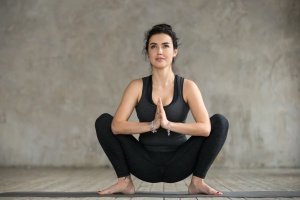 This wide-legged, deep squat stretches the lower back and strengthens the legs. This āsana also opens the hips and exercises the muscles of the ankles and feet. It’s all together a very helpful pose for soothing tension in the lower back and improving posture, which can get thrown off from long hours of desk work.

 By no means are the postures insignificant; Iyengar asserted that, for the average person, practicing āsana and prāṇāyāma are the two most effective disciplines for quieting the mind. But, in reality, the postures are only a piece of a much bigger process of self-discovery and transformation. Teaching āsana is not the only way to share yoga.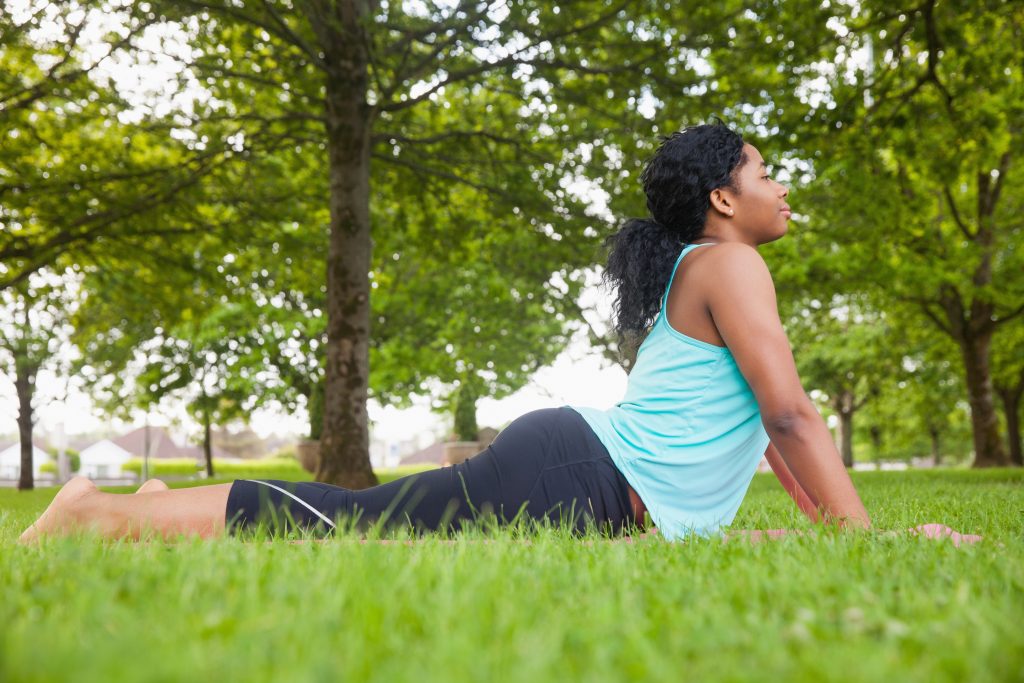
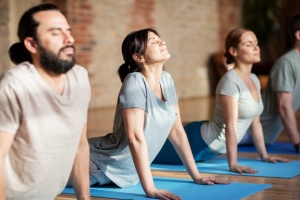 Vinyasa yoga has its roots in Ashtanga yoga; a style of practice developed by K. Pattabhi Jois in the mid-twentieth century, which is considered to be the backbone of modern Western yoga. Ashtanga yoga’s formulated sequence of poses is preformed in a specific order, whereas vinyasa yoga is a freeform practice with limitless variations. Both styles are energetic, dynamic, and steadily paced. The term vinyasa is a linkage of two Sanskrit words: nyasa, meaning “to place”, and vi, “in sacred accord.” To vinyasa, therefore, is to preform poses in accordance to the breath, each transition synchronized with either an inhalation or exhalation.
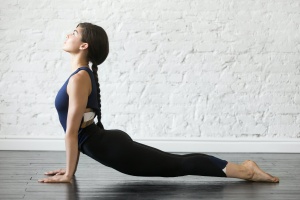 Building from Cobra Pose, Upward Facing Dog