
The first thing my in-laws asked my husband after he’d put them into near-cardiac arrest telling them that I was 1) American and 2) not of Indian descent was, “Is she vegetarian?” As Gujarati Jains, ahimsa (non-harm) is at the core of their faith, life—and diet.
Fortunately, this other kind of Indian is vegetarian (and vegan in the US). Vegetarianism flew in the face of my upbringing as a citizen of the Cherokee Nation where hunting is imbued into culture, but as we grow, increase our knowledge and expand our experiences, we are consistently re-aligning our values.
However, vegetarianism in authentic Indian households is worlds apart from what many of us westerners experience on a daily basis. Both my mother-in-law and my husband are phenomenal cooks. Here are two of my favorite vegetarian recipes including a savory and sweet option.
Both recipes are surprisingly simple, although for some the ingredients might seem unfamiliar, overwhelming, or difficult to get. If you’re lucky enough to live in an area with an Indian store, they will have everything you need (if not, ordering online is always an option). When it comes to spices, it’s always simplest and most affordable to trust Indian stores in my experience.
SPICY MOONG DAHL

INGREDIENTS
1 cup split moong dahl (presara pappu)
3 Cups Water
1/4 tsp canola oil
1 tsp cumin seeds
2 green chilis
2 dry red chilis
1 tsp ginger, grated
10 curry leaves
big pinch asafetida (also known as ting)
to taste salt
1/2 lemon
1/4 tsp turmeric
1 onion
DIRECTIONS
1. Pre-soak dahl in water as long as possible (2 hours is ideal).
2. Cook dahl in water in pressure cooker until soft.
3. Heat oil in pot and add cumin seeds; cook until brown but do not burn.
4. Shred red chilis and add to pot (you can leave seeds or de-seed depending on how much spice you want).
5. Dice and add green chilis, curry leaves, ginger.
6. Add turmeric and diced onion, asafetida.
7. Stir and immediately add to dahl.
8. Check to be sure there is enough water in dahl throughout process. Dahl can be made either thick (like yogurt) or more watered down (like a soup). This depends on your preference. Water can always be added to taste.
9. Add salt to taste. This recipe is from my friend who is Gujarati Jain in Mumbai. I was told this recipe is meant to be a bit bland and they often add a good amount of salt.
10. Simmer for 10 minutes. Right before serving add squeezed lemon.
NOTES:
I’ve found that pressure cookers have different “personalities” and it’s best to just watch the dahl to see when it’s soft and to monitor water levels.
As noted in the directions, I’ve found most people like a good amount of salt added to this dahl, but that is up to taste and health.
It is best served with white rice.
HALWA/SHEERA* INDIAN DESSERT

*This dessert dish is called different things in different parts of India, but it’s delicious and very easy to make.
INGREDIENTS
1 cup Semolina
1 Cup Sugar
1/2 Cup Ghee (or unsalted butter)
2 Cups Water
1/2 Cup Cashew halves/pieces
1/4 Cup Raisins
4 Pods Cardamom
4 Sticks Cloves
2 Sticks Cinnamon
DIRECTIONS
1. Melt the ghee or butter in a flat-bottomed pan and add the cardamom, cloves, and cinnamon. I’ve been able to find most ingredients at stores like Whole Foods/Trader Joes but you may have to go to an Indian grocer. I have substituted cardamom powder in lieu of pods and it has tasted fine.
2. Fry cashew nuts and raisins along with spices in the ghee/butter until light brown.
3. Add the semolina and stir until there are no dry spots in the semolina.
4. Add water and mix well.
5. Cover the pan and keep on low flame for 2 minutes or until the water is absorbed and semolina is cooked.
6. Add the sugar and stir well on low flame until bubbles start popping through semolina.
7. Cover pan and keep on low flame one more minute.
8. Serve while warm.
Try these vegetarian-friendly recipes today!
Many Indian foods and entire cuisines (depending on the community) are inherently vegetarian. Anthony Bourdain once said that Indian food was the one food where he didn’t have issues eating vegetarian. By adopting more vegetarian recipes and dishes into your diet, you can enjoy a more varied experience and the ayurvedic benefits that often come with it. For instance, turmeric is an excellent immunity booster and can be added to virtually any savory Indian dish. Most importantly, have fun, experiment, and play—cooking and food should be joyful.
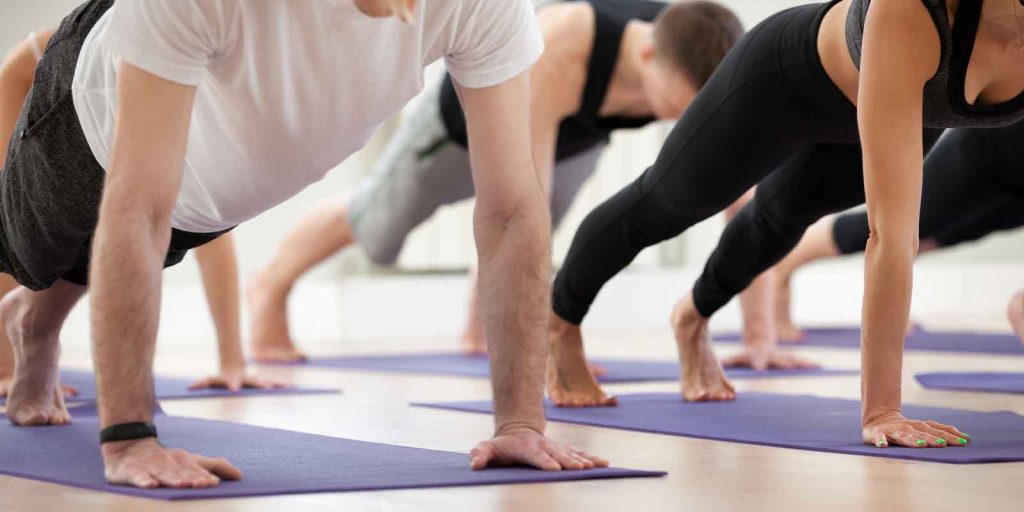
 Chaturanga begins in plank pose. However, you can train your body and mind to shift into Chaturanga from plank simply by moving forward about one inch. Your wrists should be directly under your shoulders while in plank, but prep for Chaturanga requires you to be slightly forward.
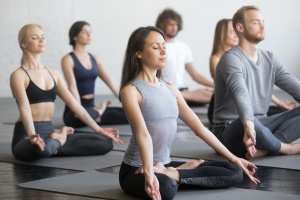 Linking breath with movement is one definition of yoga. It’s not just “movement.” If you’re not practicing the breathing half of things, you’re only doing half of yoga.
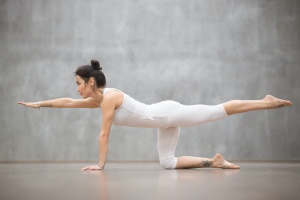 Think of verbal cues as a practice of connecting with people through language. Our words will likely fall flat from time to time, but we’ll always have the opportunity to try again. If a cue results in confusion or students move in a way we didn’t intend, that’s helpful information. In that situation, try a different approach instead of moving on. Self-correcting in the moment reveals our leadership and care. Our students’ responses to our cues are feedback on the cue itself and are not judgements on our value as yoga teachers. Here are some tips for improving our communication skills in class:
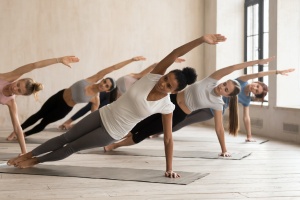 When it comes to verbal cues, less is more. We don’t want to muddy our key message with a lot of words and it’s important to give our students time in the poses without us talking so they can turn inward and listen to whatever surfaces. Keep it clear and concise, and allow the combination of breath and asana to work its magic.
 Yoga happens to be an activity that actually has all many
 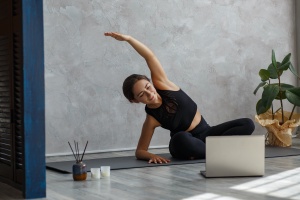 “We’ve seen a significant uptick in referrals from psychologists, especially for patients with anxiety,” says Steve Hickman, PsyD, executive director of the University of California San Diego Center for Mindfulness, where health care practitioners — including psychologists — conduct mindfulness research and offer classes for patients. “Therapists and doctors are rethinking their attitudes toward meditative approaches largely because there’s a persuasive body of evidence showing that [these modalities] can help with stress and mood disorders.”
 What’s the first thing a yoga or meditation instructor usually asks you to do at the beginning of a class? Usually, it’s to begin focusing on your breath. Breathing techniques, or Pranayama, are a powerful tool to regain
 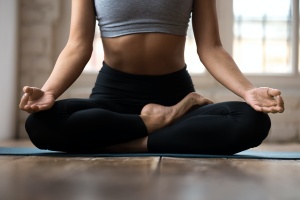 Practice as many cycles as you’d like, I would recommend at least 9 cycles if you can. If you can increase the length of your cycles you are welcome to do so, you may find that your lung capacity and breath control increase with practice. Once you are finished with your cycles take a couple deep rounds of breath regularly. How do you feel?


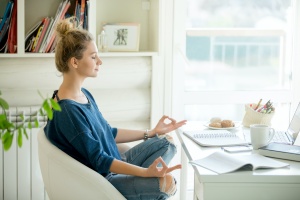 Most commonly today in modern Western society, meditation is the term used to describe the technique of training your mind to be calm, similar to how you go to the gym to train your body to be strong and flexible. Meditation refers to a practice that brings the practitioner into a state of consciousness, connectedness, and profound awareness. Usually attained by sitting still, focusing on breathing, and clearing of erroneous thoughts. It is often described as the journey into stillness, silence, and space. Meditation teaches us to look within ourselves, which ultimately deepens the connection we have to ourselves, and the entirety of life and existence.
 Time spent in silence and stillness, connecting to one’s own inner experience is often pushed further down on the To-Do list in the life of a busy, modern person. As the old Zen saying goes, “You should sit in meditation for 20 minutes a day, unless you’re too busy; then you should sit for an hour.” While not everyone has a full hour to practice meditation, starting small with a realistic goal is beneficial. A three or five-minute meditation can increase a state of calm and peace amidst a world that never sleeps.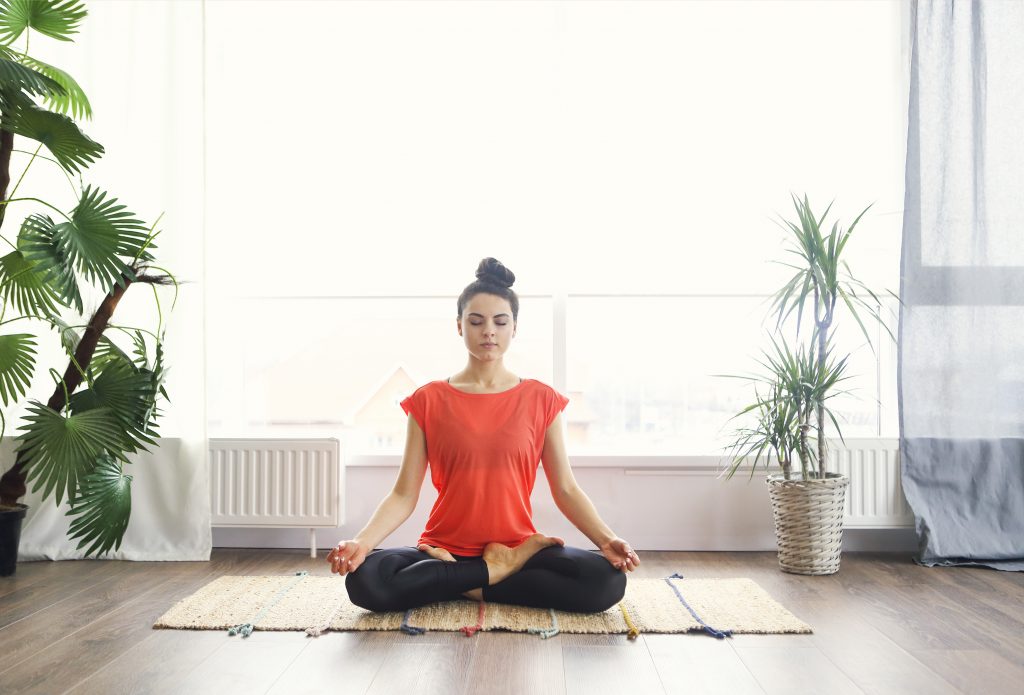
 Yoga has been widely recognized as a way to

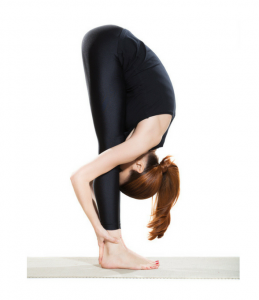 Dropping the head below the heart has a calming effect on the mind and body. In a standing forward fold, the body can quickly relax and get a stretch of the entire back line: from the hamstrings all the way up to the back of the neck. The pose may also help ease headaches and chronic fatigue.

 Begin by sitting on the mat with a straight back and your legs extended in front of you. Feel free to sit on a folded blanket or a bolster for additional support. As you inhale, reach your arms up towards the sky and with a deep exhale, fold your body from your hips as you attempt to reach your knees, feet, or even toes. A key thing to remember is that the goal is not to force your fingertips to your toes; instead, focus on bringing your chest to your thighs, nose to your knees, and forehead to your legs during this stretch. With every exhale, allow tension to be released from your body and surrender even further in this asana. Some benefits of
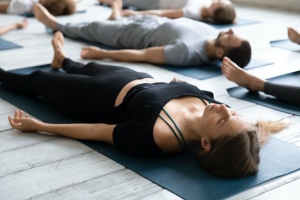
  Let’s end this sequence with a mindful asana to eliminate any meaningless thoughts and ground yourself. Keep your legs extended in front of you on the mat with your arms resting by your sides with your palms facing up. Make sure that your back is straight and there is no arch in your lower back as you lie flat on the mat. Close your eyes and feel your body sink as it becomes heavier with every breath. Corpse Pose is a favorite asana for many people due to its restorative nature. Corpse Pose is a pose of total relaxation which requires remaining in a neutral position, often a challenging task. The purpose of corpse pose is to consciously calm the mind which in turn, calms the nervous system and lowers blood pressure resulting in a state of ultimate serenity. The duration of this asana depends on your preference, however 10-20 minutes are recommended.