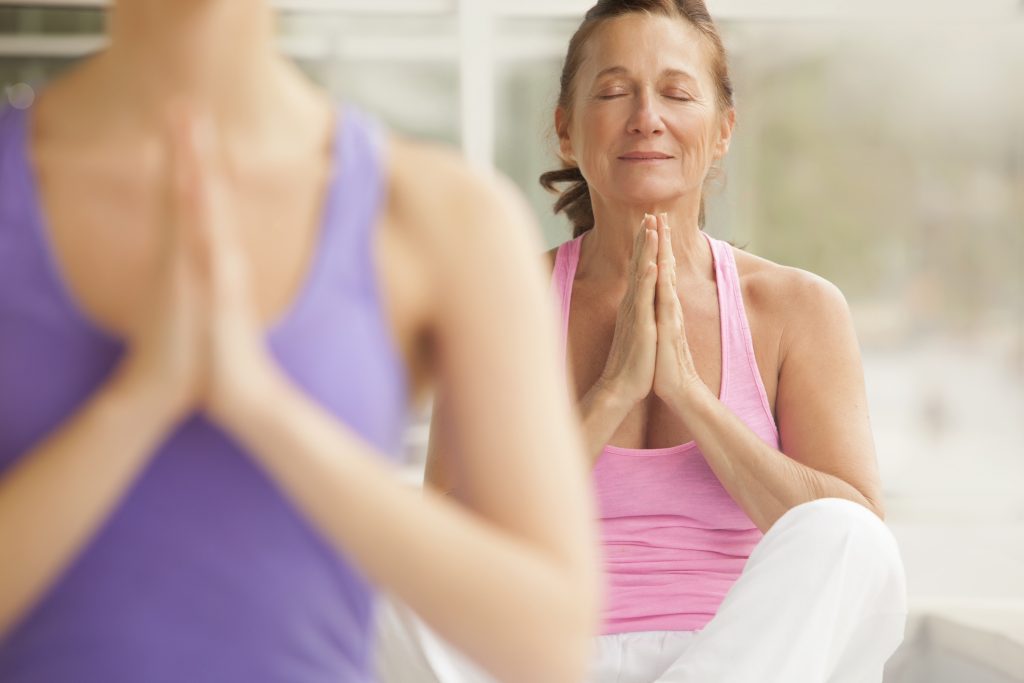
A holistic health practitioner once told me: “The body is designed to heal.” I found her words very comforting. In yogic terms, the body’s dharma, or purpose, is to repair itself so it can remain a healthy vehicle for the soul. We may feel particularly vulnerable right now due to widespread illness, but we can support the body’s healing abilities with yoga.
Home Yoga Practice For Respiratory Wellness
In response to the coronavirus pandemic, here is a home practice that promotes respiratory wellness by exercising the lungs, opening the chest, and improving posture.
1. Three Part Breath and Alternate Nostril Breathing
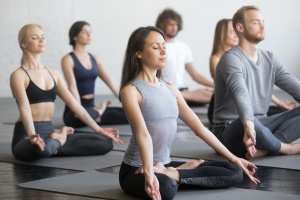
With repeated practice Three Part Breath (Dīrgha Prāṇāyāma) teaches us to use our full lung capacity. Sit in Easy Pose (Sukhāsana) with your hips elevated on a block or blanket. Place one hand on your abdomen and one on your heart to feel the rhythm of your breath. Inhale deeply from your belly, send the breath up through your rib cage, and then into your chest until your lungs are full. Exhale from your chest, deflate your ribs, and draw your navel back towards your spine to completely empty your lungs.
Alternate Nostril Breathing (Nāḍī Śodhana Prāṇāyāma) purifies the nāḍīs, which are channels for energy flow in the body, and it’s very calming. Place the pointer and middle fingers of your dominant hand on the bridge of your nose or curled into your palm. Inhale fully through both nostrils. If you’re right handed, press your right nostril closed with your thumb and exhale through your left nostril. With your right nostril blocked, inhale fully through your left. Close your left nostril with your ring finger. Then release your thumb and exhale out your right nostril. With your left nostril blocked, inhale fully through your right. Close your right nostril and then exhale out your left. If breathing through the nose is difficult due to sinus congestion, practice Three Part Breath through the mouth and avoid Alternate Nostril Breathing until the airways clear. Take long, full breaths for the remainder of the practice.
2. Bound Angle Pose
Bound Angle Pose (Baddha Koṇāsana) opens the abdomen for deep breathing. Sit upright and bring the soles of your feet together in front of you with your knees wide. Place a prop under each knee for support. Inhale from below your navel and fill your lungs completely. Take several rounds of deep breaths in this posture.
3. Locust Pose
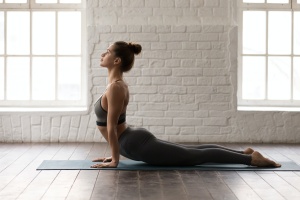
Locust Pose (Śalabhāsana) improves our posture which promotes lung efficiency. Lay face down and interlace your hands behind your back, drawing them towards your feet. Bring your feet together, and on an inhale, lift your feet and chest off the mat. Press your hips down as you stretch from your waist, opening your chest from below your shoulder blades, rather than bending at your lumbar spine. Incorporate this pose into a few rounds of Classical Sun Salutations (Classical Sūrya Namaskar). Practice it in place of Cobra Pose (Bhujaṅgāsana). Classical Sun Salutations prepare the body for other āsanas by loosening the shoulders and hips.
4. Cow Face Pose
Cow Face Pose (Gomukhāsana) opens the chest and shoulders. Start on your hands and knees. Cross your left shin over your right calf behind you. Sit upright so your right knee stacks on top of your left and your feet land by your sides. Alternatively, practice the upper body portion of this pose in a comfortable seated position. Reach your right arm out to the side and bring your right hand to your low back, palm facing out. Extend your left hand to the ceiling, bend the elbow and reach your left hand down your back. Gently move your hands towards each other along your spine until your fingers clasp. If your hands don’t meet, don’t force it. Hold the ends of a towel or piece of clothing to bridge the gap between your hands. Repeat on the opposite side.
5. Bridge Pose
Bridge Pose (Setu Bandhāsana) opens the chest while strengthening the lower back and legs. In a reclined position, lift your hips off the mat, position your feet under your knees, and relax your arms by your sides. For support, position a block under your sacrum (triangular bone at the base of your spine). Send nourishing prāṇa into the heart-space with Three Part Breath.
6. Corpse Pose
Conclude in Corpse Pose (Śavāsana) or in another restful posture like supported Reclining Bound Angle Pose (Supta Baddha Koṇāsana). Cease breath control and relax the body. Withdraw your senses from the external world and focus on the natural rhythm of your inhales and exhales. Meditate on an affirmation like The body is designed to heal or My body is the home of my spirit. Your own inner wisdom may surface during this relaxation period



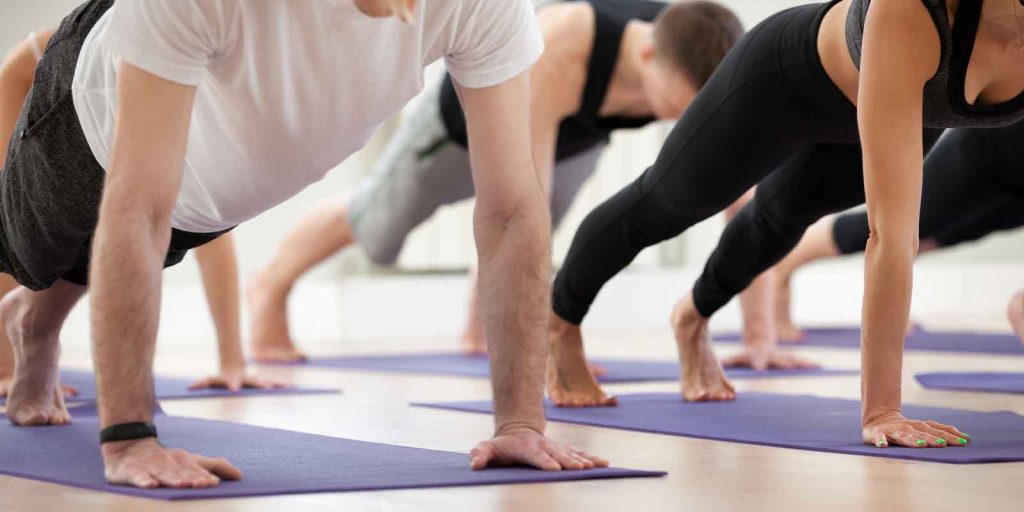
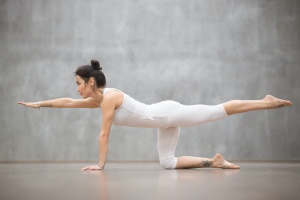
 Chaturanga begins in plank pose. However, you can train your body and mind to shift into Chaturanga from plank simply by moving forward about one inch. Your wrists should be directly under your shoulders while in plank, but prep for Chaturanga requires you to be slightly forward.
 Linking breath with movement is one definition of yoga. It’s not just “movement.” If you’re not practicing the breathing half of things, you’re only doing half of yoga.
 Think of verbal cues as a practice of connecting with people through language. Our words will likely fall flat from time to time, but we’ll always have the opportunity to try again. If a cue results in confusion or students move in a way we didn’t intend, that’s helpful information. In that situation, try a different approach instead of moving on. Self-correcting in the moment reveals our leadership and care. Our students’ responses to our cues are feedback on the cue itself and are not judgements on our value as yoga teachers. Here are some tips for improving our communication skills in class:
 When it comes to verbal cues, less is more. We don’t want to muddy our key message with a lot of words and it’s important to give our students time in the poses without us talking so they can turn inward and listen to whatever surfaces. Keep it clear and concise, and allow the combination of breath and asana to work its magic.
 Yoga happens to be an activity that actually has all many
 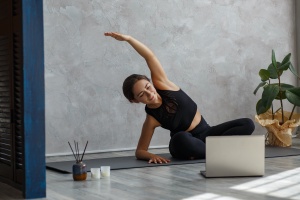 “We’ve seen a significant uptick in referrals from psychologists, especially for patients with anxiety,” says Steve Hickman, PsyD, executive director of the University of California San Diego Center for Mindfulness, where health care practitioners — including psychologists — conduct mindfulness research and offer classes for patients. “Therapists and doctors are rethinking their attitudes toward meditative approaches largely because there’s a persuasive body of evidence showing that [these modalities] can help with stress and mood disorders.”
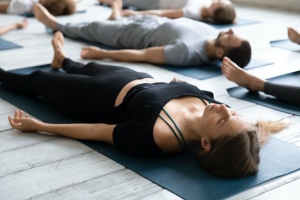 What’s the first thing a yoga or meditation instructor usually asks you to do at the beginning of a class? Usually, it’s to begin focusing on your breath. Breathing techniques, or Pranayama, are a powerful tool to regain
 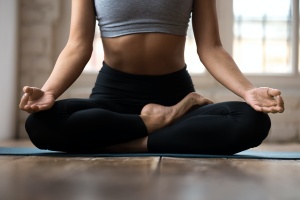 Practice as many cycles as you’d like, I would recommend at least 9 cycles if you can. If you can increase the length of your cycles you are welcome to do so, you may find that your lung capacity and breath control increase with practice. Once you are finished with your cycles take a couple deep rounds of breath regularly. How do you feel?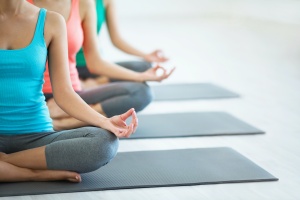
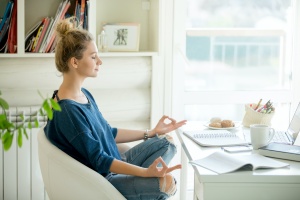 Most commonly today in modern Western society, meditation is the term used to describe the technique of training your mind to be calm, similar to how you go to the gym to train your body to be strong and flexible. Meditation refers to a practice that brings the practitioner into a state of consciousness, connectedness, and profound awareness. Usually attained by sitting still, focusing on breathing, and clearing of erroneous thoughts. It is often described as the journey into stillness, silence, and space. Meditation teaches us to look within ourselves, which ultimately deepens the connection we have to ourselves, and the entirety of life and existence.
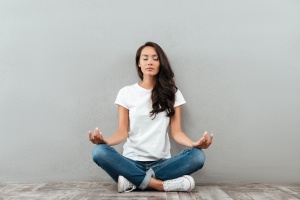 Time spent in silence and stillness, connecting to one’s own inner experience is often pushed further down on the To-Do list in the life of a busy, modern person. As the old Zen saying goes, “You should sit in meditation for 20 minutes a day, unless you’re too busy; then you should sit for an hour.” While not everyone has a full hour to practice meditation, starting small with a realistic goal is beneficial. A three or five-minute meditation can increase a state of calm and peace amidst a world that never sleeps.