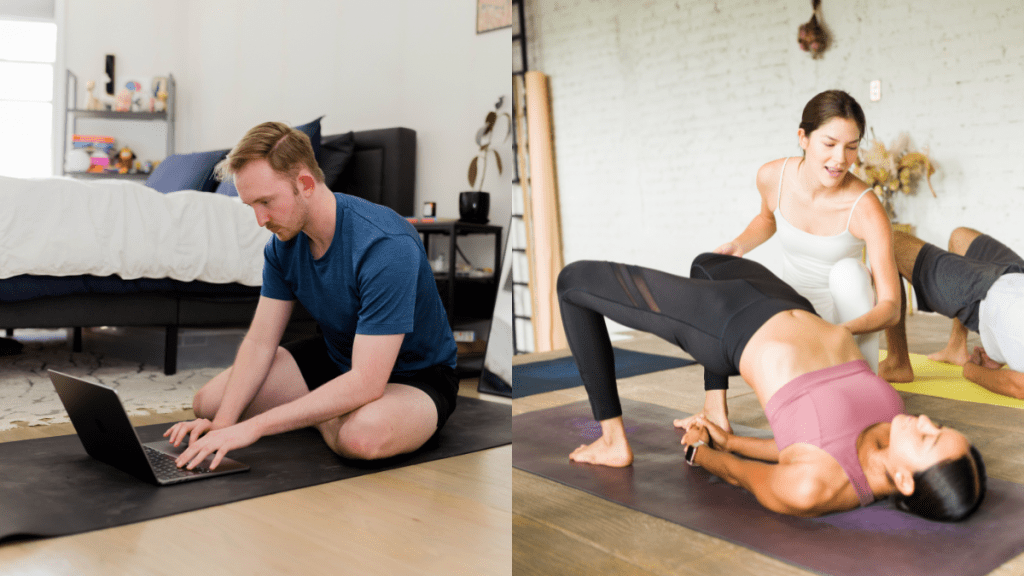
The Best Yoga Apps For At Home Practice

Ranking The 20 Best Free Yoga Apps in 2026

By Online YogaNo Comments

Today's Best Free Yoga Apps For Practicing At Home

We’re pretty fortunate to have a TON of yoga apps available today. It can be a little daunting to find one that aligns with your interests, goals, experience level or tastes. Are you looking for live classes, or beginner guidance? Is there a specific style or intensity level you prefer? Music? Fitness tracking? There’s a lot of options available with different niches or target audiences, but fortunately I’ve outlined all of this and more for you below.

In This Article:

1. Yoga app vs. YouTube?
2. Ranking criteria
3. Full Ranking of the best free yoga apps
4. Reviews of the best free yoga apps
5. Common Questions/FAQ

What's the difference between a yoga app and free yoga classes on YouTube?

With so many online yoga classes available on YouTube, why should you even bother with a free yoga app? While yoga on YouTube is a quick and easy option for somebody looking to get a class in, there’s plenty of reasons why a free yoga app would be preferable. Apps have better functionality for guidance, customization, tracking, navigation and goal-setting. The functionality within yoga apps make it a lot easier to filter and browse options to find the perfect class based on your goal, experience level, duration or interest. You also don’t usually have to deal with ads and will get better music integration than you’d find with YouTube classes.

In this article, I’ll parse through this vast landscape to give you insight on what different apps offer and ultimately a full list of the best free yoga apps.

What should you look for in a yoga app?

Let’s take a look at the criteria we used to rate each app and compile our ultimate list. Each app was ranked across a set of criteria which was converted to a numerical value and ultimately scored out of 45 points.

For example, the criteria “class video quality” was ranked on a scale of 1-5, with 1 being the lowest and 5 being the highest. Apps that scored a ‘1’ for this criteria just had animations or a timed sequence of poses, while apps that scored a ‘5’ had high definition video and settings to control things like the music volume separate from the instructor’s voice.

Here is the scoring criteria used to rate the best yoga app:

  • How Many Free Classes Are Available?
  • What’s The App Store Ranking?
  • Are There Live Classes?
  • How Is The Class Video Quality?
  • Is There Goal-Oriented Content?
  • Are There Custom Filtering Options?
  • Are There Specific Programs Focused on Beginners?
  • Do Classes Have Music & Customization?
  • Is There a Library Of Yoga Pose Tutorials?
  • Are There Focused Educational Courses?
  • Does The App Have Fitness Tracking/Apple Health Or Google Fit Integration?
  • Are There Ads In The Free Version?

Let’s quickly look at this criteria in more detail and some considerations for ranking the top apps. Or you can scroll on down below to check out our full list of the 20 best free yoga memberships.


Free Yoga Membership App Options

What are you actually getting for free? Some yoga apps are simply free to download but require a paid membership to take classes. Others have ads with their classes or have free previews but don’t allow you to view a full class until you subscribe. Some yoga apps allow you to take 1 or two classes for free, and others have hundreds of free classes. This seems like important information, so we’ll definitely highlight what each yoga app provides for free in addition to what you get with a paid subscription.

This criteria was worth 1-3 points in our score.


Reviews & Ratings

One big consideration we’ll look at is social proof. What are the app’s users saying? Has the app received any notable press or accolades from reputable thought-leaders or publications?  Outside of comparing functionality and content options, this is the most direct way to measure an app’s ranking because it draws from a diverse range of opinions and experiences.

Since all of the apps reviewed had at least a 4 rating in the US app store, we looked at the decimal place to get a more meaningful calculation. For instance, a 4.9 rating was given a score of ‘9’ in the ranking calculation.


Does The Yoga App Have Goal-Oriented Practices Or Functionality?

Many yoga apps will design content or functionality around goals like weight loss, flexibility, or stress relief. Other apps simply provide classes without highlighting a specific outcome. If you have a particular goal in mind, this is an important consideration. For example, apps that are strictly focused on weight loss might have functionality for counting calories or tracking progress around that goal which could be helpful.

This criteria was worth 1-3 points in our score.


Can I Customize My Practice With This Yoga App?

Yoga has a diverse landscape of formats with different intensity levels, frameworks, and desired outcomes. It can be tough to find what you’re looking for if there’s a lot of content and you have something specific in mind. In order to easily find a class, you’ll want to be able to apply multiple filters to customize results based on your interest. For example if you only have 30 minutes and you want to find a quick Vinyasa class designed for beginners, can you do that? Or do you need to browse through a massive library to find that class.

Some of the things to consider in terms of content & customization:

  • Can I customize my practice based on experience level, styles, formats or outcomes?
  • Does this app have different instructors with unique areas of expertise, or just one instructor?
  • Can you customize the class duration based on your availability or does this app target a niche with shorter classes?
  • Is there any additional content included within the app that’s not typically found elsewhere?

This criteria was worth 1-3 points in our score.


Does This Yoga App Have Health & Fitness Tracking Available?

The rise of fitness tracking has been swift and pervasive. You don’t need to have a wearable fitness tracker to take advantage of this either. Apple Health and Google Fit integrate directly with a lot of apps and offer some cool functionality without needing a wearable device. Even if you’re just starting out and don’t plan on using this functionality today, it’s nice to know where it’s available in case you adopt it down the road as your practice gains momentum.

This criteria was worth 1-3 points in our score.


Does This App Have Live Online Yoga Classes?

I know a lot of people that find it easier to commit to an online practice when there are live classes held at a specific time. There’s something special about joining a live yoga class and taking part in a shared community experience. For many, it’s a motivational factor and a key requirement in their search for online yoga classes.

This criteria was worth 1-3 points in our score.


Are There Beginner-Friendly Yoga Programs or Guidance?

If you’re just getting started on your yoga practice, this one is key. For true beginners, you’ll want an app that goes beyond simply providing beginner level classes. Look for an app that includes elements of educational content that can help you get started on your journey. You can learn a lot in beginner level classes, but having supplemental learning content can make a big difference. As example of this could be something as simple as having a set of tutorials to learn different yoga poses.

This criteria was worth 1-3 points in our score.


Pose Tutorials & Guidance

Whether you’re a beginner looking to learn the basics of each yoga pose, or a more experienced yogi looking to fine tune your practice, having a set of pose tutorials can be a really valuable piece of functionality. Many apps provide a dedicated area to learn yoga poses, so we’ll highlight this when applicable.

This criteria was worth 1-3 points in our score.


App Navigation & Interface

One thing I’ve seen quite often in user reviews is complaints around an app’s navigation or functionality. It doesn’t matter how great the content is within the app if you’re unable to use it properly. A big element of this comes down to having simple filters or functionality to customize your practice.


Does This App Have Ads?

This one is pretty straight forward. Ads can be a big pet peeve for a lot of people so it’ll be good to know up front which apps have ads in exchange for their free content.

This criteria was worth 1-2 points in our score.


Intermediate or Advanced Classes?

It’s good to know which apps cater to beginners, but another question we should ask is whether this is an app we can grow with? Beginners may eventually grow into more demanding, or intensive classes and want an app that can grow along with them. We’ll take a look at where these options are within different apps as well.


Music & Music Customization

For some people, music is a nonnegotiable aspect of attending a yoga or fitness class and enhances the overall experience. For others, music is a distraction and they’d rather tune into the instructor’s voice without any interference. Some apps allow users to change the music volume separate from the instructor’s voice which is a pretty awesome piece of functionality that caters to both of these audiences. Music licensing can be expensive and complicated, so some apps avoid music entirely.

This criteria was worth 1-3 points in our score.


Educational Programs

Yoga Apps are typically centered around physical classes, but structured educational programs like courses, workshops and lectures can provide incredible value. These could include self-improvement courses, programs designed around philosophy, anatomy, motivation, nutrition, or other areas of wellness. Or they could simply be courses that are more lecture oriented than experiential physical practices. Since yoga is a vast modality that goes beyond the physical practice, this would be key to consider when looking at an app that capture’s yoga holistically.

This criteria was worth 1-5 points in our score, accommodating a wide range of educational programs, interfaces, and content types.

Best Free Yoga Apps: Overview

Below you’ll find a summary ranking of the best yoga apps with some key criteria highlighted. We looked at areas beyond what’s included in this chart, so keep scrolling to get a full breakdown at what these apps offer and how they compare with one another. You’ll find detailed reviews covering all our ranking criteria and insight on content, quality and functionality.

The 20 Best Free Yoga Apps

Full Ranking of The Best Free Yoga Apps

#1. YogaRenew

App Store Rating: 4.9
Rating Score: 45 out of 45
The Best Free Yoga App Overall
Download  on IOS  | Download  on Android

Overview
What’s the best free yoga app? With hundreds of free classes and tutorials, plus live classes and online courses, YogaRenew is the best yoga app available today. This beginner-friendly app has a 4.9 rating in the App Store and has been highlighted as the ‘Best App For Yoga’ in Women’s Health, and ‘Best Online Yoga Classes’ by Rolling Stone magazine. There’s a wide selection of instructors with international recognition who are regularly featured in publications like Yoga Journal, Well+Good, SHAPE, Forbes, Motherly and Bustle. So you know you’re in good hands in terms of the class quality.

Users with a free membership gain access to hundreds of yoga classes + pose tutorials with no ads and music you can control separate from the instructor’s voice. Or you can subscribe to access vast on-demand content, daily live classes & special live events like workshops or lectures.

One of the most special features and differentiators of this app however is the stellar educational programs. These self-paced courses explore areas like philosophy, meditation, anatomy, self-improvement, social health, goal-setting, ayurveda and asana. YogaRenew is the leader in online yoga teacher training, but there’s courses in there for anybody – whether you’re a seasoned yoga teacher or total newbie.

Best Ranked Free Yoga App

The YogaRenew app is great for beginners with structured guidance & learning programs, free pose tutorials and a ton of beginner level classes. There’s also a ton of intermediate and advanced level classes available for you to grow into over time. As your practice progresses, you’re able to stay within one app to fulfill changing needs or desires.

Within the app, you can easily customize your practice based on specific objectives with series built around goals like hip mobility, sleep or strength building. You can also customize classes based on criteria like class duration, experience level, or style. The app goes beyond yoga and has a ton of different class formats to choose from including Meditation, Breathwork, Sculpt, Vinyasa, Yin, Restorative, Prenatal, Chair Yoga and more.

As far as we’re concerned, there’s nothing that comes close to the scope and quality of content that the YogaRenew app provides. Whether you’re looking to access a ton of classes and tutorials with a free membership or looking for live events and more with a paid membership – this is your one stop shop for the best of the best.

Free Content: Over 200 classes & pose tutorials available for free
Live Classes: Yes, Daily
Beginner Programs & Guidance: Yes
Music: Classes have music, and you can adjust the volume of the music separate from the instructor’s voice.
Class Customization/Filtering: Yes
Fitness Tracking: Yes
Goal-Oriented Content: Yes
Pose Tutorials: Yes
Educational Programs: Yes
Ads: No Ads.

#2. Glo

App Store Ranking: 4.9
Rating Score: 40 out of 45
Best Yoga App for Live Classes

Overview
Glo is one of the most popular yoga apps, and for good reason! It has world renown instructors and a really clean interface with great filtering options. It has been around for quite a long time and has been featured in SELF, PopSugar and Rolling Stone magazine. There’s a lot of diverse yoga content as well with tons of styles or formats to choose from, as well as podcasts and educational content. It would be great if there was more educational content that came with course notes or resources but the limited lectures available are wonderful.

Aside from having a great interface, and a wonderful selection of content – the quality of instructors and wide selection of live classes really helps it stand out. There’s on-demand classes from over 50 instructors with heavy hitters like Jason Crandell, Amy Ippoliti or Tiffany Cruikshank.

While the app is free to download you need a subscription to really use it. There are free previews available within the app, but you’ll need a subscription to access an entire class unfortunately.

Free Content: Free download, no free classes (preview only)
Live Classes: Yes, daily
Beginner Programs & Guidance: Yes
Music: Classes have music, and you can adjust the volume of the music separate from the instructor’s voice.
Class Customization/Filtering: Yes
Fitness Tracking: Yes
Goal-Oriented Content: Yes
Pose Tutorials: Yes
Educational Programs: Limited structured lectures.
Ads: No ads

glo yoga app

#3. Alo Wellness Club

App Store Ranking: 4.9
Rating Score: 38 out of 45
Best Yoga App For Stunning Backgrounds

Overview
Taking the number 3 spot in our ranking for the best yoga apps is Alo Wellness Club (previously Alo Moves). What started as a clothing company has transformed into a fitness empire. One of the great things about this app is their destination shoots, with classes filmed against beautiful scenery.

Alo has received a ton of press over the years and has a lot of recognition build on the back of its clothing empire. But don’t be too quick to shout out product nepotism – the app stacks up on its own. There are some great filtering options with a wide range of content options. The app isn’t solely focused on yoga, so you’ll see other wellness related modalities in there which can be a bit limiting in terms of interface navigation. The target audience is going to be more fitness oriented than those looking into the more spiritual elements of yoga. It doesn’t appear to be available on Android at the moment either.

Free Content: Free download, no free classes
Live Classes: No
Beginner Programs & Guidance: Yes
Music: Classes have music, and you can adjust the volume of the music separate from the instructor’s voice.
Class Customization/Filtering: Yes
Fitness Tracking: Yes
Goal-Oriented Content: Yes
Pose Tutorials: Yes
Educational Programs: Some wellness lectures, no structured educational courses.
Ads: No ads

#4. Obe Fitness

App Store Ranking: 4.8
Rating Score: 35 out of 45
Best Yoga App For Women

Overview
Scoring 35 out of 45, Obe Fitness ranks number 4 on our list of the best free yoga apps. Obe is targeted towards women’s fitness, and while yoga isn’t front and center within the app there’s still a lot of great content options. I love the bright look of the interface. It’s color galore, and I’m here for it. In addition to a wide range of content and programs, this app has some good insights and goal setting. There’s functionality for health, mood and cycle tracking in there as well. While there are some good educational programs in there, they don’t have anything specifically focused on yoga and they’re largely comprised of articles with some audio recordings sprinkled in.

Free Content: 3 Free Classes
Live Classes: No
Beginner Programs & Guidance: Yes
Music: Classes have music but no option to customize the music volume separate from the instructor’s voice.
Class Customization/Filtering: Yes
Fitness Tracking: Yes
Goal-Oriented Content: Yes
Pose Tutorials: No dedicated pose library
Educational Programs: Limited – mostly articles
Ads: No ads

#5. Yoga Anytime

App Store Ranking: 4.9
Rating Score: 34 out of 45
Best Yoga App For Shows


Overview
Yoga Anytime has a wide range of yoga and meditation videos to stream or download. Included within the app are ‘shows’ that are essentially collections of videos around different themes or practices. Some are goal-oriented classes, while others are purely educational. I love how many options there are in terms of their ‘shows’ which cover areas like Ayurveda, Anatomy, Chakras, and Yoga Philosophy. It’s a well-rounded app with lots of great content options. There’s a lot of great content, I wish it was organized into categories to make it a little easier to navigate and find different things.

Free Content: Download only
Live Classes: No
Beginner Programs & Guidance: Yes
Music: Music, but no options to adjust the volume separate from the instructor’s voice.
Class Customization/Filtering: Yes
Fitness Tracking: No
Goal-Oriented Content: Yes
Pose Tutorials: No
Educational Programs: Educational programs available
Ads: No Ads

#6. Yoga International

App Store Ranking: 4.6
Rating Score: 34 out of 45
Best Yoga App For Advanced Yogis


Overview
Yoga International has been a leader in the digital yoga space for a long time. They were acquired by Gaia recently, so they’re part of a larger organization with good funding behind them. There’s a ton of well known instructors like Leslie Kaminoff, Rodnee Yee or Amy Ippoliti and great programs. They’re known as one of the places to go to for yoga education and one of the things that makes this yoga app really wonderful is their courses and workshops which cover different aspects of yoga’s practice and philosophy. A lot of the content is geared towards yoga instructors, so it’s a great app for advanced yogis looking to deepen their practice.

In addition to the courses included within their subscription, there’s premium courses which can be purchased as well. Classes have reliably great instructors and guidance, and a lot of diversity. The app is solely focused on yoga and has avoided widening their offering into other modalities like so many other apps have. This gives them a dense niche to master in the space.

Free Content: Free download only
Live Classes: No
Beginner Programs & Guidance: Yes
Music: No customization for music
Class Customization/Filtering: Yes
Fitness Tracking: Yes
Goal-Oriented Content: Yes
Pose Tutorials: Surprisingly couldn’t find a dedicated area within the app for a pose library
Educational Programs: Yes – tons of great courses and learning programs.
Ads: No Ads

#7. Yoga Download

App Store Ranking: 4.9
Rating Score: 33 out of 45


Overview
Similar to the rest of our apps in the top 10, Yoga Download has a solid library of classes overall. They also offer a ton of free classes available both on their app and YouTube channel. There are programs designed around specific goals or outcomes, and some good content for yogis just getting started as well. The app’s interface feels like it was built more for a web browser than as a mobile app, but there’s some great filtering options and a ton of different styles of yoga covering formats like Iyengar, Jivamukti, Kundalini, Power Yoga, Vinyasa, Prenatal, etc.

Free Content: Yes, over 200 free classes
Live Classes: No
Beginner Programs & Guidance: Yes
Music: No custom control
Class Customization/Filtering: Yes
Fitness Tracking: No
Goal-Oriented Content: Yes
Pose Tutorials: No
Educational Programs: No
Ads: No ads

#8. Daily Yoga: Yoga for Fitness

App Store Ranking: 4.7
Rating Score: 33 out of 45


Overview
Daily Yoga has a lot of different modalities and a great pose library with video tutorials and well-designed descriptions. There are programs designed around specific goals like back and neck relief or stress relief. In addition to classes, there’s a community element and eBooks available for an extra fee.

Free Content: 1 class available for free, then a subscription is required.
Live Classes: No
Beginner Programs & Guidance: Yes
Music: Yes, there is music and the volume can be customized separate from the instructor’s voice.
Class Customization/Filtering: Yes
Fitness Tracking: Yes
Goal-Oriented Content: Yes
Pose Tutorials: Yes
Educational Programs: No
Ads: No ads

#9. Simply Yoga: Workouts, Classes

App Store Ranking: 4.7
Rating Score: 34 out of 45


Overview
Simply Yoga is another popular yoga app that allows you to design custom routines or follow guided practices. There’s functionality within the app to schedule reminders for yourself and track the weekly progress of how many hours/minutes you’ve worked out. Unfortunately, the content library seems rather limited compared to other apps ranking in the top 10 and some of the classes are just videos of people moving through poses with a voiceover. There is another app under the Simply Yoga brand marketed as a ‘premium’ version which was not tested within this evaluation since it isn’t free to download.

Free Content: Yes
Live Classes: No
Beginner Programs & Guidance: Yes
Music: No custom music options
Class Customization/Filtering: No
Fitness Tracking: Yes
Goal-Oriented Content: Limited
Pose Tutorials: Yes
Educational Programs: No
Ads: No Ads

#10. YogaFit | Yoga for Beginners

App Store Ranking: 4.8
Rating Score: 32 out of 45


Overview
Free Content: Conflicting information – there appear to be free classes available but lots of reviewers saying they have to subscribe in order to access content after a certain period.
Live Classes: No
Beginner Programs & Guidance: Yes
Music: Yes, there’s music and it can be customized separate to the instructor’s voice.
Class Customization/Filtering: Unable to find a place to combine different filters
Fitness Tracking: Yes
Goal-Oriented Content: Yes
Pose Tutorials: Yes
Educational Programs: No
Ads: No Ads

#11. Asana Rebel

App Store Ranking: 4.7
Rating Score: 30 out of 45

Overview
Free Content:
Free download only
Live Classes: No
Beginner Programs & Guidance: Yes
Music: Yes, there’s music and it can be customized
Class Customization/Filtering: No
Fitness Tracking: Yes
Goal-Oriented Content: Yes
Pose Tutorials: No
Educational Programs: No
Ads: No ads

#12. DoYogaWithMe

App Store Ranking: 4.7
Rating Score: 31 out of 45

Overview
Free Content:
Over 200 free classes
Live Classes: Limited, subscribers get 25% off livestream events but there doesn’t appear to be a place within the interface for live events or classes.
Beginner Programs & Guidance: Yes
Music: No music
Class Customization/Filtering: No
Fitness Tracking: No
Goal-Oriented Content: Yes
Pose Tutorials: Yes
Educational Programs: No
Ads: I didn’t see ads, however their subscription is marketed as ‘ad-free’ which implies there are ads for free users

#13. Yoga-Go

App Store Ranking: 4.6
Rating Score: 28 out of 45


Overview
Free Content:
Free download only
Live Classes: No
Beginner Programs & Guidance: No
Music: Yes, with customization
Class Customization/Filtering: Yes
Fitness Tracking: No
Goal-Oriented Content: Yes
Pose Tutorials: No
Educational Programs: No
Ads: No ads

#14. YouAligned

App Store Ranking: 4.6
Rating Score: 28 out of 45


Overview
Free Content:
Under 20 free classes in their ‘free for all’ section
Live Classes: Limited, only once a month
Beginner Programs & Guidance: No
Music: No
Class Customization/Filtering: Yes
Fitness Tracking: No
Goal-Oriented Content: Yes
Pose Tutorials: No
Educational Programs: No
Ads: No Ads

#15. Yoga Studio: Stretch on the go

App Store Ranking: 4.5
Rating Score: 28 out of 45


Overview
Free Content:
Download only
Live Classes: No
Beginner Programs & Guidance: Yes
Music: No customization
Class Customization/Filtering: Yes
Fitness Tracking: Yes
Goal-Oriented Content: Yes
Pose Tutorials: Yes
Educational Programs: No
Ads: No ads

#16. BetterMe

App Store Ranking: 4.7
Rating Score: 26 out of 45

Overview
Free Content:
Free download only
Live Classes: No, but coaching available
Beginner Programs & Guidance: No
Music: Limited – you can turn it on or off.
Class Customization/Filtering: No
Fitness Tracking: Yes
Goal-Oriented Content: Yes
Pose Tutorials: Yes
Educational Programs: No
Ads: No ads

#17. Bend

App Store Ranking: 4.8
Rating Score: 26 out of 45

Overview
Free Content
: No classes, only free sequences or routines with a timer
Live Classes: No
Beginner Programs & Guidance: No
Music: No music
Class Customization/Filtering: Yes, you can create custom routines based on your interests or needs
Fitness Tracking: Yes
Goal-Oriented Content: Yes
Pose Tutorials: No
Educational Programs: No
Ads: No ads

#18. Down Dog App

App Store Ranking: 4.9
Rating Score: 26 of 45


Overview
Free Content:
No free content available although there used to be. Classes are a computer generated voiceover with a video of somebody moving through a sequence rather than instructor guided classes.
Live Classes: No
Beginner Programs & Guidance: No
Music: Yes, lots of customization options here
Class Customization/Filtering: Yes
Fitness Tracking: Yes
Goal-Oriented Content: No – only body focus areas. No goals like ‘stress relief’ or ‘weight loss’ available within this yoga app.
Pose Tutorials: No
Educational Programs: No
Ads: No ads

#19. 5 Minute Yoga Workouts

App Store Ranking: 4.7
Rating Score: 25 out of 45

Overview
Free Content
: Download only
Live Classes: No
Beginner Programs & Guidance: No
Music: Yes, with customization
Class Customization/Filtering: No
Fitness Tracking: Yes
Goal-Oriented Content: No
Pose Tutorials: Yes
Educational Programs: No
Ads: No ads

#20. CorePower Yoga On-Demand

App Store Ranking: 4.6
Rating Score: 24 out of 45


Overview
Free Content:
No
Live Classes: No
Beginner Programs & Guidance: No
Music: No customization
Class Customization/Filtering: Search only
Fitness Tracking: No
Goal-Oriented Content: No
Pose Tutorials: No
Educational Programs: No
Ads: No ads

That’s your exhaustive & detailed list of the 20 best free yoga apps. Hopefully you’ve gotten a good sense of what’s available and how different apps serve different needs. Many free apps strictly have animations or timed sequences of poses, while others have guided classes with varying levels of video quality. Finding the best yoga membership can be daunting with so many choices, so hopefully this list can be a helpful guide to find one that’s right for you!


Frequently asked questions

What do I need to practice yoga at home with an app or online classes?

Realistically you don’t need anything to get started practicing yoga, however a yoga mat and two yoga blocks are a good starting point! Most mobile apps will connect to your TV, computer or tablet so you can stream videos on a larger screen.

What's the best free yoga app?

With over 200 free classes and tutorials, YogaRenew is the best free yoga app hands down. In addition to the free classes & tutorials, there are educational courses, goal-oriented series and daily live classes available. You can download classes for viewing offline, connect to Apple Health or Google Fit and discover content based on your goals or objectives.

What’s the best yoga app for women?

Obe Fitness is the best yoga app targeting women with tracking specific to areas like physical or mental health, and cycle tracking.

What yoga app is the best for live classes?

Glo yoga has a ton of live class options and is a great app if you’re looking for live sessions from reputable instructors.

What's the best yoga app for scenic views and videos?

Alo moves is the best app if you’re looking to practice with some stunning backgrounds in the video.

What’s the best app for AI generated yoga sequences?

DownDog has a ton of customizations and is great for computer generated sequences and classes.

What's the best yoga app for beginners?

YogaRenew is the best yoga app for beginners. It provides beginner focused series and educational programs with clear guidance across every facet of yoga. It’s a great free yoga app for beginners looking to get started.

What yoga app is the best for advanced yogis?

Yoga International is the best app for advanced yogis looking to deepen their practice with training and educational content.

What is the best free yoga app for full length classes?

Once again, YogaRenew is the best free yoga app and provides a ton of full length classes free.

weekly class theme: samadhi class

Weekly Class Theme: Samadhi

By Weekly Class ThemeNo Comments

This week, we’re preparing for a blissful year ahead. The sacred thing about yoga is it can reveal our true selves to us if we stay consistent and dedicated. But what is the true purpose for why we practice yoga? It would certainly depend on who you ask. Lucky for us, we’ve got an in-house, resident yoga philosopher, Julie Pasqual, and in this week’s class theme, she’s breaking down Samadhi — true, eternal bliss.

Samadhi is best understood as total absorption, meaning all of the elements of the yoga practice (Yamas, Niyamas, The Yoga Sutras, etc.) are weaved together to reach enlightenment, or total bliss. Julie describes it through the lens of Bhakti yoga as being fully devoted to the divine. All outer layers have been peeled back and melted away to reveal the soul or the true self. Nothing is clouded, there are no obstructions, the soul can see itself and is represented purely.

In this week’s class theme, we’ll tie a physical yoga asana practice to the theme of Samadhi by incorporating poses that invigorate the mind, body and that also support the stillness of the mind. When thinking of the concept of Samadhi, we can look at active, vigorous poses like handstand, heart opening poses like Urdhva Dhanurasana (Wheel Pose), and calming and quieting poses like Sarvangasana (Shoulderstand). Practicing all of these asanas in one class fully encompasses the true meaning of Samadhi (ultimate bliss) and will leave your students feeling refreshed, rejuvenated and clear.

Happy practicing!

Puttering:

  • Virasana
  • Sukhasana Twist
  • Sukhasana Forward Fold

Standing Poses:

  • Warrior II
  • Extended Side Angle
  • Peaceful Warrior
  • Prasarita Padottanasana

Balance & Twists:

  • Chair Pose
  • Eagle Pose
  • Warrior III
  • Revolved Half Moon
  • Pyramid Pose

Backbends & Inversions

  • Handstand
  • Wheel
  • Shoulderstand

Wind Down:

  • Supported Fish
  • Supine Twist
  • Happy Baby

Final absorption: Savasana

Online Yoga Teacher Training Courses:

200 Hour Online Yoga Teacher Training

200 Hour Online Yoga Teacher Training

300 Hour Online Yoga Teacher Training

300 Hour Online Yoga Teacher Training

500 Hour Online Yoga Teacher Training

500 Hour Online Yoga Teacher Training
Samadhi hero image

Samadhi – The Goal of Yoga

By Yoga PhilosophyNo Comments

Author: Julie Pasqual/Jamuna Jaya Devi Dasi

Yoga is ubiquitous! There seems to be nowhere that this beautiful, ancient practice has not taken root. But sometimes when something is spread out, the true meaning of it gets lost. Sort of like the old children’s game of telephone – where one person whispers something into another person’s ear – and that person speaks into the next person’s ear, and by the time it has gotten all the way around the circle, the original sentence spoken has been completely changed. If those who practice and teach yoga don’t know what it’s original goal was, we may be left with a superficial understanding of something that is much, much deeper than an elegant physical posture.

You may have heard that the goal of yoga is:

  • To relieve stress
  • To gain flexibility and strength
  • To teach one to meditate
  • To practice being more mindful
  • To help one sleep better
  • To maintain an active lifestyle
  • To become a calmer, less reactive person

While all of these are all wonderful things, none of them are the actual goal of yoga. What is remarkable about this practice is that it has many side effects – and they are all good (like the ones listed above). But what tends to happen, is that people are mistaking the side effect for the actual goal. In the language of Sanskrit, the word for this grand finale of the yoga practice is called Samadhi.

Why the need to attain Samadhi?

To understand why Samadhi is the goal of yoga, first we need to address the predicament that pretty much every human being has – we think we are something that we are not! We think we are a body and a mind, when those are things we have, not what we are. It’s sort of like thinking you are your car, instead of the person driving the car.

Yoga philosophy 101 is that we are not our bodies, nor our minds, we are eternal souls. In the second chapter of the Bhagavad Gita, Krsna spells this out for us:

  • 2.20: For the soul there is neither birth nor death at any time. He has not come into being, does not come into being, and will not come into being. He is unborn, eternal, ever-existing and primeval. He is not slain when the body is slain.
  • 2. 23: The soul can never be cut to pieces by any weapon, nor burned by fire, nor moistened by water, nor withered by the wind.
  • 2.24: This individual soul is unbreakable and insoluble, and can be neither burned nor dried. He is everlasting, present everywhere, unchangeable, immovable and eternally the same.

But, every time the blissful, knowledge soul takes on a body, it comes with a wonderful machine called the mind, whose job is to think. And, it does it’s job very, very well. As it churns out thought after thought after thought, the soul begins to forget that it’s not this mind (like us forgetting we aren’t our car) and so it is caught in a web of things that effect the mind and the body, but don’t really effect the soul. Sort of like the way we can get so elated or deflated when our favorite sports team wins or loses. We can feel our heart beating faster as the seconds of the game tick off, we scream, we yell, we cry – but none of what we are watching is actually happening to us! So, we are trapped reacting to things that, in reality, are not our problems, but very much feel like they are. And, this is where Samadhi comes in.

So, what is Samadhi?

Samadhi is that state where the soul frees itself from the trap of the mind, and is able to perceive itself.

The Yoga Sutras of Patanjali lay this out in the second and third line of the text:

  • 1.2: Yoga is the stilling of the changing states of the mind.
  • 1.3: When that is accomplished, the seer (the soul) abides in it’s own true nature.

Samadhi, it might be said is the soul recovering from the worst case of amnesia ever! In Ashtanga Yoga – named for it’s ashta (eight) step process, Samadhi sits as that eighth practice that the other components: Yamas, Niyamas, Asana, Pranayama, Pratyahara, Dharana, and Dhyana lead to. In this system of yoga, though things are in a list, it is not usually said to be necessary to prefect one of the steps to move onto the other. The regulations of the Niyamas don’t have to be prefect before you can do a down dog (thank goodness, because I personally would never be on my mat if that were true!) However, in the case of Dharana, Dhyana, and Samadhi, the perfection of the first two are what leads to the third.

For Samadhi to be reached, first, one must concentrate (Dharana), and when the focus is held long enough and deeply enough that morphs into meditation (Dhyana), where the strands of the mind are weaved into one unit. And if that state is held long enough, only then is Samadhi reached.

One might ask what the difference is between the deep meditative state that is Dhyana, with the absorption of Samadhi. Here is the detail that separates these two states: In Dhyana, although the mind is being brought to a singular point, the yogi is still aware of outside elements. They would still feel the air at the tip of their nose, or feel the weight of their legs on the ground, for example. They may not be distracted by it, but they do know it’s there. In Samadhi, the only thing the soul can perceive is it’s own eternal, wise, and blissful nature – everything else has fallen away.

Samadhi graphic

Samadhi: a state of intense concentration achieved through meditation. In Hindu yoga this is regarded as the final stage, at which union with the divine is reached (before or at death).

Gradations of Samadhi

Just as one can say that Dharana, Dhyana and Samadhi are gradations of each other, Samadhi itself has different levels. One level is called Samprajnata-Samadhi, the other Asamprajnata-Samadhi.

Here is the major difference between the two:

  1. Samprainata-Samadhi still uses the mind as a prop. It uses the mind to cultivate absorption first in a particular focal point, then in the more subtle or energetic aspects of that particular focal point, then with the blissfulness that is the actual state of the soul, then finally, the mind helps the soul to see. In other words, all those labels, “I am tall, I am short, I am an American, I am a European,” are actually not correct. The mind in this Samadhi has been an aid in getting itself out of the way. (Yoga Sutras 1.17)
  2. Asamprajnata-Samadhi (this is the ultimate in Samadhi) where the soul is not aware of anything, needs no support at all to see only itself. All thought has been shut down completely. (Yoga Sutras 1.18)

What focal point is powerful enough to achieve Samadhi?

In the Yoga Sutras, Patanjali gives a list of possible focal points for the mind. But, he states that only one of them brings the perfection of Samadhi – Isvara Pranidhanai, meaning to surrender to a Higher Power.

This concept of Isvara Pranidhanai is a link between Ashtanga Yoga and Bhakti Yoga. For the Bhakta (practitioner of Bhakti) there is ONLY thinking about the Lord as a means of meditation. The names, forms, and activities of The Divine are what the Bhakta cultivates in their minds and cherishes. And, because Bhakti is what is called a “grace tradition,” The Divine, seeing the Bhaktas dedication, actually enables them to focus on Him. As Krsna says in Bhagavad Gita 10.10, “ To those who are constantly devoted to serving Me with love, I give the understanding by which they can come to Me.” The Yoga Sutras also say this (1.23), “Previously mentioned state of Samadhi is attainable from devotion to The Lord.”

Whatever the focal point of the yogi’s meditation that ripens into Samadhi may be, the fruit is that state where the soul, who has traversed through so many bodies, for so many lifetimes, finally comes home to itself… Samadhi.

Weekly Class Theme: Contentment – Lotus Pose (Padmasana)

By Weekly Class ThemeNo Comments

The iconic yoga posture Lotus Pose (Padmasana) leaves much to be in awe over. A perfectly still posture allowing the spine to sit up straight and the heart to be open while the seat is steady and balanced, it’s a great pose to practice when you need a little extra grounding.

Much like a lotus flower, Lotus Pose invites the body to find stillness and only truly bloom when ready. Patience and contentment must be practiced along the way if you are to truly embody the power of the pose. Lotus pose is a great posture to work towards when practicing contentment because there are many stops along the journey that help you get closer and closer to the full expression of the pose. As you move freely throughout this sequence, pay attention to where your body feels content, trusting yourself enough to know when to relinquish control and when to keep trying.

In this week’s class sequence, we’ll practice asanas that support and open the hips, stretch the inner thighs and ankles and allow you to maintain the integrity of your seat through balance, stillness and acceptance— all through the lens of contentment (Santosha).

Puttering

  • Sukhasana
  • Happy Baby
  • Child’s Pose
  • Crescent Lunge
  • Prasarita Padottanasana
  • Lizard Lunge
  • Crescent Twist

Standing

  • Warrior II
  • Extended Side Angle
  • Three Legged Dog
  • Pigeon Pose

Balance & Twist

  • Tree Pose
  • Revolved Half Moon

Peak Pose: Padmasana (Lotus Pose)

Wind Down

  • Reclined Figure 4
  • Savasana

There is so much to be explored with this pose, and you really can approach it from many different angles. As depicted as one of the later postures in Light on Yoga by BKS Iyengar, it’s advanced shape tends to lend itself to be an intermediate to advanced posture but it is not impossible to attain and work towards. Even the effort needed to embody the full pose is allowing you to feel the benefits of the pose without having your arms fully bound around behind your back. Each step of the journey for the flower to unfurl is equally as important and significant. Your patience and practice in contentment will guide you along the way!

Happy practicing xx

free resources for yoga teachers!!!

Yoga Resources from YogaRenew

By YogaNo Comments

Hi! It’s almost time to ring in the new year… and a lot has been happening here at YogaRenew HQ. We’re celebrating our 3rd year of having a physical studio and just about 6 years in celebrating our online company! What a journey it’s been.

In the mood of celebration, we figured we’d tackle some free online yoga resources for you on your yoga journey — whether it’s for your personal practice or teaching.

Let’s breakdown some resources our students found helpful!

Yoga Pose Database

About halfway through this year, we created a yoga asana pose database that features some of the most popular yoga poses. Inside the database, you’ll find tutorials on how to get into the pose as well as alignment tips and cues. You’ll also find modifications and variations of the specific poses and how you can access them or instruct students into the poses safely and effectively.

Kate and Patrick hero image of them both in triangle pose on the grass

Explore the yoga pose database


Free PDF Downloads

We’ve compiled all our best “freebies” in this corner of our website. After popular demand, we kept creating yoga teacher templates for some of the most popular yoga categories.

This section includes things like:

  1. Sun Salutation Breakdown
  2. Yin Yoga Teacher Starter Guide
  3. How to Become a Yoga Instructor
  4. Sequencing Pamphlets

and so much more.

A Free YouTube Channel & Yoga App

One of our most treasured corners of the internet is our YouTube channel. We’ve uploaded all of our pose tutorials as well as tons of free yoga classes to it! Here you can follow along with your favorite instructors at your own pace. Keep up with what’s happening at the studio with our YouTube shorts and stay tuned for LIVE recordings of events and workshops hosted at HQ.

Our other most treasured corner with untapped resources in the yoga market is our app. If you’ve studied with Kate & Patrick inside our trainings or have taken a class at HQ in Hoboken, NJ, then you know our classes are no joke! And now you can access them any time, any place, from any device. The YogaRenew app not only features movin’ and groovin’ live classes but there’s also specialty classes like Restorative, Yin, Sound Meditations alongside engaging virtual workshops and courses that don’t compromise the in-person quality.

We designed both our YouTube channel and app with you in mind. We wanted a way for our global students to be able to access live classes and workshops from anywhere in the world. Download it today and start your 7-day free trial! 

Free online yoga classes:

Yoga pose tutorial videos:

Ayurveda, Philosophy, Anatomy & More

We not only focus on yoga asana, but we also dive deep into the many branches of yoga, including:

& so much more! If you’ve been subscribed to our emails for a while, you know just how many topics we’ve explored in the last year or so. All of our courses feature the same familiar, friendly faces and come with the added support of a loving and caring network of fellow students and mentors.

Helpful Blogs on How to Start Teaching

Our blog acts as a constant resource for yoga teachers, aspiring yoga teachers and dedicated yogis. Inside On The Mat you’ll find articles discussing a plethora of yoga topics, including:

  1. How Much Do Yoga Teachers Make?
  2. Why Teach to a Peak Pose
  3. What To Know When Leading Your First Yoga Retreat
  4. Tips for New Yoga Teachers
  5. The Benefits of Yin Yoga

Vinyasa, Yin & Restorative Sequences

Technically they aren’t all sequences, but here you’ll find downloadable vinyasa sequence PDF graphics along with poses to evoke a certain vibe or energy for the day — and the best part is, they’re published weekly! Subscribe to our blog and email list to gain insight into inspiring weekly yoga class themes and yoga poses.

Check out the most recent weekly class themes below:

Join the community of +99k students worldwide!

Weekly Class Theme: Release & Surrender with Pigeon Pose

By Yoga

This week’s practice invites us to soften, unclench, and let go — not by forcing release, but by creating the space for it to arrive naturally. As we move toward Pigeon Pose, we’ll explore the hips and heart with mindful intention, offering ourselves permission to release tension and get rid of anything that doesn’t contribute to our peace of mind. Let your breath be the gas to power the vehicle (your body) that moves you. Find space, relaxation, and a safe space to release with this week’s vinyasa yoga class building toward Pigeon Pose (Kapotasana).

Puttering

Begin on your back, allowing the mat to fully support you.

  1. Reclined Knee to Chest
    Hug one knee, then both, gently rocking side to side. Invite the low back to soften and the breath to deepen.
  2. Thread the Needle 
    Draw awareness into the outer hips, breathing into any sensations with patience and curiosity.
  3. Lizard Lunge
    Hands frame the foot as you sink into the hips, grounding through the back leg.
  4. Lizard Lunge with Quad Stretch
    Bend the back knee, reaching for the foot to invite openness through the quads and hip flexors.
  5. Prasarita Padottanasana
    Fold forward, crown of the head heavy, releasing tension from the spine and neck.
  6. Crescent Lunge, Reaching Back
    Rise slowly, arms lifting and gently reaching behind you as the chest opens.
  7. Crescent Lunge with Arms in a T-Shape
    Extend the arms wide, opening across the collarbones and cultivating spaciousness.
  8. Yogi Squat
    Step forward, sink low, and pause — letting gravity do the work as you breathe into the hips.

Standing Portion

  1. Warrior II
  2. Peaceful Warrior
  3. Extended Side Angle
  4. Half Moon Pose

Balance & Twists

  1. Tree Pose
  2. Revolved Side Angle

Peak Pose | Pigeon Pose

Start in Downward Facing Dog. Lift one leg high and draw your knee towards your nose. Lie your shin down of your lifted leg towards the top of the mat, shin parallel to the front edge of the mat (if the shin wants to be more angled, allowing the heel of the foot to be close to the pubic bone, let it – it can be difficult to get the shin fully parallel).

Pigeon Pose

Wind Down

  1. Seated Straddle
    Fold forward or explore gentle side bends, releasing the inner thighs.
  2. Reclined Twist
    Melt into the mat, allowing the spine to unwind and the breath to slow.
  3. Savasana
    Rest fully. Absorb the practice. Let go — completely.

As you transition off the mat, carry this sense of release with you. Remember, surrender isn’t giving up — it’s trusting the process and meeting yourself with compassion, exactly as you are.

The Quiet Power of Generosity: A Yogic Path to Well-Being

By Yoga

December always seems to turn the volume up on life. The streets feel busier, the lists get longer, and emotions—both tender and overwhelming—sit a little closer to the surface. 

But once all the gifts are opened and the holiday season starts coming to a close, I’m always left with this feeling of gratitude that’s not related to all the stuff, but instead comes back to one of yoga’s most underrated teachings: generosity.

Not generosity as in buying more or doing more—but the kind of generosity that begins within, changes the way we breathe, softens the way we move through the world, and expands our sense of connection.

A Personal Story: Redefining Generosity

Years ago, earlier in my teaching career, I gave a dharma talk about an experience I had where I witnessed a car accident and ended up helping the older gentlemen involved by sitting with him and guiding him through simple deep breaths until his family could be there to support him.

Two years later, around the holiday season, one of my regular students stayed after class and asked if she could speak with me. I was worried because honestly the class I had just finished didn’t feel like my best. I planned a sequence that didn’t feel right anymore, I was tired, and honestly—I was questioning everything.

But after class, once it was just us left in the studio, she put her hand over her heart and said, 

“Two years ago I was recovering from a traumatic car accident and unsure if my life would ever be the same. 

Reluctantly, I wandered into a yoga class as a final effort to find a way to move forward.

 I sat down in class and all of a sudden you started talking about how you’d just helped a man in a car accident. I couldn’t believe it. 

It was like the Universe was speaking directly to me. That class carried me through some of my hardest days and made me believe things would be ok again. And now, two years later– they are.”

I was stunned. 

I remembered the dharma talk, though I hadn’t thought about it since. But I didn’t remember this student being in that class– it was at an entirely different studio. 

She didn’t have to share this with me. It was vulnerable. It was honest. And it was profoundly generous.

Her words gave me exactly what I didn’t know I needed: reassurance, connection, and a reminder that what we give to the world—sometimes without even recognizing it—matters.

That moment changed how I understood generosity. It isn’t about having extra; it’s about offering what feels authentic, whether that’s presence, kindness, patience, or simply a story that reminds people of the power of a deep breath.

Generosity + Yoga Philosophy

In yoga philosophy, generosity grows out of the foundations of the Yamas and Niyamas—the ethical guidelines that shape how we relate to ourselves, others, and the world around us.

The Yama Aparigraha– non-attachment–  asks us to loosen our grip. To soften the instinct to hold tight, cling, or accumulate. When we release the pressure to “have more” or “be more,” space opens. And in that space there’s room for generosity to naturally arise.

When we’re not attached to outcomes, identities, or possessions, giving becomes an expression of freedom and connection rather than sacrifice.

Aparigraha explanation chart

Similarly, the Niyama Santosha– contentment– invites us to rest in enough-ness. When we cultivate contentment—not complacency, but a grounded gratitude for what’s here—we shift from scarcity to sufficiency.

 And when we lean into that abundance, that’s when generosity flows with ease. When we feel steady within ourselves, it feels safe to offer outward.

santosha image explaining the concept

Together, Aparigraha and Santosha remind us that generosity isn’t about excess. It’s not reserved for the moments when we have extra time, extra energy, or extra money. It’s a mindset—a way of inhabiting the world with a softer heart and understanding that we’re a part of a greater whole.

One of the things I love about this, and about yoga in general, is that the ancient yogis understood things that modern science is now officially proving.

Generosity + Positive Psychology

Modern psychology keeps “discovering” things yogis have been talking about for thousands of years– and generosity is one of them.

Positive psychology researchers have actually studied what happens in the body and brain when we give—and it lines up so beautifully with the spirit of Aparigraha (letting go) and Santosha (contentment).

Here are a few things we know:

1. Generosity literally lights up the joy centers of your brain.

There’s this well-known study by Jorge Moll and colleagues (PNAS, 2006) where researchers scanned people’s brains while they made generous decisions.

And guess what lit up?

The same areas of the brain associated with joy, connection, and even purpose.

It’s like the brain says, “Ah yes—this is who we are.”

This is Aparigraha in action: when we let go—of fear, of grasping, of “not enoughness”—we create room for joy.

2. Small acts of kindness create lasting boosts in happiness.

Psychologist Sonja Lyubomirsky, who’s done decades of research on what makes humans genuinely happy, found something fascinating:

Doing little acts of kindness regularly (not huge, elaborate gestures) consistently increases well-being.

Not temporarily. Consistently.

That feels very Santosha to me—a reminder that contentment doesn’t come from doing more or giving more. It comes from small, intentional choices that remind us of our interconnectedness.

3. Giving to others often brings more satisfaction than giving to ourselves.

In one study from the University of British Columbia (Dunn, Aknin, & Norton, 2008), people were asked to spend money either on themselves or on someone else.

The people who chose generosity reported greater feelings of happiness and meaning—every single time.

And here’s the part I love: This effect shows up whether the “gift” is money, time, attention, or emotional support.

Which means generosity doesn’t require resources—just presence. Which, is what we’re always teaching and practicing through yoga. 

4. It’s the mindset—not the magnitude—that matters.

Across all these studies, one theme stands out :You don’t need to give a lot to feel the benefits. You just need to give from a place that feels true, grounded, and open-hearted.

Yoga’s been telling us that forever: When we stop clinging (Aparigraha) and settle into enoughness (Santosha), generosity becomes the most natural thing in the world.

How Yoga Helps Us Cultivate Everyday Generosity

Generosity begins in awareness—and yoga gives us so many ways to practice paying attention.

  • Breathwork reminds us that life is a cycle of receiving and releasing. We inhale, we exhale. We take in, we give back.
  • Asana teaches us to notice when we push too hard or hold too tightly. It invites us to offer ourselves compassion in moments of challenge.
  • Meditation expands the space between stimulus and response, giving us room to choose kindness even on days we feel stretched thin.
  • Community—the unexpected generosity of shared practice—reminds us that we’re not doing any of this alone.

Every time we choose presence over distraction or compassion over judgment, we practice generosity in subtle, meaningful ways.

Generosity becomes not something we do, but something we become.

When we practice yoga in group settings, we foster a community. This allows our gratitude to expand + magnify.

Unexpected Ways to Practice Generosity (Even When Life Feels Hard)

Sometimes the most generous act is also the simplest. Here are a few ideas that feel light, doable, and impactful:

1. Let someone else go first—without rushing yourself.

It’s tiny, but it shifts the energy instantly.

2. Say the kind thing you’re already thinking.

Your compliment might land in someone’s heart at exactly the right moment.

3. Offer yourself the grace of not being okay.

Generosity starts with honesty.

4. Generously delete something from your to-do list.

Not because you’re giving up—because you’re human.

5. Practice micro-presence.

Ten seconds of full attention is one of the rarest forms of generosity.

6. Share something that supported you.

A practice, a recipe, a mantra, a quote—your offering doesn’t need to be original to be valuable.

7. Set a boundary that protects your energy.

Boundaries are generosity in disguise—because they allow you to show up wholeheartedly where it matters.

The Ripple Effect

Generosity is contagious.

One small act can shift someone’s entire day, and that shift can ripple further than we ever know. You may not even know how what you’ve given has helped someone else– remember it was two years before I knew my dharma talk actually made a difference.

But it’s not about giving for a “result”, it’s about giving just to give. Because it’s part of what makes us human. 

In a season that often asks us to do more, buy more, and be more, maybe the real invitation is much simpler:

Give what’s true.
Give what’s kind.
Give what’s available.
And start with yourself.

— Sending love, Kate

kapinjalasana sequence pdf

Vinyasa Flow — Peak Pose: Kapinjalasana

By Weekly Class Theme

Kapinjalasana (Partridge Pose) is a deep backbend that combines hip extension, quad opening, and spinal mobility while asking for balance and focused engagement. The shape builds strength through the back body, opens the front line of the hips and chest, and improves shoulder mobility as the arm reaches back to bind the lifted foot. Energetically, it’s an expansive pose that counteracts prolonged sitting and forward-folded postures.

This time of year, Kapinjalasana is especially supportive because it stimulates circulation, builds heat, and lifts energy when the body and mind can feel heavier or more stagnant. The pose encourages upright posture and breath capacity, helping offset seasonal tension in the hips and chest. Practicing Kapinjalasana now can support resilience, confidence, and a sense of forward momentum as the seasons shift.

Warm-Up

  • Tabletop: Cat/Cow
  • Supported Side Plank (both sides)
  • Thread the Needle with 1/2 Bind (both sides)
  • Plank
  • Lower to Belly
  • 1/2 Sphinx with Quad Stretch (both sides)
  • Child’s Pose
  • Downward Dog
  • Anjaneyasana Twist (both sides)
  • Prasarita Padottanasana
  • Rise to Stand
  • Triangle Pose (both sides)
  • Downward Dog

Sun Salutations

  • 2–3 rounds Sun Salutation of choice

Standing Series

Round 1

  • Warrior I
  • 1/2 Devotional Fold with Bind to the Back

Round 2

  • Triangle Pose (front foot)
  • Ardha Chandrasana
  • Side Plank

Round 3

  • Ardha Chapasana
  • Downward Dog
  • Side Plank
  • Wild Thing

Repeat Standing Series on second side.

Balance / Twist

  • Two-Armed Baby Dancer (both sides)
  • Low Lunge
  • Three-Legged Dog
  • Anjaneyasana Twist
  • Prasarita Padottanasana
  • Locust or Bow

Peak Pose

  • Kapinjalasana (both sides)

Wind Down

  • Seated Twist
  • Baddha Konasana
  • Paschimottanasana
  • Supine Twist
  • Supta Baddha Konasana

See also: A Yoga Sequence to Improve Flexibility


pratyahara

Pratyahara

By Yoga Philosophy

About every eight weeks I drive from the New York City area to just outside Washington, DC. Inevitably, along the way I have to stop at one of the big rest stops along the highway. Maybe you know the kind I mean – they have a gas station, little shops, and several fast food restaurants in a giant food court.

Almost every trip, this is what I see:

A person enters the facility and clearly, they are coming in to use the restrooms. As a five year old might say, they are doing the “pee-pee walk”. They walk as fast as they can, headed for the alcove marked toilets, when all of a sudden they are greeted by a plethora of aromas. It’s usually the smell of cinnamon from the bakery items that are as large as my head, or the buttery goodness of a soft pretzel. Their heads lift, their eyes open a bit wider, and their noses twitch and then, almost like a zombie in a horror movie, they move… seemingly not of their own will towards the pretzel or the pastry and the urgent need that got them out of the car is gone. Something greater took over – a desire to consume one of those food items, and it was driven by a powerful thing. Only one of the five things that, if left uncontrolled, can pull us around like a Great Dane with a weak leash – the sense of smell.

Pratyahara – Withdrawal of the senses

In the Bhagavad Gita, Lord Krsna says this (2.67) “As a strong wind sweeps away a boat on the water, even one of the roaming senses on which the mind focuses can carry away a man’s intelligence.”

While eating that pretzel or cinnamon bun may not be the most horrible thing in the world, (and maybe the sugar will keep you more alert on the road for a while at least) we can probably easily think of times when letting our senses get the better of us, might lead to disaster. It is said that one must master the senses, or else they will master you. And they make very bad masters! We can think of people struggling with addictions. Even as they know what they are doing is injurious to their health, family, and relationships, they are drawn to something, like the proverbial moth to a flame. This tendency is what the practice of Pratyahara addresses.

In the Yoga Sutras (2.54) the sage Patanjali writes, “Pratyahara, withdrawal from sense objects, occurs when the senses do not come in contact with their respective sense objects. It corresponds, as it were, to the nature of the mind – when it is withdrawn from the sense objects.”

That’s a lot of words! But we can also understand the concept of Pratyahara from The Bhagavad Gita, which I find more digestible. In verse (2.58) it reads, “One who is able to withdraw his senses from sense objects, as the tortoise draws its limbs within the shell, is firmly fixed in perfect consciousness.”

In other words, it is not that we are to plug up our noses, so that we cannot smell, or wear blindfolds so we can’t see – it is that we need to use our superpower to pull those senses in, like our friend the turtle.

Luckily, we all possess this powerful aspect of the mind called The Buddhi. It is the part of our mind that can discern and say, “Wait a minute! The senses are NOT the boss of me! I do NOT need to eat/hear/buy/touch something, simply because my senses tell me to!” But, this, as we know, is quite hard. There is a VERY famous analogy about our five senses being like five out of control horses pulling a chariot. The chariot is our body, the passenger inside is our soul being thrown around here and there, as the horses do whatever they want. But luckily there is a driver, and that driver is our intelligence, aka The Buddhi! And when it contains the pull of those horses, to safely guide the chariot, that is known as Pratyahara.

The Bhagavad Gita on The Senses

As you have already read, Lord Krsna has quite a bit to say about the senses in the Gita. In the 15th chapter, Krsna notes that the living entities are struggling with the senses.

Here’s what else he says (2.60-2.63):

  • “The senses are so strong and impetuous, O Arjuna, that they forcibly carry away the mind even of a man of discrimination who is endeavoring to control them.”
  • “One who restrains his senses, keeping them under full control, and fixes his consciousness upon Me, is known as a man of steady intelligence.”
  • “While contemplating the objects of the senses, a person develops attachment for them, and from such attachment lust develops, and from lust anger arises.”
  • “From anger, complete delusion arises, and from delusion bewilderment of memory. When memory is bewildered, intelligence is lost, and when intelligence is lost one falls down again into the material pool.”

That’s quite a fall down! There’s an interesting yogic story from the Bhakti Yoga tradition that illustrates these excerpts quite well.

The tale of Ajamila

In the 6th Canto (book) of the great work Srimad Bhagavatam (sometimes referred to as the Bhagavad Purana), we find the story of Ajamila. He is a pious, moral young man. Dutiful to his parents, married and loving to his wife. One day, by accident, he sees a prostitute with a man in the woods. It is only a glimpse, but from that moment on, Ajamila became obsessed with this woman. In time, he leaves his wife and parents and marries this other woman. He takes to thieving, gambling and cheating people out of their money to support himself and the ten children he has. It is written that for eighty eight years he lives a life of (I love that the texts use this word) debauchery! The story of Ajamila goes on… and (spoiler alert) in the end, he is granted a second chance at life, and turns his life around. However, as the story illustrates, we can see how one sense (in this case sight), lead him down a dark path.

Now, you might say, “it’s not his fault! He did not go looking to see that man and woman in the woods! And, once he saw it, he cannot unsee it! Why blame poor Ajamila?!” Let’s look back at Bhagavad Gita verse 2.62 above. Krsna says, “While contemplating the object of the senses.” That even contemplating the object of the senses is where we can go wrong. That’s the mistake Ajamila (and most of us) make. There are sense objects out there – things to see, smell, taste, touch, hear – and living in a modern day world, most of us cannot pull ourselves away from everything we do not want to see, smell, taste, touch, and hear. But, we do not need to let them take space in our thinking. This is Pratyahara at work! When we are able to pull our senses back in – back to the space of soul, instead of allowing them to continue to run after the that which is external to us, that is Pratyahara.

What Pratyahara can look like in today’s world

To bring Pratyahara into our everyday lives takes practice. Much like anything in the yoga world. And, like breaking any habit, it begins with awareness. What senses are we allowing to pull us around like those horses of the chariot? Hearing? Smell? Taste?

Every time we sense one of our senses triggering us to spend more time chasing it, we can choose to tune inward, and use our intelligence to say, “Wait… Do I need to let this particular sense have it’s way right now? Is what this sense is telling me to do beneficial for me in this moment?” It’s not to say that we should starve ourselves, or not appreciate the beauty we may be seeing with our eyesight, but rather realize moments when we have become like Ajamila – more of a slave to our senses, as opposed to the master of them.

In the Bhakti Yoga tradition, one is urged to use the senses to make an offering to Divinity. The ancient texts say to go ahead and buy those beautiful roses, but also understand who created it, give thanks and then in some way offer it back to The Source (like offering it up on an altar or using it as a gift to someone in need). That way, the senses do not become a thing you continually chase, pulling you away from your truest self, but a way to plug back in and stay aware.

Pratyahara may be hard to practice, but when we see the benefits of not allowing our senses to jerk us around like marionettes on a puppet stage, we can understand it is well worth the time and effort.

Why do we study yoga philosophy?

Pratyahara is one nugget of wisdom from yogic philosophy written about in the ancient texts, often illustrated by captivating stories. If you’re interested in diving deeper into more branches of yoga philosophy, I am the lead teacher in YogaRenew’s Online Yoga Philosophy Teacher Training where we explore subjects such as these! Inside the course, you can find me retelling these stories along with giving deeper explanations on philosophical concepts transmuted by the ancient sages.

Learn more about yoga philosophy through these concepts:

yin yoga for abundance

Weekly Class Theme: Yin Yoga for Abundance

By Weekly Class Theme

In a world that often tells us to chase, accumulate, and strive, Yin Yoga invites us to pause, soften, and receive. This week’s theme centers on abundance — not as something to grasp, but as a natural state of being that becomes clear when we quiet the noise and listen inwardly.

Abundance isn’t only about material wealth; it’s the inner richness that arises when we feel spacious, supported, and connected. It’s the fullness that comes when we allow life to flow without forcing. In Yin Yoga, we practice abundance by slowing down, creating physical space, and trusting that what we need will meet us in the stillness.

Below, you’ll find the poses featured in this week’s class sequence along with a dharma talk you can offer during the practice.

Dharma Talk: “Opening to the Flow of Abundance”

“As we settle into today’s practice, take a moment to notice the breath moving effortlessly in and out. The breath is one of our greatest teachers of abundance — always arriving, always renewing, without us having to earn it or fight for it.

Abundance isn’t something we chase. It’s something we uncover. It’s already here, beneath the layers of tension, fear, scarcity, and overexerting. When we soften, we make space. When we make space, we receive.

In Yin, we’re asked to release striving. The stillness becomes a form of trust — trust that the body knows how to open in its own time; trust that we don’t have to push to be worthy of growth; trust that life is generous when we stop gripping.

As you move through each pose today, feel where you might be holding on — physically or energetically — and gently ask, ‘What could I soften? What could I open to?’

Abundance shows up when we align ourselves with flow, not force. Today, let the breath, the ground, and your own intuitive awareness guide you back into the spaciousness that is already within you. When we create room inside, life fills it with exactly what we need.”

Yin Yoga Sequence for Abundance

1. Seated Side Stretch (3–4 minutes each side)

Theme tie-in: Abundance begins with expansion — in body, breath, and perspective.

Invite students to stretch laterally through the ribs and intercostals, creating more room for the breath. Encourage them to imagine widening into possibility, allowing the body to feel spacious and receptive.

Cue: “Breathe into the length of your side body. Picture yourself expanding beyond old limitations.”

2. Child’s Pose (3–5 minutes)

Theme tie-in: A posture of surrender that teaches us abundance flows when we release the weight we carry.

Child’s Pose provides a sense of grounding, safety, and return to self. It softens the nervous system and offers a moment to reconnect with inner knowing.

Cue: “Let the earth support you. Let go of the need to hold everything together.”

3. Puppy Pose (3–4 minutes)

Theme tie-in: Opening the heart to receive.

This gentle, heart-opening shape invites vulnerability and trust. Students can imagine creating space for more compassion, generosity, and emotional abundance.

Cue: “Let the chest melt down. Soften into trust — in yourself and in life.”

4. Caterpillar Pose (4–6 minutes)

Theme tie-in: Abundance sometimes comes through slowing down, folding inward, and listening deeply.

Caterpillar lightly compresses the front body and offers a meditative inward journey. Remind students that introspection is fertile ground for clarity and renewal.

Cue: “As you fold, imagine dropping old scarcity stories and making room for new beliefs.”

5. Reclined Knee-to-Chest (2–3 minutes each side)

Theme tie-in: The abundance of simple nurturing.

This pose massages the organs, eases the low back, and supports emotional digestion. It’s a moment for gentle self-holding and self-compassion.

Cue: “Draw the knee toward the heart as if welcoming yourself home.”

6. Legs Up the Wall (5–8 minutes)

Theme tie-in: Receiving without effort.

This posture reverses stagnation and symbolizes the natural ease of abundance flowing toward you. Students can rest in the feeling of allowing.

Cue: “Let the body absorb this ease. Abundance arrives when we give ourselves permission to rest.”

Closing Reflection

As your students come out of the final pose, invite a moment of gratitude for all the ways abundance already exists in their lives — breath, body, community, nature, creativity, kindness, and connection.

“Remember: You don’t create abundance. You recognize it.”